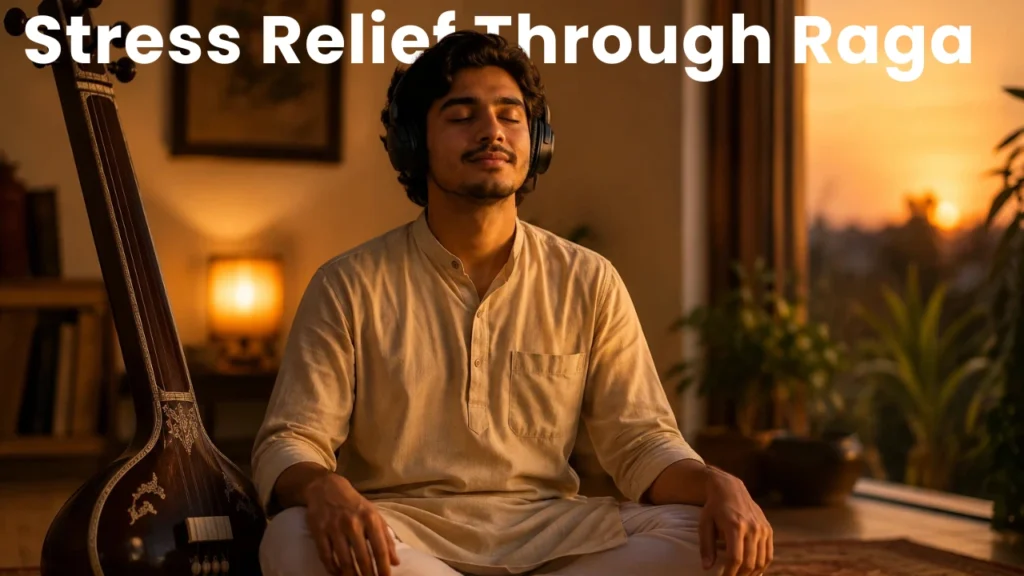
Picture this. It’s 11 p.m. Your mind won’t switch off. You’ve tried the breathing apps, the white noise, the lavender pillow spray. Nothing sticks. You scroll through “relaxing music” playlists on YouTube, and every third video is either a fake spa loop or someone selling a course.
This is the story of almost everyone who has typed “how to calm anxiety with music” into Google at 2 a.m. There’s a lot of noise out there literally and very little that explains why certain music works while other music just becomes background clutter.
Here’s something most of those playlists never mention. Indian classical music has an entire branch dedicated to exactly this problem, and it’s been developed, tested, and refined over more than a thousand years. It’s called raga, and unlike a random “chill” playlist, each raga is built around a specific emotional target calm, courage, longing, joy, or stillness. You can learn more about how structured musical training works on our music classes page at Manasukh Dhvani, a registered music school based in Pulchowk, Lalitpur. And if you’re wondering whether this is backed by anything beyond tradition, a 2024 study published in Scientific Reports found that listening to Raga Bhairavi for six days produced measurable drops in stress, anxiety, and depression scores, along with improved heart rate variability a marker of how well your nervous system recovers from stress (Bhat et al., Nature Scientific Reports, 2024).

So no, this isn’t just a nice idea passed down from grandparents. It’s music with a job to do. Let’s talk about what that job actually is, and which five ragas are worth adding to your calm-down routine.
What Exactly Is a Raga? (In Plain Words)
Think of a raga like a mood, not a song. A song is one fixed piece of music. A raga is more like a set of rules — which notes you can use, which notes you can’t, which note you always return to, and which notes you touch gently and which ones you linger on.
A simple way to picture it: if a Western musical scale (like C major) is a box of crayons, a raga is a box of crayons plus instructions on how to color with them — which colors go first, which ones you barely use, and what mood the final picture should leave you with.
Every raga is tied to a specific rasa, which is a Sanskrit word roughly meaning “emotional flavor.” There’s a rasa for peace, one for romance, one for heroism, one for wonder, one for sorrow, and so on. Musicians spend years learning to bring out the correct rasa of a raga, because a raga sung without its intended mood is just notes — technically correct, emotionally empty.
This is exactly why raga music behaves differently in your brain than random calming music. It isn’t vague ambience. It’s a structured emotional signal, repeated and reinforced through the entire piece.
Why Does Raga Music Calm the Nervous System?
There are three big reasons researchers keep coming back to when they study this.
1. Slow tempo and limited note range reduce sensory overload. Anxiety often comes with a racing, jumping qualityyour thoughts leap from one worry to the next. Many calming ragas (especially the ones performed in the evening or late night) use a slow, steady tempo and a narrow, predictable set of notes. Your brain doesn’t have to keep “guessing” what’s coming next, so it can relax its guard.
2. Repetition builds a feeling of safety. A raga performance typically opens with an alap a slow, unhurried, rhythm-free exploration of the notes. There’s no beat pushing you forward. This slow unfolding has been linked to physiological relaxation, including increased alpha brain wave activity, which is associated with a calm, alert-but-relaxed state (biorxiv EEG study on Carnatic music, 2019).
3. Measurable changes in the body, not just “vibes.” This is the part skeptics usually ask about first, so let’s be direct. In one randomized controlled trial with 140 healthy adults, researchers tested three ragas — Miyan ki Todi, Malkauns, and Puriya — against natural background sounds. Raga Puriya produced the largest drop in state anxiety, and all three ragas reduced salivary alpha-amylase, a biological marker of stress response (PMC, “Effect of Indian Music as an Auditory Stimulus,” 2022). Another pilot study on patients diagnosed with anxiety disorder found that listening to Raga Ahir Bhairav for 15 days significantly reduced depression, anxiety, and stress scores compared to a control group (Indexed study, Journal of Ayurveda and Integrative Medicine affiliated research, 2022).
None of this means raga listening replaces therapy or medication when those are needed. Think of it as a genuinely evidence-supported tool you can add to your toolbox — not a miracle cure.
Quick Answer: Ragas calm anxiety because they use slow tempo, a limited and predictable set of notes, and a rhythm-free opening (alap) that lowers sensory overload. Research shows measurable drops in cortisol, stress hormones, and self-reported anxiety after listening to specific ragas like Bhairavi, Ahir Bhairav, and Puriya.
The 5 Ragas for Stress Relief and Anxiety
Below are five ragas that show up again and again — both in centuries of musical tradition and in modern research — as reliable tools for calming an anxious mind. For each one, you’ll find what it feels like, when to listen to it, and where to find a good starting recording.
1. Raga Bhairavi – The Deep Reset
Raga Bhairavi is often called the “queen of ragas” and is traditionally performed at the very end of a concert, almost like a closing lullaby for the mind. It uses all seven notes but leans on the softer, flatter versions of them, giving it a gentle, grounded, slightly melancholic warmth — the musical equivalent of a long exhale.
In the 2024 Scientific Reports study, participants who listened to Raga Bhairavi through an immersive virtual reality format for six days showed significant reductions across every subscale of the DASS-21 test — depression, anxiety, and stress — along with meaningful improvement in heart rate variability, a strong marker of nervous system recovery (Bhat et al., Scientific Reports, 2024).
- Best time to listen: Late evening or right before bed
- Good for: Racing thoughts, end-of-day overwhelm, difficulty winding down
- How to use it: Play a 10–15 minute instrumental version (sitar, sarod, or flute) with your eyes closed and no other screens on
2. Raga Ahir Bhairav — The Morning Anchor
Ahir Bhairav is a morning raga with a quiet, devotional character. It blends the seriousness of Raga Bhairav with a softer, more approachable note (komal Ni), which gives it a feeling of calm resolve rather than heaviness. It’s often the raga musicians choose to open a concert because it settles both the performer and the audience.
A pilot clinical study involving patients formally diagnosed with anxiety disorder found that a 15-day listening intervention using Raga Ahir Bhairav produced a statistically significant decrease in depression, anxiety, and stress scores compared to a control group, describing raga listening as an inexpensive, non-invasive, and safe complementary approach (Indexed Journal study on Raga Ahir Bhairav, 2022).
- Best time to listen: Early morning, before the day’s demands pile up
- Good for: Morning anxiety, dread about the day ahead, setting a steady tone
- How to use it: Pair it with 5 minutes of quiet breathing or light stretching right after waking
3. Raga Yaman — The Everyday Peacemaker
If you only remember one raga from this list, make it Yaman. It’s one of the most widely taught and widely loved ragas in Indian classical music, often the very first raga a vocal student learns — and for good reason. Yaman carries a rounded, complete, deeply peaceful character. Musicians describe its rasa as shanta — pure tranquility.
Because Yaman is performed in the early evening, it works beautifully as a transition raga — the bridge between a busy day and a restful night. Its structure avoids sharp, jarring note jumps, which is part of why listeners consistently describe it as “settling.”
- Best time to listen: Early evening, around sunset
- Good for: Transitioning out of work mode, general daily stress, background focus music
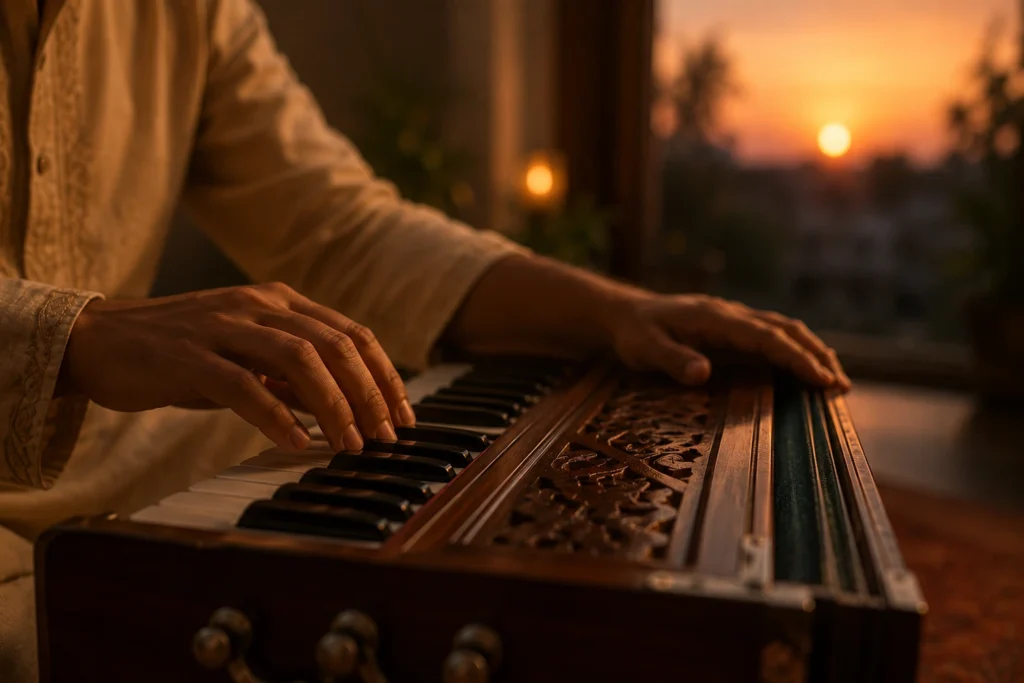
- How to use it: Use an instrumental version (harmonium or violin works especially well) as study or work background music — it’s calm enough not to distract, structured enough to hold your attention
4. Raga Malkauns — The Grounding Raga
Malkauns is one of the oldest and most minimal ragas, built on just five notes. That sparseness is exactly what makes it powerful for anxiety. There’s nowhere for the mind to get “busy” the notes are few, the pace is unhurried, and the mood is deep and internal, almost meditative.
In the same 140-participant randomized controlled trial mentioned earlier, Raga Malkauns was one of three ragas tested against natural sound, and it produced a significant reduction in salivary alpha-amylase, a real biochemical stress marker, alongside noticeable drops in reported anxiety (PMC, 2022).
- Best time to listen: Late night or during a meditation session
- Good for: Overthinking, restlessness, anxious insomnia
- How to use it: Combine with a seated meditation posture — even 8–10 minutes can help interrupt a spiral of anxious thoughts
5. Raga Darbari Kanada — The Slow, Steady Grounding
Darbari Kanada is a majestic, unhurried night raga known for its extremely slow, deliberate movement between notes, with a signature “oscillating” ornamentation that gives it a deep, almost hypnotic gravity. It was historically performed in royal courts late at night, meant to bring dignity and stillness to a room.
Recent research reviewing raga-based emotional regulation studies notes that Darbari Kanada, along with Raag Khamaj, has been associated with lower subjective stress levels among listeners, and that slow-tempo ragas like these are linked to reduced skin conductance response and improved heart rate variability — both signs of a nervous system shifting from “alert” to “rest and recover” mode (Kheljournal review on ragas and emotional regulation, 2026).
- Best time to listen: Late night, when you want deep, heavy calm rather than light relaxation
- Good for: Chronic stress, emotional heaviness, needing to feel grounded rather than “uplifted”
- How to use it: Best experienced through vocal or sarod renditions — give it time, since Darbari unfolds slowly and rewards patience
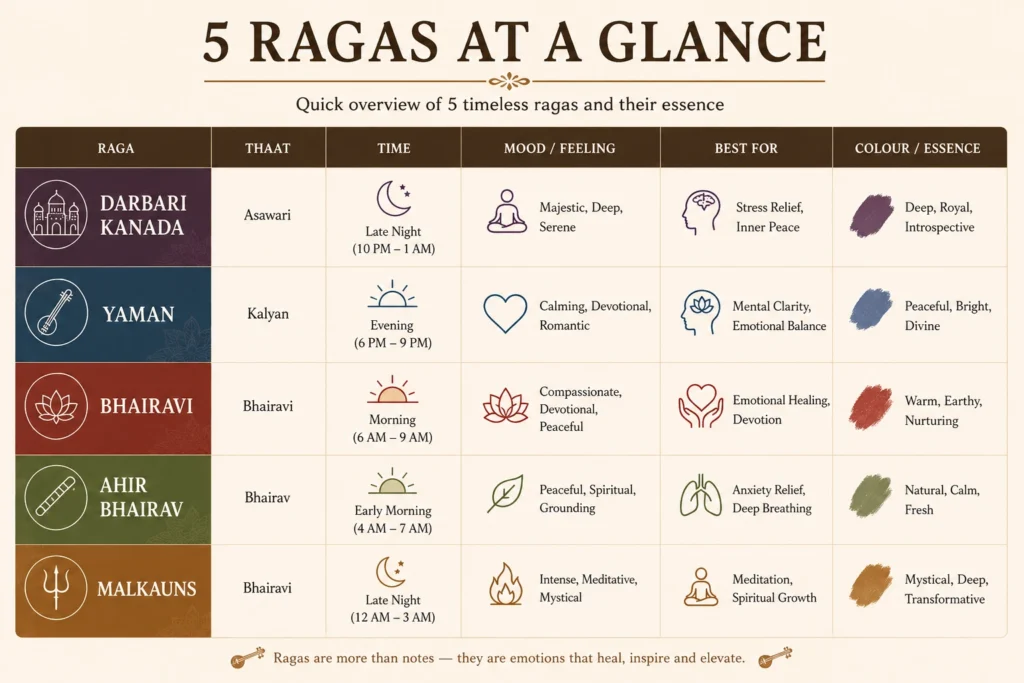
Quick Answer Box: The 5 Ragas at a Glance
| Raga | Best Time | Primary Feeling | Ideal For |
|---|---|---|---|
| Bhairavi | Late evening / bedtime | Deep, warm release | Winding down after a hard day |
| Ahir Bhairav | Early morning | Calm resolve | Morning anxiety and dread |
| Yaman | Sunset / early evening | Balanced peace | Everyday stress, work transitions |
| Malkauns | Late night | Grounded stillness | Overthinking, restlessness |
| Darbari Kanada | Late night | Heavy, deep calm | Chronic stress, emotional heaviness |
How to Actually Listen: A Step-by-Step Guide
Knowing the raga names is only half the job. How you listen matters almost as much as what you listen to.
- Pick one raga per session. Don’t shuffle between all five. Consistency is part of what makes the effect noticeable — the same way a workout only helps if you actually repeat it.
- Choose an instrumental version first. Vocal renditions are beautiful, but for beginners, instrumental (flute, sitar, sarod, violin, or santoor) is easier to simply absorb without following lyrics or vocal technique.
- Give it at least 10 minutes. Ragas unfold slowly. The calming effect usually builds in the second half of a listening session, not the first thirty seconds.
- Sit or lie somewhere quiet. No multitasking. Even folding laundry while listening reduces the effect, because your attention is split.
- Breathe slowly and match the pace of the music. You don’t need to meditate formally — just let your breathing slow down naturally as the raga does.
- Repeat daily for at least a week before judging results. The 2024 Bhairavi study measured effects after six consecutive days, not after one listen (Bhat et al., 2024). Give it a fair trial.
Common Mistakes People Make
- Mistake: Playing a raga at full volume while working or scrolling on the phone. Why it fails: The nervous system needs a break from stimulation, not more of it layered on top.
- Mistake: Expecting instant results after one listen. Why it fails: Most research on ragas measures effects over multiple days, not a single session.
- Mistake: Choosing a raga at the wrong time of day. Why it fails: Ragas are traditionally tied to specific times because their emotional character matches the natural rhythm of that time — a morning raga at midnight can feel oddly mismatched.
- Mistake: Assuming any “Indian classical” playlist labeled “relaxing” is the correct raga. Why it fails: Many streaming playlists mislabel or blend ragas loosely. Search for the raga by its specific name (e.g., “Raga Bhairavi flute”) rather than a vague “Indian meditation music” tag.
- Mistake: Using raga listening as a total replacement for professional help during a genuine mental health crisis. Why it fails: Raga listening is a supportive tool, not a treatment for clinical anxiety disorders or depression on its own.
Myth vs Fact
| Myth | Fact |
|---|---|
| Ragas are just old folklore with no real evidence | Multiple peer-reviewed studies, including a 2024 randomized study in Scientific Reports, show measurable reductions in anxiety and stress markers after raga listening |
| You need to understand music theory to benefit | You only need to listen — understanding raga theory helps musicians perform it correctly, but listeners benefit without any training |
| Any slow instrumental music works the same way | Ragas follow a defined note structure and emotional intent (rasa); this precision is part of what distinguishes their effect from generic “calm” music |
| Ragas work instantly, like a switch | Most research shows benefits build over repeated listening across days, not a single session |
| Learning to sing a raga is only for professional musicians | Beginners of any age can start learning basic ragas through structured one-to-one classes |
Beginner, Intermediate, and Advanced Questions Answered
Beginner: Do I need any musical background to benefit from listening? No. You can benefit from raga listening with zero training. The calming effect comes from exposure to the structure and pace of the music, not from understanding it technically.
Beginner: Which raga should I try first if I’ve never listened to Indian classical music before? Start with Raga Yaman. It’s melodically the most approachable and widely recorded, making it easy to find quality versions on any streaming platform.
Intermediate: Can I combine raga listening with breathing exercises or yoga? Yes, and it’s actually a well-matched pairing. Ancient Indian wellness traditions grouped music, breathing (pranayama), and meditation together under practices sometimes called raga chikitsa, or raga-based healing (ResearchGate review, “Indian Classical Music, Raag as Music Therapy,” 2024).
Intermediate: Does it matter which instrument performs the raga? It shapes the texture of the experience but not the raga’s core emotional identity. A flute version of Bhairavi will feel airier; a sarod version will feel deeper and more resonant. Try a few instruments to find what settles you best.
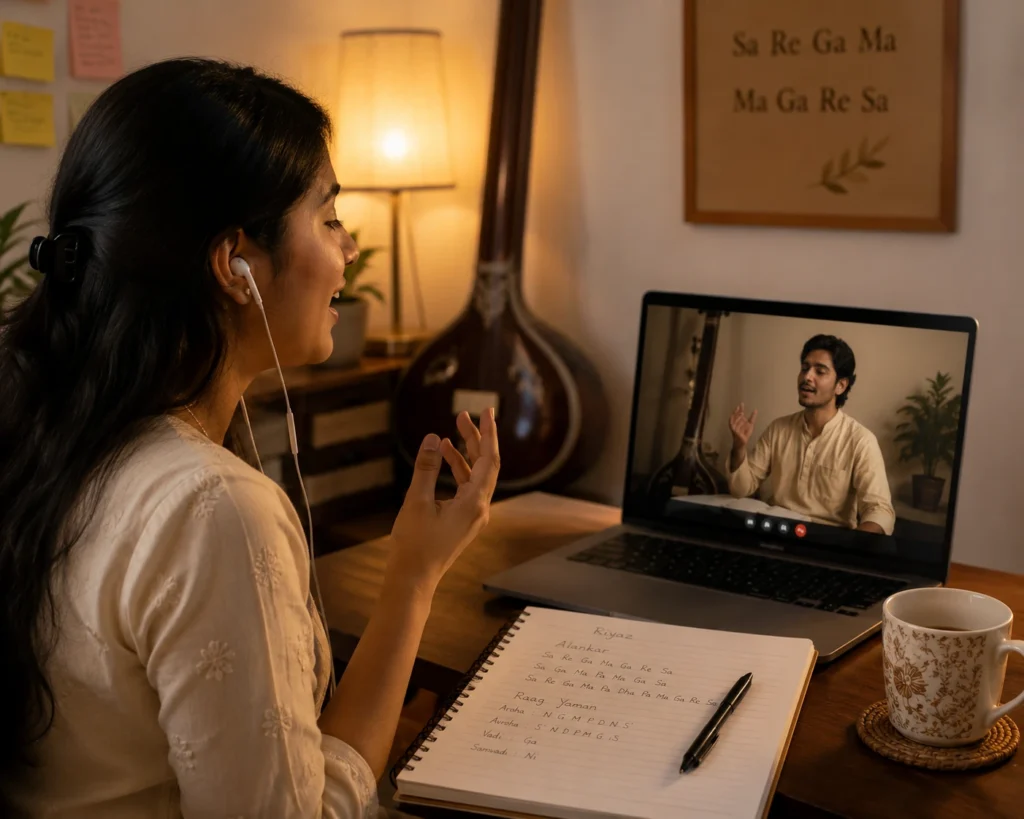
Advanced: Can singing a raga myself be more effective than just listening? Many practitioners and teachers believe active singing deepens the effect, because it combines controlled breathing, vocal resonance, and focused attention — three things independently linked to stress reduction. This is one reason structured vocal training is worth exploring beyond passive listening.
Advanced: Are there ragas to avoid before sleep? Fast-paced, high-energy ragas performed in bright, energetic styles (often associated with festive or heroic rasa) are better suited to daytime energy and focus, not winding down. Save those for mornings or midday motivation instead of bedtime.
Expert Tips for Getting the Most Out of Raga Listening
- Use headphones for a more immersive, focused experience, especially in a noisy home.
- Keep a simple listening journal — even one line a day — noting your stress level before and after. Patterns become obvious within a week.
- If you’re new, look for renditions by well-established Hindustani or Carnatic musicians rather than generic “relaxing music” channels, since accuracy to the raga’s structure matters.
- Try the same raga at the same time daily for two weeks before switching — this mirrors how the research studies were structured.
- If a particular raga doesn’t resonate with you emotionally, that’s normal. Musical and emotional response is personal — try another from the list before giving up on the method entirely.
Pros and Cons of Using Ragas for Stress Relief
| Pros | Cons |
|---|---|
| Backed by peer-reviewed research on anxiety, stress, and HRV | Requires consistency over multiple days for best results |
| No cost, no equipment, no side effects | Full benefit may need guidance to choose the right raga and time |
| Works for all ages, including children and seniors | Not a replacement for therapy or medical treatment in clinical cases |
| Can be paired with breathing, meditation, or vocal practice | Streaming platforms sometimes mislabel raga content |
| Deepens further if you learn to sing or play it yourself | Learning to perform a raga correctly does take structured guidance |
Latest Trends and Future Outlook
Interest in raga-based music therapy has grown noticeably in recent years, partly driven by wellness apps and partly by a wave of new clinical research. Virtual reality-based raga therapy, like the 2024 Bhairavi study, points toward a future where immersive audio-visual raga sessions could become a mainstream complementary tool in hospitals and wellness clinics, not just a personal listening habit (Bhat et al., Scientific Reports, 2024). EEG-based studies are also exploring exactly which musical properties — tempo, octave, note spacing — drive the calming effect, which could eventually allow therapists to fine-tune raga recommendations to an individual’s specific anxiety pattern (biorxiv, South Indian Classical Music EEG study, 2019).
For now, the simplest and most accessible version of this trend is still the original one: sit down, choose the right raga for the time of day, and listen with full attention.
Key Takeaways
- Ragas are structured musical frameworks, each tied to a specific emotional mood (rasa) — not random calming background music.
- Peer-reviewed research, including a 2024 study in Scientific Reports, shows raga listening can significantly reduce anxiety, stress, and depression scores over several days of consistent listening.
- The 5 ragas covered here — Bhairavi, Ahir Bhairav, Yaman, Malkauns, and Darbari Kanada — each suit a different time of day and emotional need.
- Consistency matters more than a single listening session; most studies measured effects after several days to two weeks.
- Active practice, such as learning to sing or play a raga, may deepen the calming effect beyond passive listening.
- Raga listening is a supportive wellness tool, not a substitute for professional mental health care when needed.
FAQs
Q1. What is the best raga for anxiety at night? Raga Malkauns and Raga Darbari Kanada are both traditionally performed late at night and are well suited for anxious, racing thoughts before sleep. Malkauns uses only five notes, which limits mental stimulation, while Darbari Kanada offers slow, deep, grounding movement. Try either for 10–15 minutes with the lights dimmed and no screens nearby.
Q2. How long should I listen to a raga to feel calmer? Most research studies measured benefits after 6 to 15 days of consistent daily listening, not after a single session. A single 10–15 minute session can still provide short-term relaxation, but for measurable, lasting change in anxiety and stress levels, aim for at least one week of daily listening at the same time each day.
Q3. Can children listen to ragas for stress relief too? Yes. Ragas have no age restriction, and their slow, structured nature can actually help children build focus and emotional regulation. Many children respond especially well to Raga Yaman because of its balanced, gentle character. Keep sessions shorter for younger children — around 5–10 minutes is a good starting point.
Q4. Is there scientific proof that ragas reduce anxiety, or is this just tradition? Both. The emotional mapping of ragas comes from centuries of musical tradition (rasa theory), but modern research has independently confirmed measurable effects. A 2024 Scientific Reports study found significant reductions in depression, anxiety, and stress scores, plus improved heart rate variability, after six days of Raga Bhairavi listening.
Q5. Do I need to understand Indian classical music theory to benefit from listening? No. You don’t need any musical training to feel the calming effect of a raga. The benefit comes from exposure to its structure, tempo, and tonal pattern, not from intellectually analyzing it. Understanding raga theory becomes useful only if you want to learn to sing or play it yourself.
Q6. What’s the difference between listening to a raga and learning to sing one? Listening is passive and still effective for relaxation. Singing is active — it adds controlled breathing, vocal resonance, and focused attention, which many practitioners believe deepens the calming effect further. If you’re curious about going beyond listening, one-to-one vocal classes are a low-pressure way to start.
Q7. Which raga is best for someone who has never listened to Indian classical music before? Raga Yaman is the most beginner-friendly starting point. It’s widely recorded, melodically balanced, and doesn’t require prior familiarity with Indian classical music to feel its calming effect within the first few minutes.
Q8. Can raga music help with sleep problems caused by anxiety? Many people use Raga Bhairavi, Malkauns, or Darbari Kanada as part of a wind-down routine before bed. While raga listening isn’t a clinical sleep treatment, its slow tempo and grounding quality make it a reasonable addition to a broader sleep hygiene routine, alongside consistent sleep timing and reduced screen exposure.
Q9. Are there any risks or side effects to listening to ragas for stress relief? No documented risks exist for simply listening to raga music. It’s non-invasive and cost-free. That said, it should complement — not replace — professional treatment for diagnosed anxiety disorders, depression, or other clinical mental health conditions.
Q10. Where can I find good quality recordings of these ragas? Search for the raga by its exact name (for example, “Raga Bhairavi sitar” or “Raga Yaman flute instrumental”) on YouTube or major streaming platforms, and look for recordings by established Hindustani or Carnatic classical musicians rather than generic “relaxing music” channels, which sometimes mislabel or loosely blend ragas.
Conclusion
Anxiety doesn’t need a complicated solution to feel a little lighter. Sometimes it just needs ten quiet minutes and the right sound in the room. Ragas like Bhairavi, Ahir Bhairav, Yaman, Malkauns, and Darbari Kanada aren’t trendy wellness hacks — they’re centuries-old musical tools that modern research keeps quietly confirming, study after study.
Start small. Pick one raga that matches your day. Sit with it fully, without your phone competing for attention. Notice what happens after a week of showing up for it daily. That’s really the whole method no shortcuts, no gimmicks, just consistent, intentional listening.
If listening to these ragas leaves you curious about going further maybe even learning to sing or play one yourself — that curiosity is worth following. Manasukh Dhvani is a registered music school in Pulchowk, Lalitpur, offering online one-to-one vocal and instrumental classes, including Classical Vocal, Harmonium, Tabla, Guitar, Piano, and more, for absolute beginners of every age. There’s no pressure to commit right away. A free demo class is often enough to know whether music might become part of how you manage stress, not just something you listen to occasionally. You can reach out through manasukhdhvani.com or email manasukhdhvani@gmail.com to ask a question or book a session.