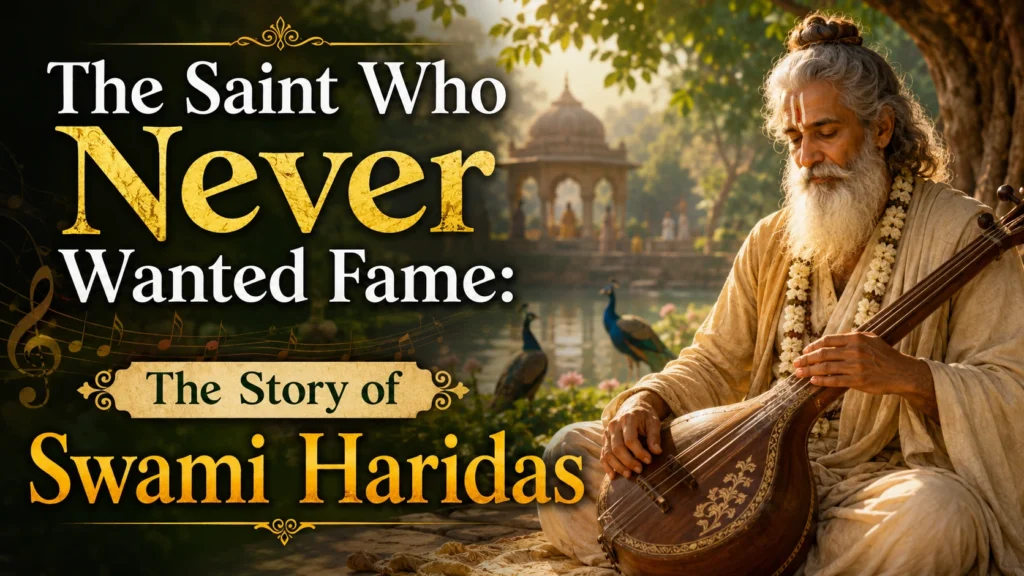
Most of what we know about Indian classical music today, the raags, the discipline, the idea that music is worship and not performance, passes back through one quiet, barefoot ascetic who lived in a forest and refused to sing for kings. According to the Sangeet Natak Akademi, India’s national academy for music, dance, and drama, dhrupad is considered the oldest surviving form of Hindustani classical music, and Swami Haridas stands among its most important early figures. Yet he never wanted the crown that history eventually placed on him.
This is his story, told the way it should be told. Slowly, honestly, and without the exaggeration that so many websites add just to make it sound grander than it needs to be.
Who Was Swami Haridas
Swami Haridas was a sixteenth century mystic, poet, and classical musician who lived most of his life in Vrindavan, a small forested town in present day Uttar Pradesh, India. He is remembered today as the founder of the Haridasi school of devotion, a spiritual tradition that worships Krishna and his beloved Radha as one united presence rather than two separate gods.
He is also remembered, almost as a footnote to his own life, as the guru of Tansen. Tansen would go on to become one of the nine legendary court musicians, the Navratnas, of Mughal Emperor Akbar. That single fact alone has made history books mention Haridas. But reducing him to “the teacher of a famous student” misses almost everything that made him remarkable.
Haridas composed over a hundred devotional songs, most of them in the Dhrupad style, describing the tender, playful, and eternal love between Radha and Krishna. Historical accounts agree on very little about the exact dates of his birth or the details of his family, and scholars openly admit the records conflict with one another. What almost everyone agrees on, across every version of his story, is this. He built a hermitage in a quiet grove called Nidhivan, in Vrindavan, and he never left it for wealth, comfort, or recognition, even when the most powerful empire in India came looking for him.
Quick Answer Box
In simple words: Swami Haridas was a saint and musician from sixteenth century India who taught the legendary singer Tansen, composed over a hundred devotional songs in the Dhrupad style, and founded a spiritual path called Haridasi Sampradaya. He lived in a forest hermitage in Vrindavan and famously refused to perform for kings and emperors, choosing instead to sing only for God.
The Early Life Nobody Fully Agrees On
Here is something honest that most articles will not tell you. We do not have a single, confirmed timeline of Swami Haridas’s early life. Different traditions within his own spiritual lineage record different birth years, different parents, and different hometowns.
One account places his birth around 1480, describing him as the son of Ganga Devi and a Saraswat Brahmin family connected to Multan. Another tradition names his parents as Chitra Devi and Ashudheer, and places his birth near Aligarh district in Uttar Pradesh, close to Vrindavan. A third version says his family settled in a village that later came to be called Haridaspur in his honor.
Rather than picking one version and presenting it as fact, the honest answer is this. Historians and even his own religious lineage admit that the details of his early life are preserved mostly through oral tradition, not written records, and that the different Haridasi sub schools each tell slightly different versions of his biography.
What we can say with more confidence is this. He became an ascetic, a sanyasi, while still young, likely in his twenties, and he moved into the forests of Vrindavan to build a simple hermitage. That forest grove is known today as Nidhivan, and it remains one of the most sacred and mysterious places in Vrindavan.
Why Vrindavan
If you have never been to Vrindavan, imagine a small town wrapped almost entirely around devotion to one story, the love between Krishna and Radha. In the sixteenth century it was not the crowded pilgrimage town it is today. It was dense forest, quiet, and largely untouched.
Haridas chose this place on purpose. He was not building a career. He was building a life centered on one relationship, his relationship with the divine. Nidhivan became his home, his temple, and eventually his final resting place. His samadhi, the traditional term for a saint’s memorial shrine, still stands there today.
A Simple Timeline
| Approximate Period | What Happened |
|---|---|
| Around 1480 to 1512 (accounts vary) | Born, likely near Vrindavan or in a Saraswat Brahmin family connected to Multan |
| Early twenties | Renounces worldly life and becomes a sanyasi |
| Early life in Vrindavan | Builds a hermitage in Nidhivan and begins composing devotional songs |
| Early to mid sixteenth century | Teaches Tansen, who later becomes a legendary Mughal court musician |
| Later life | Reveals the idol later known as Bankey Bihari, worshipped in Nidhivan |
| 1575 or 1607 (accounts vary) | Passes away in Vrindavan; samadhi remains in Nidhivan |
A quick note on honesty here. You will notice two possible death years listed. That is not a mistake on our part. Different biographical traditions genuinely disagree, and rather than inventing false certainty, it is more responsible to show you both.
The Story of Tansen: Student, Not Just a Footnote
Most people who have heard of Swami Haridas heard the name attached to a much bigger one, Tansen. It is worth slowing down here, because this relationship tells you almost everything about who Haridas really was.
As a child, Tansen’s voice is said to have carried the power of a roaring lion. When Haridas heard him, he recognized the boy’s extraordinary talent immediately and took him in as a student. According to accounts shared by musicians in the Dagar family, a lineage that has carried forward dhrupad singing for generations, Tansen spent close to a decade under the guidance of Haridas in Vrindavan before he ever set foot in a royal court.
Think about that for a second. A student who would go on to become one of the most famous musicians in Indian history spent ten formative years not performing, not competing, not chasing an audience, but simply learning, in a forest, under a teacher who himself avoided every royal invitation that came his way.
There is a well known anecdote passed down through generations of musicians. Emperor Akbar, curious after hearing Tansen perform at his court, once traveled into the forests of Vrindavan with Tansen to hear Haridas sing in person. Akbar reportedly asked Tansen why his guru’s music carried so much more feeling, so much more “asar” or impact, than Tansen’s own celebrated performances at court. Tansen’s answer has been repeated by musicians for centuries. He sings for the Lord, I sing for a king.
That single sentence explains the entire difference between the two men’s lives. One sang to please power. The other sang because he could not help himself, because music was how he spoke to God.
It is worth being clear that this anecdote, like much of Haridas’s biography, comes down to us through oral tradition rather than a contemporary written record. That does not make it worthless. It means we should hold it the way we hold most stories about saints, as a truth about character even if we cannot verify every historical detail.
Founder of the Haridasi Sampradaya
Beyond music, Haridas founded a distinct spiritual path known as the Haridasi Sampradaya. Unlike many devotional traditions that focus primarily on Krishna, the Haridasi path places enormous emphasis on Radha, treating her not as a secondary figure but as the living embodiment of divine love itself, inseparable from Krishna.
This philosophical shift mattered. It influenced how devotional poetry and music in North India were written for centuries afterward, with countless songs, still sung today, describing Radha and Krishna’s love in the same tender, intimate language that Haridas pioneered.
His disciples and their disciples carried this tradition forward long after his death, and it remains active in North India today, particularly around Vrindavan.
The Discovery of Bankey Bihari
One of the most well known stories connected to Swami Haridas involves the origin of one of Vrindavan’s most beloved deities, Bankey Bihari.
According to temple tradition, Haridas’s disciples once requested that he sing a particular composition in Nidhivan. As he sang, describing the union of Radha and Krishna as a single, radiant presence, tradition holds that the divine couple appeared before him and, at his request, merged into one form. That form became the idol known today as Bankey Bihari, meaning roughly “the enjoyer who is bent in three places,” referring to the graceful triple bend posture in classical Krishna iconography.
The idol was worshipped in Nidhivan for generations before a formal temple was constructed nearby in the eighteen sixties, where it remains one of the most visited shrines in Vrindavan today. To this day, the temple famously avoids bells and conches during worship, and priests repeatedly open and close a curtain in front of the idol during darshan, a practice tied directly back to devotional customs associated with Haridas’s own style of worship.
Again, this is a story rooted in devotional tradition rather than verified historical record, and it is presented here as belief, not as established fact. But its cultural importance is undeniable. It shows how deeply Haridas’s influence is woven into the religious life of Vrindavan even today, centuries after his death.
What Made His Music Different
Dhrupad, the musical style Haridas practiced and helped shape, is often described by musicologists as the oldest surviving form of Hindustani classical music still performed today. It values simplicity, restraint, and depth of feeling over ornamentation or speed. Where many musical styles chase virtuosity, dhrupad chases stillness.
Haridas is often credited with giving new depth to a style that, before him, had largely been used as court entertainment. Raja Man Singh Tomar of Gwalior is generally credited with formalizing dhrupad as a court tradition, but it was Haridas who elevated it into something closer to prayer.
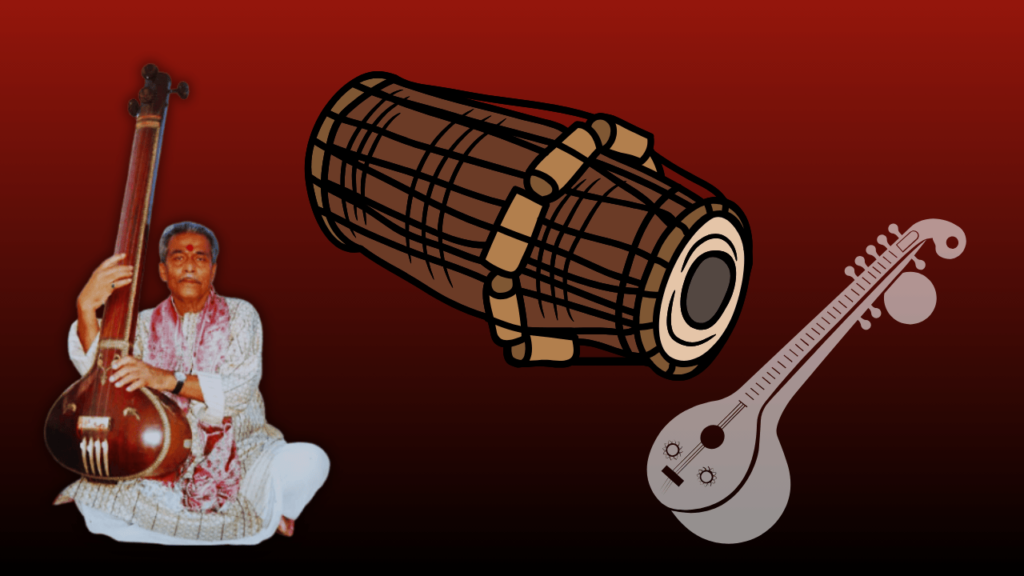
He is said to have used instruments like the daff, a hand drum, the kinnari, an early stringed instrument, and the mridanga, alongside his voice, and to have composed extensively in raags including Kedar, Basant, Gauri, and Malhar. Each of these raags is still taught and performed today, hundreds of years later, in classical vocal and instrumental training around the world, including in structured online vocal and instrumental classes that carry the tradition forward for a new generation of students.
Myth vs Fact Table
| Common Claim | What We Actually Know |
|---|---|
| Swami Haridas was born in a specific year with certainty | False. Multiple traditions record different birth years, ranging roughly from 1480 to 1512 |
| He personally invented dhrupad | Not accurate. Dhrupad as a court style is generally credited to Raja Man Singh Tomar; Haridas deepened and spiritualized the form |
| He refused to ever meet Akbar | Accounts suggest Akbar did travel to hear him, though Haridas remained detached from court life and never joined it |
| He wrote thousands of songs | Historical sources credit him with over a hundred devotional compositions, a large but specific number, not an exaggerated one |
| His death year is confirmed | Disputed. Some accounts say 1575, others 1607 |
Why He Avoided Fame, and Why That Still Matters
Here is the question that probably brought you to this article in the first place. Why would someone this talented, this respected, someone whose own student became a legend in the most powerful court in India, choose to stay hidden in a forest instead.
The honest answer is that fame was never his goal. Music, for Haridas, was not a performance. It was a form of communication with something he considered infinitely more important than any king, than any audience, than any applause. When Tansen told Akbar that his guru sang for the Lord while he himself sang for a king, he was not being poetic. He was describing a real difference in motivation, and that difference showed up in the music itself.
There is a lesson buried in this that has nothing to do with religion specifically. Anyone who has ever picked up an instrument or opened their mouth to sing knows the temptation to perform for approval rather than to simply express something true. Haridas represents the opposite extreme. Music purely for its own sake, purely because it needed to come out of him.
You do not have to be religious to take something useful from that. Many working professionals, students, and even children learning music today feel pressure to be impressive quickly, to post a video, to win a competition, to prove something. Haridas’s life is a five hundred year old reminder that the deepest music usually comes from the opposite instinct, from doing it because you love it, not because someone is watching.
Common Mistakes People Make When Learning About Haridas
Mistake one: Treating him only as “Tansen’s teacher.” This flattens an entire life and philosophy into a single credential. Haridas’s own compositions, his spiritual philosophy, and his role in shaping Vrindavan’s devotional culture stand on their own.
Mistake two: Assuming every legend about him is literal historical fact. As shown above, much of his biography comes from oral tradition and devotional literature written generations after his death. Respecting the tradition does not require pretending it is a court record.
Mistake three: Confusing him with other saints of the same era. Haridas is sometimes mixed up with contemporaries like Hariram Vyas of the Radha Vallabha Sampradaya, a separate but related devotional tradition from roughly the same period and region. They are different people, from different lineages, even though both were devoted to Radha and Krishna and lived in and around Vrindavan.
Mistake four: Assuming dhrupad is no longer relevant. Dhrupad is still actively taught and performed today, including by well known lineages such as the Dagar family, whose ancestors trace their musical training back through disciples of Haridas himself.
Expert Tips for Understanding His Legacy
If you want to genuinely understand why Swami Haridas matters, here is where to focus your attention.
- Listen to actual dhrupad recordings, not just descriptions of the style. Notice the slowness, the sustained notes, the near meditative pacing.
- Visit or research Nidhivan and Bankey Bihari temple if you are ever in Vrindavan. The physical space tells a story words cannot.
- Read a few of his compositions, even in translation. Notice how personal and tender the language is, almost like private conversation rather than formal hymn.
- Understand the guru shishya parampara, the traditional one on one teacher to student relationship in Indian classical music, which Haridas and Tansen exemplify. This is still the foundation of serious one to one classical vocal and instrumental training today.
Pros and Cons of the “Away From Fame” Path in Music
| Approach | Advantages | Challenges |
|---|---|---|
| Haridas’s path: music for devotion, away from public life | Deep authenticity, freedom from outside pressure, lasting spiritual and artistic depth | Less documented history, fewer surviving personal records, slower recognition during his own lifetime |
| Tansen’s path: music within a royal court | Wide influence, historical documentation, ability to shape music at a national level | Constant pressure to please an audience, less personal creative freedom |
Neither path is “better.” They simply serve different purposes, and understanding both helps explain why classical Indian music developed the way it did, shaped by both the court and the hermitage.
Frequently Asked Questions
Who was Swami Haridas in simple words? Swami Haridas was a sixteenth century Indian saint, poet, and classical musician who lived in Vrindavan. He is best known for founding the Haridasi spiritual tradition, composing devotional songs about Radha and Krishna, and teaching the legendary musician Tansen.
Was Swami Haridas really Tansen’s guru? Yes, according to widely accepted historical and musical tradition, Tansen studied under Swami Haridas in Vrindavan for many years before becoming a court musician, first for Raja Ram Singh at Rewa and later for Emperor Akbar.
Why is Swami Haridas called the saint who never wanted fame? Because despite having extraordinary musical talent and a legendary student, Haridas consistently avoided royal courts, performances for kings, and public recognition, choosing instead to live simply and sing only as an act of personal devotion.
Did Swami Haridas ever meet Emperor Akbar? Popular accounts describe Akbar traveling with Tansen to hear Haridas sing in the forests of Vrindavan. However, Haridas is not recorded as having ever joined the Mughal court or performed there himself.
What is the Haridasi Sampradaya? It is a devotional tradition founded by Swami Haridas that worships Radha and Krishna as a united divine presence, with special emphasis on Radha. It remains active in parts of North India today.
What is Nidhivan and why is it connected to Swami Haridas? Nidhivan is a sacred forest grove in Vrindavan where Swami Haridas built his hermitage, composed his music, and is believed to have revealed the idol later known as Bankey Bihari. His samadhi, or memorial shrine, is also located there.
Is Swami Haridas connected to the Bankey Bihari temple? Yes. Temple tradition credits Swami Haridas with revealing the idol that became known as Bankey Bihari while singing in Nidhivan. The idol was worshipped there before a formal temple was later built nearby.
How many songs did Swami Haridas compose? Historical and biographical sources generally credit him with over a hundred devotional compositions, most in the Dhrupad style, focused on the love between Radha and Krishna.
What is Dhrupad music and why is it connected to Swami Haridas? Dhrupad is considered the oldest surviving style of Hindustani classical music, known for its simplicity, restraint, and depth. While the court style is credited to Raja Man Singh Tomar of Gwalior, Swami Haridas is credited with deepening it into a form of spiritual expression rather than mere entertainment.
Why do historical records about Swami Haridas differ so much? Because most information about his life was preserved through oral tradition and devotional literature rather than contemporary written records. Different branches of the Haridasi tradition recorded slightly different details, which is common for saints of this era across India.
Is Swami Haridas the same as Hariram Vyas? No. They are two separate saints from roughly the same period and region. Hariram Vyas belonged to the Radha Vallabha Sampradaya, a related but distinct devotional tradition, and had a different guru and lineage.
What can modern music students learn from Swami Haridas’s life? That music practiced with sincerity and patience, without chasing attention or approval, often produces deeper and more lasting results than music practiced purely for performance or recognition.
Latest Relevance and Future Outlook
Interest in Swami Haridas has grown in recent years, partly through classical music festivals held in his name alongside Tansen, and partly through renewed academic and cultural interest in preserving dhrupad as a living tradition rather than a museum piece. Musicians from lineages like the Dagar family continue to publicly credit their training back to disciples connected to Haridas, keeping his influence alive in real, performed music rather than only in history books.
As more students around the world, including in places like Nepal, gain access to structured online classical training, the philosophy Haridas represented, patience, sincerity, and learning for its own sake, is quietly finding new relevance among people who are tired of shortcuts and quick fame.
Key Takeaways
- Swami Haridas was a sixteenth century saint, poet, and musician who lived in Vrindavan and founded the Haridasi Sampradaya
- He composed over a hundred devotional Dhrupad songs about the love between Radha and Krishna
- He taught the legendary musician Tansen for close to a decade before Tansen ever entered a royal court
- He consistently avoided fame, royal patronage, and public performance, choosing devotion over recognition
- Temple tradition credits him with revealing the idol later worshipped as Bankey Bihari in Nidhivan, Vrindavan
- Much of his biography comes from oral tradition, and different accounts disagree on exact dates
- His approach to music, sincere, patient, and free from the need for approval, still offers a lesson for music students today
Conclusion
Swami Haridas never set out to be remembered. He built a small hermitage in a forest, sang because he needed to, and let the world come to him instead of chasing it. Five hundred years later, his music is still taught, his temple in Nidhivan still receives devotees, and his most famous student’s name is still spoken with awe across India. Yet Haridas himself would probably have been uncomfortable with an article like this one being written about him at all. Maybe that discomfort is exactly the point. The people worth remembering are often the ones who were never trying to be.
If this story left you curious about learning classical music the way it was originally meant to be taught, slowly, patiently, one to one with a real teacher, you are welcome to try a free demo class at Manasukh Dhvani. Whether you are a complete beginner, a parent exploring options for your child, or an adult finally getting back to something you always wanted to learn, we offer online one to one vocal and instrumental classes as well as in person group and private sessions from our school in Pulchowk, Lalitpur. Sometimes one lesson is all it takes to know if this is the right path for you.
Write to us at manasukhdhvani@gmail.com or visit manasukhdhvani.com to book your free demo class.