This is a musical family and I never got the chance to learn something.
That’s the line we hear the most at Manasukh Dhvani. A 34-year-old software engineer from Kathmandu told us this right before her first class, then asked the question everyone lands on this page to answer: what is the best age for singing class?
Quick answer: kids can start structured vocal training around 7–9 years old, but singing has no upper age limit adults, teens, and even people in their 60s can start today and improve fast. The rest of this guide breaks down exactly why, using real vocal-science data, not guesswork. If you’d rather skip the reading, book a free demo class, it’s the fastest way to get your real answer.
A 2025 brain-imaging study on 132 healthy adults found that music training visibly grew grey matter and improved working memory in people nowhere near school age . So if you’ve been Googling “am I too old to sing” at 2 AM — stop. Your brain is still very much taking applications.
Quick Answer (For The Skimmers)
Key takeaways:
- Best age to start structured singing lessons for kids is 7–9 years — vocal cords are developed enough to train but still flexible.
- There is no maximum age to start singing. Adults and seniors improve measurably with training.
- Singing is roughly 80% trainable skill, not fixed-at-birth talent.
- Instrument readiness (tabla, violin, drums) can start earlier — around age 5–7.
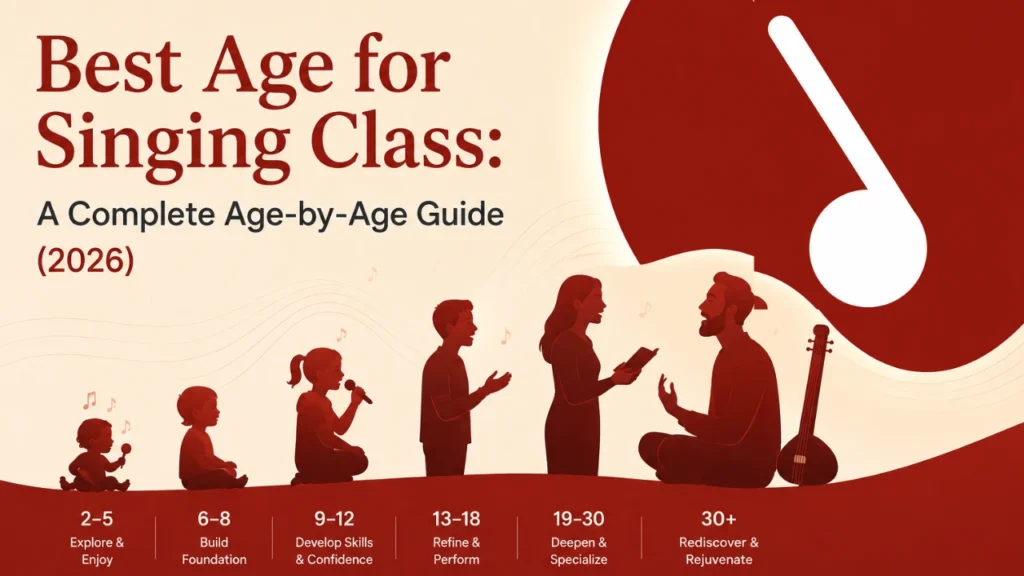
| Your Situation | Best Age to Start | Why |
|---|---|---|
| Child, casual singing/fun | 3–6 years | Ear training, rhythm, no formal technique yet |
| Child, structured vocal lessons | 7–9 years | Vocal cords reach near-adult length, child can follow instruction |
| Teenager (voice changing) | 10–15 years | Voice is changing — light, careful technique only |
| Teen post-puberty | 15+ years | Voice has settled, ready for real range-building |
| Adult (any age) | Right now | Voice matures your whole life; skill is 100% trainable |
| Instruments (tabla, violin, drums) | 5–7 years | Motor coordination is ready earlier than singing technique |
The Big Myth: “I Missed My Window”
Here’s the sentence that stops more people from singing than any actual lack of talent: “I’m too old now.”
It’s false, and it’s costing people years of joy for no reason.
Unlike gymnastics or ballet, singing has no hard biological cutoff. Vocal cords are muscle and mucous-membrane tissue — they respond to training at every life stage, the same way your legs get stronger the more you walk. Opera singers routinely peak vocally in their 30s and 40s, because the voice keeps maturing well past childhood (source: Angeles Academy of Music). A 2018 study published in the Journal of Voice found something even more encouraging: with consistent training, adults across age groups improved their vocal range, tone, and control — not just twenty-somethings.
So the real question was never “am I too old.” It’s “when did I start” and that can simply be today.
Age-By-Age: What Actually Happens To The Singing Voice
Ages 3–6: The “Play, Don’t Push” Years
At this age, a child’s larynx sits high in the throat and their vocal cords are still thin and short. They can enjoy music fully clapping rhythm, humming tunes, mimicking pitch — but formal, structured vocal training this early can do more harm than good if the coach isn’t trained specifically for young children. Let them play with sound first.
Ages 7–10: The Sweet Spot For Structured Lessons
This is the age range almost every credible vocal source agrees on. By age 8 or 9, a child’s vocal cords are close to functional adult length but still flexible — not yet stiff — making this window genuinely ideal for building good habits. Vocal cord length reaches near-adult size (10–15mm for girls, 13–17mm for boys) somewhere between ages 6 and 10, giving children enough vocal “hardware” to actually sing, not just shout in tune. School of Rock and multiple independent vocal academies land on the same 7–9 range as the practical sweet spot.
At this age, a child also needs to be able to:
- Sit still and follow instructions for 15–20 minutes at a stretch
- Copy pitch and rhythm reasonably well
- Genuinely want to be there (forced lessons rarely stick)
Ages 10–15: The Puberty Curveball
This is where parents panic unnecessarily. During puberty, the larynx grows and drops, and vocal cords thicken this happens for girls roughly between 10–14 and boys between 12–16. Boys go through a dramatic “voice break”; girls experience a subtler deepening.
This does not mean lessons should stop. It means the type of training should change less demanding range work, more breath control and ear training, taught by someone who understands adolescent vocal anatomy. A coach pushing a cracking 13-year-old voice to hit high notes is how good singers quit before they even start.
Ages 15–25: Prime Building Years
Once the voice settles post-puberty, this is one of the best windows to build serious range, control, and stage-ready technique. Vocal folds have matured but stay flexible well into the mid-twenties this is where discipline pays off fastest.
Ages 25–60: The “Actually, You’re Fine” Years
Adult voices are more stable and more emotionally expressive, and contrary to popular belief often easier to teach in some ways, because adults follow instructions, breathing cues, and feedback far better than a 7-year-old ever will. Career singers, worship leaders, wedding performers, and weekend hobbyists across the world start exactly here.
Ages 60+: Still Not Too Late
Multiple studies on older adults learning music found measurable improvements in memory, cognitive function, and mood after just months of training, published neuroscience, not feel-good marketing (source: NCBI systematic review). A UCSF researcher has specifically studied choir singers who started after age 60 and found real cognitive and quality-of-life benefits (source: National Geographic).
That means: your grandmother can absolutely learn to sing “Resham Firiri” properly, and her brain will thank her for it.
What About Instruments — Tabla, Violin, Drums?
Since Manasukh Dhvani also teaches tabla, violin, drums, and other instruments, here’s the honest answer many schools won’t give you: instruments and singing don’t follow the same age rules.
- Violin & keyboard: Fine motor skills develop early — many children start around age 5–6.
- Tabla: Requires hand coordination and rhythm sense; 6–7 years onward works well, though older beginners often progress faster due to focus.
- Drums: Full-kit coordination (hands + feet together) usually clicks better from age 7–8, though pad-based basics can start earlier.
- Adults, any instrument: No cutoff. Motor learning and music theory are trainable skills, not childhood-only superpowers.
The 8 Questions Everyone’s Actually Googling
Can I learn singing at 40?
Yes. Vocal cords keep responding to training throughout adulthood, and many singers report their strongest, most controlled voice in their 30s and 40s, once breath control and emotional maturity catch up with technique.
What age is too late to start singing?
There isn’t one. Formal training can begin at any age; only the teaching style should change gentler for very young children and older seniors, more intensive for teens and adults.
Is singing talent or skill?
It’s mostly skill. A small percentage of people are born with naturally pleasant tone or pitch accuracy, but breath control, range, tone, and stage presence are all trainable — the same way handwriting improves with practice, not just genetics.
How can I improve my singing voice?
Consistent breath-support exercises, daily short practice (10–15 minutes beats one long weekly session), pitch-matching drills, hydration, and structured feedback from a real vocal coach not YouTube guesswork improve a voice fastest.
What’s the rarest voice type?
Among women, it’s the contralto under 1% of singers (source: Ramsey Voice Studio). Among men, it’s the countertenor, a voice trained to sing in the female alto/soprano range, which remains genuinely rare even today (source: Wikipedia).
Did Taylor Swift have vocal training?
Yes — her live performances have visibly improved in pitch consistency and control from her 2006 debut era to her recent Eras Tour shows, a change vocal analysts widely attribute to years of professional coaching, not just natural growth.
What is Taylor Swift’s voice range?
She’s classified as a light mezzo-soprano, with most vocal analysts placing her range around two to two-and-a-half octaves, though exact figures vary by source depending on which live notes are counted (source: Singing Carrots vocal database).
How much is a 30 Day Singer subscription?
As of 2026, the popular self-paced app 30 Day Singer costs roughly $29.95/month or $129/year useful for solo practice, but it’s a video library, not a real teacher who can hear your voice and correct it live (source: AM Vocal Studios review).
For a live classically trained teacher who can hear you and correct you and make you better finally you can send a text in whatsapp or fill enrollment form and inquire the prices directly with the teacher.
Why “Best Age” Is The Wrong Question (Mostly)
If you take one thing from this guide, let it be this: age decides how you train, not whether you can train. A 7-year-old and a 47-year-old both have a real, valid path into singing they just need a teacher who understands both.
That’s a big reason parents and adult beginners in Nepal keep struggling. Most local options are either unstructured group tuitions with no real curriculum, or gatekept classical schools that assume everyone’s aiming for a stage career. There’s rarely a proper, guided, age-appropriate path for a child, a working adult, or someone in their 50s picking up a long-postponed dream.
How Manasukh Dhvani Solves This
We’re a registered music school based in Pulchowk, Lalitpur, offering:
- 1-to-1 private online vocal classes — for any age, anywhere with internet
- In-person classes in Pulchowk — both private and group
- Instrumental training in tabla, violin, flute and more
- Curriculum matched to your actual age and vocal stage — not a one-size-fits-all method
Whether you’re a parent deciding if your 8-year-old is ready, a teenager whose voice just changed, or an adult finally doing the thing you kept postponing the right starting point exists for you, and it starts with an honest assessment, not a sales pitch.
Try It Before You Decide
You don’t need to take our word or the internet’s word for any of this. Book a free demo class with Manasukh Dhvani and let a real vocal coach tell you, in one session, exactly where your voice (or your child’s) stands today.
Questions first? Email us directly at manasukhdhvani@gmail.com, we reply like humans, not chatbots.
Manasukh Dhvani is a registered music school in Pulchowk, Lalitpur, Nepal, offering online and in-person vocal and instrumental classes for all ages.