

Naad is an Sanskrit term for the “essence of all sound” and “vibration,” representing the foundational cosmic energy behind all matter and consciousness, rather than just audible noise. It is categorized into Ahata (struck/audible sound) and Anahata (unstruck/internal, mystical sound), forming the basis of Naad Yoga, a practice to tune the mind and harmonize body and spirit
The term “Nada” is used in two aspects ,one in its broad sense, and the other in a specific sense. The ancient scholars have interpreted “Nada” in the context of a broader meaning. In modern times, the term “Nada” is generally used in a more concise manner.
Under the broader sense of “Nada,” it encompasses all types of sounds, whether melodic or non-melodious, soothing or harsh, that are audible to our world.
There are two intriguing types of Nada. The first one is called “Anahata Nada,”which is subtle and transcends the physical realm. It can only be heard by advanced yogis during deep meditation. The other type is “Ahata Nada,” which gets its name from “ahata,” meaning struck or collision. Ahata Nada encompasses all sounds that occur when something is struck, essentially including every sound we hear in the physical world.
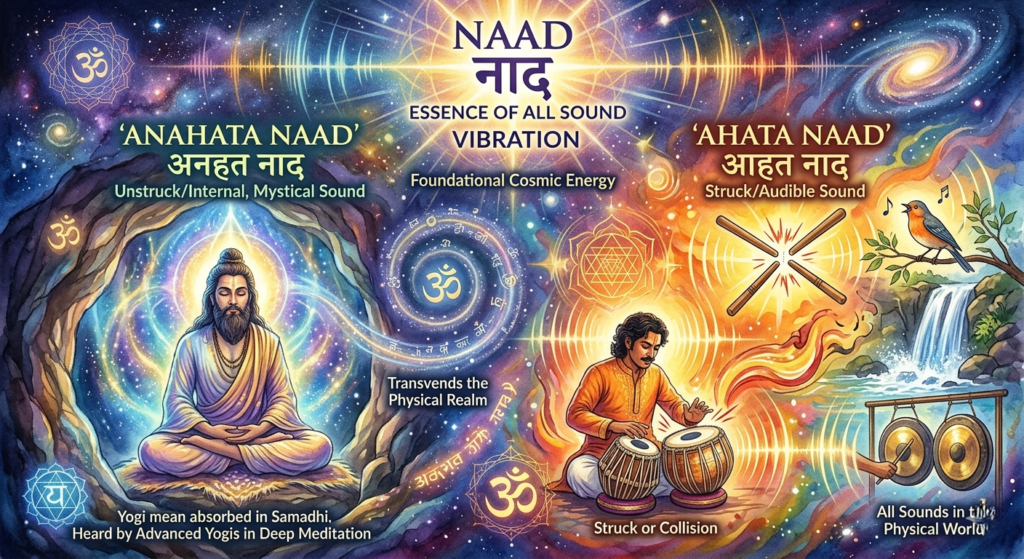
Aahat and anahat naad
+
- Aahat Naad
- Anahat Naad
- Aahat Naad (Struck Naad)
- Definition: Aahat Naad is the resonance produced when one object strikes another, creating a vibration through an external impact. When the strings or surface of an instrument are played with the hand, a pick, or other objects, the resulting vibrations produce a resonance known as Aahat Naad.
- Examples: Resonances produced by instruments like the sitar, tanpura, tabla, harmonium, and pakhawaj are examples of Aahat Naad. Playing these instruments requires some form of impact or plucking to generate vibrations and produce naad. Aahat Naad is perceptible and widely used in music.
- Characteristics: The form, intensity, and quality of Aahat Naad depend on the object producing the resonance. Instruments made of different materials—such as strings, leather, or wood—generate distinctive Aahat Naad qualities.
- Anahat Naad (Unstruck Naad)
- Definition: Anahat Naad is a naturally occurring resonance that arises without any external impact. Known as the “inner naad” or “divine resonance,” this type of naad is experienced internally, especially in meditation and spiritual practices. Scriptures describe it as the “universal naad” present throughout the cosmos.
- Examples: Resonances experienced in yoga and meditation, such as the chanting of “Om,” are considered examples of Anahat Naad. Unlike physical vibrations, Anahat Naad is an internal experience, attained through deep meditation.
- Characteristics: Anahat Naad does not require any external object or impact. It symbolizes completeness and is said to be present at the core of one’s soul. Experienced through meditation, Anahat Naad guides one towards peace and spirituality.
Characteristics of Naad
The Three Main Characteristics of Naad
- Pitch of Naad
- Timbre or Quality of Naad
- Loudness of Naad
1. Pitch of Naad
- Definition: The pitch of naad refers to its frequency, indicating how “high” or “low” a sound feels. It represents the intensity of naad.
- How It Occurs: When singing or playing, each note varies in pitch. In music, there are twelve notes like ‘Sa’, ‘Re’, ‘Ga’, ‘Ma’, etc., where ‘Re’ is higher than ‘Sa’, and ‘Ga’ is higher than ‘Re’. This means that the vibration frequency of ‘Re’ is higher than ‘Sa’ and that of ‘Ga’ is higher than ‘Re’. When frequency increases, the sound appears higher, and when it decreases, it sounds lower.
- Scientific Basis: Pitch directly relates to a sound’s frequency. Higher frequencies produce higher pitches, while lower frequencies result in lower pitches. This variation in pitch distinguishes different notes and brings depth and diversity to music.
- Example: When a sitar string is plucked quickly, the pitch rises, producing a sharp and high sound. Conversely, if the string is plucked slowly, the resulting sound is lower in pitch.
2. Loudness of Naad
- Definition: Loudness of naad refers to its intensity—how far and to what extent it can be heard. This depends on the amplitude of the string’s vibration.
- How It Occurs: When an instrument’s string is plucked gently, the resulting naad is soft and can only be heard at a short distance, known as “soft naad.” Conversely, when the string is plucked forcefully, the naad produced is louder and can be heard over a greater distance, known as “loud naad.”
- Scientific Basis: The amplitude of a string’s vibration determines the loudness of the naad. Greater amplitude causes the string to vibrate more widely, making the sound louder and clearer. When the amplitude is lower, the resulting sound is softer and audible only within a limited range.
- Example: When the string of a tanpura or sitar is plucked gently, the amplitude (vibration) is low, producing a soft naad. If the string is plucked forcefully, the amplitude increases, resulting in a louder naad.
3. Timbre or Quality of Naad
- Definition: Timbre, or the quality of naad, is the characteristic that differentiates the sound of one instrument from another. Known as timbre, it makes each instrument’s naad unique.
- How It Occurs: The sound produced by various instruments differs. For instance, the sound of a sitar differs from that of a violin, and a violin’s sound is different from a harmonium’s. This uniqueness depends on the number, order, and strength of the accompanying overtones of each instrument.
- Scientific Basis: According to scientists, no naad exists alone; it is accompanied by additional overtones. These overtones are associated with the primary naad and determine its timbre. Each instrument has a unique set of overtones, in number, order, and strength, making its sound distinct.
- Example: When a sitar is played, it produces several overtones that give its sound a unique identity. Due to these overtones, one can recognize the instrument without seeing it. The same principle applies to other instruments like the harmonium, sarod, or violin, each with its unique sound.

