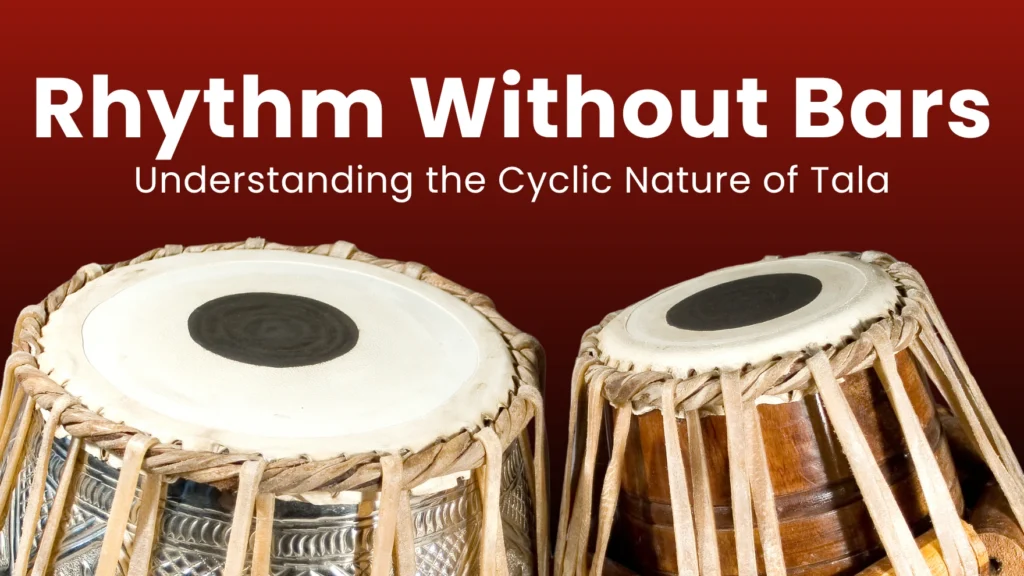
Taal: The Rhythmic Foundation of Indian Classical Music
Tala, or Taal, originates from the Sanskrit word meaning “clap” or “beat”[.It represents the rhythmic cycle or pattern underlying both Hindustani (North Indian) and Carnatic (South Indian) classical music. While analogous to a Western time signature, its complexity goes far beyond a simple numerical representation.
In Western music, rhythm is typically structured in linear, discrete measures or bars that march forward sequentially. Indian classical music, however, conceptualizes time as an endless, looping circle known as Tala. It is a holistic framework of temporal architecture where rhythm behaves like a spiral or clock, always returning to its origin.
This cyclical nature is essential for improvisation, allowing musicians to freely create within a defined structure. This constant repetition creates a hypnotic effect, drawing the listener into the musical experience and providing a solid foundation for the often-complex melodic improvisations.

Inside the taal
In Indian classical music, whether Hindustani (North Indian) or Carnatic (South Indian), rhythm is encapsulated in the concept of taal (spelt and pronounced tala in English), which means ‘clap.’ Loosely speaking, one may define it as ‘rhythm’, but the idea is more complex than this, and it works by time being divided cyclically rather than in a linear fashion. Each cycle is, in turn, subdivided into segments of varying measurement.
It requires exceptional skill on the part of the percussionist as well as the melodic soloist to keep track of all the measurements and subdivisions pertaining to any given taal. At first, it is taught by counting and clapping to show the relevant beats but eventually it becomes part of the natural instinct of professional musicians (as well as some of their audiences) to know exactly where they are, physically, at any given time in any rhythm cycle.
One will often notice that even when there is an interruption in the recital, or the soloist has paused to speak to the audience or one of the accompanists, the taal itself continues uninterrupted – almost like a loop – in the background with the soloist resuming at the appropriate beat.
There are several hundred kinds of rhythm cycles in Indian classical music with varying numbers of beats, but in the North it is more usual to hear the varieties that come in 16, 12, 10, 7, or 14 beats (respectively – tintal, ektal, jhaptal, rupak taal, and dhamar, jhoomra, or deepchandi). Taals also have a vocalised equivalent whereby beats are expressed as phonetic representations of various strokes played on different percussion instruments. Percussionists will often recite these phrases and then demonstrate the same on the tabla or mridangam. This is known as bol in Hindustani music, and solkattu in the Carnatic tradition.
Taals also have a ‘low’ point known as khali (empty), usually shown by waving the hand. But the most puzzling thing for those who are new to Indian classical music is that the completion of a rhythm cycle – its ‘highest’ point, known as sam – does not happen on the final beat of the cycle, as is typical for Western music, but on the first beat of the next cycle. But, it is a very visual affair and easy to spot as musicians, as well as audiences, will be seen to nod, or clap or raise their hands when this beat is reached.
The Structure of Tala
Components and Organization
Talas are built from a specific number of beats, called matras, ranging from three to a staggering . These matras are organized into cycles, known as avartan. Musicians often mark these beats using claps (taali), waves (khaali), or finger taps, creating a visual and auditory representation of the rhythmic pattern. The precise arrangement of these beats within the avartan defines the specific Tala, and mastering these patterns is crucial for performing and appreciating Indian classical music.
Laya: The Tempo of Tala
Laya, intrinsically linked with Tala, refers to the tempo or speed of the rhythmic cycle. Mastering Indian classical music necessitates understanding both Tala and Laya, as their interplay dictates the overall feel and energy of the performance. A slow Laya might evoke serenity, while a fast Laya creates excitement. The subtle shifts in Laya throughout a performance add another layer of complexity and expressive potential.
The Relationship Between Taal and Laya
Though taal and laya are distinct, they are deeply interconnected. Taal provides the structure, while laya determines the pace of that structure. Think of taal as a road map and laya as your travel speed.
In both Hindustani classical music and Carnatic classical music, the interplay between taal and laya in music makes performances dynamic and expressive. A singer may tentatively begin a vilambit khayal and slowly accelerate to Madhya or drut laya, showcasing their command over the rhythm.
Understanding how to maintain accuracy in laya while cycling through the taal repeatedly is a critical milestone in classical singing lessons.
Techniques to Master Taal and Laya
Here are some practical strategies that can help you get better at understanding and applying taal and laya in music:
- Clapping Exercises: Practice clapping the theka (basic rhythm) of different taals while listening to compositions.
- Use a Metronome or Taal App: Tools like Artium Academy’s metronome app help keep time and simulate tabla or mridangam accompaniment.
- Count Matras Verbally: Recite “1-2-3…” or traditional bols like dha, dhin dhin dha to internalise rhythm.
- Practice with a Lehra or Tanpura: Use a drone and lehra loop to simulate live accompaniment.
- Record and Playback: Listen to your own singing or playing to identify timing flaws.
Students in our online music classes often pair these with mirror exercises, where they match hand movements to syllables, just as they did during oral traditions.
The Influence of Taal and Laya on Different Indian Classical Music Forms
Every genre within Indian classical music is guided by the rhythmic principles of taal and laya:
- Khayal: Emphasises elaborate rhythmic improvisation with different layas and intricate taans.
- Dhrupad: Maintains very strict taal adherence, with deep emphasis on vilambit and madhya laya.
- Tarana and Tappa: Known for their fast-paced execution, demanding mastery of drut laya.
- Carnatic Kritis and Alapana: Showcase a sophisticated blend of tala cycles and speed variations.
Tala and Improvisation: A Rhythmic Dance
Improvisation is central to Indian classical music, and Tala provides the essential framework. Think of it as a dance floor—the Tala defines the space, but the musician’s creativity determines the steps. The rhythmic interplay, the subtle pauses and variations within the cyclical structure, are as crucial as the notes themselves. The ability to improvise within the Tala framework is a testament to the musician’s skill and understanding of the rhythmic system.
Tala’s Reach Beyond Music: Dance and Cultural Significance
Tala in Dance
Tala’s influence extends beyond music; it forms the rhythmic basis for Indian classical dance[15]. The dancer’s movements, expressions, and even the overall narrative structure are intrinsically linked to the Tala’s beats and cycles. The rhythmic pulse of the Tala dictates the fluidity and precision of the dance. The precise timing and rhythmic variations within the Tala are mirrored in the dancer’s movements, creating a unified and visually stunning performance.
The Interplay of Raga and Tala
In Indian classical music, Raga (melody) and Tala work in perfect harmony[2][12]. The interaction between these two elements is crucial for expressing the mood and emotion of a piece. A particular Raga might be best suited to a specific Tala, creating a unified and emotionally resonant musical experience. For example, a slow, somber Raga might pair beautifully with a calm, cyclical Tala. This synergistic relationship between Raga and Tala is a defining characteristic of Indian classical music.
Regional Variations in Tala
While the fundamental concept of Tala is central to both Hindustani and Carnatic traditions, significant differences exist[15][6]. These variations reflect the distinct musical styles and traditions of each region, showcasing the adaptability and richness of the Tala system itself. A deeper understanding of these nuances allows for a richer appreciation of the diverse tapestry of Indian classical music. These regional variations highlight the organic evolution and adaptation of Tala across different musical landscapes.
Qualitative Differences from Western Meters
While Western musical meters utilize a primarily additive approach to rhythm, Tala’s cyclical nature introduces a profound qualitative difference. The emphasis on repetition and the inherent structure of the *avartan* create a rhythmic experience that feels fundamentally different from linear Western rhythms. This cyclical structure allows for a unique type of improvisation, where the musician’s creativity is constrained by the Tala’s framework, resulting in a balance between freedom and structure that is rarely seen in Western music. This difference highlights the distinct aesthetic principles underlying Indian and Western musical traditions.
| Feature | Western Bars | Indian Tala Cycles |
|---|---|---|
| Geometry | Linear (Left-to-right progression) | Cyclic (Infinite loop or Avartan) |
| Structural Unit | Fixed bars containing a set number of notes | Fixed Matras grouped into asymmetric Vibhagas |
| Downbeat Identity | Accentuated start of a short measure | The Sam—a gravity-like point of release |
| Internal Phrasing | Governed by dynamic markings or accents | Articulated via Bols (vocalized drum syllables) |
FAQS about taal in indian classical music
1. What is the fundamental difference between a Taal and Western rhythm?
A Taal is strictly cyclic, operating as an infinite loop where beats return to their origin. Western rhythm moves linearly across discrete, sequential bars that march forward.
2. What are the most common Taals used in Indian music?
Teentaal (16 beats) and Jhaptal (10 beats) dominate North Indian Hindustani classical music. Adi Tala (8 beats) is the most widely utilized rhythm cycle in South Indian Carnatic music.
3. What is the role of “Sam” in a Taal cycle?
Sam is the absolute first beat of any given rhythmic cycle. It acts as a gravitational climax point where the soloist and percussionist must resolve their improvisations together.
4. What do “Tali” and “Khali” mean?
Tali refers to the accented, strong beats marked by a physical hand clap. Khali means “empty,” representing unaccented sections indicated by a silent wave of the hand.
5. What is “Laya” and how does it relate to Taal?
Laya is the tempo or speed at which the rhythmic cycle of a Taal moves. It is categorized into Vilambit (slow), Madhya (medium), and Drut (fast) speeds.
6. What are “Bols”?
Bols are spoken mnemonic syllables like Dha, Dhin, Ge, Na that mimic drum strokes. They allow musicians to vocalize, memorize, and teach complex mathematical phrases orally.
7. What is an “Avartan”?
An Avartan is one complete rotation or cycle of a Taal from the first beat to the last. It provides the repeating framework within which all musical improvisation takes place.
8. What is a “Theka”?
A Theka is the standard, foundational pattern of drum syllables that identifies a specific Taal. It serves as the ground reality that helps musicians maintain their place in the cycle.
9. What is a “Vibhaga” or “Khand”?
A Vibhaga is an internal division or subsection of beats within a single Taal cycle. For example, Teentaal’s 16 beats are divided into four equal Vibhagas of four beats each.
10. What is a “Tihai”?
A Tihai is a mathematical rhythmic phrase repeated exactly three times. It is calculated so that the final syllable lands precisely on the first beat (Sam) of the cycle.