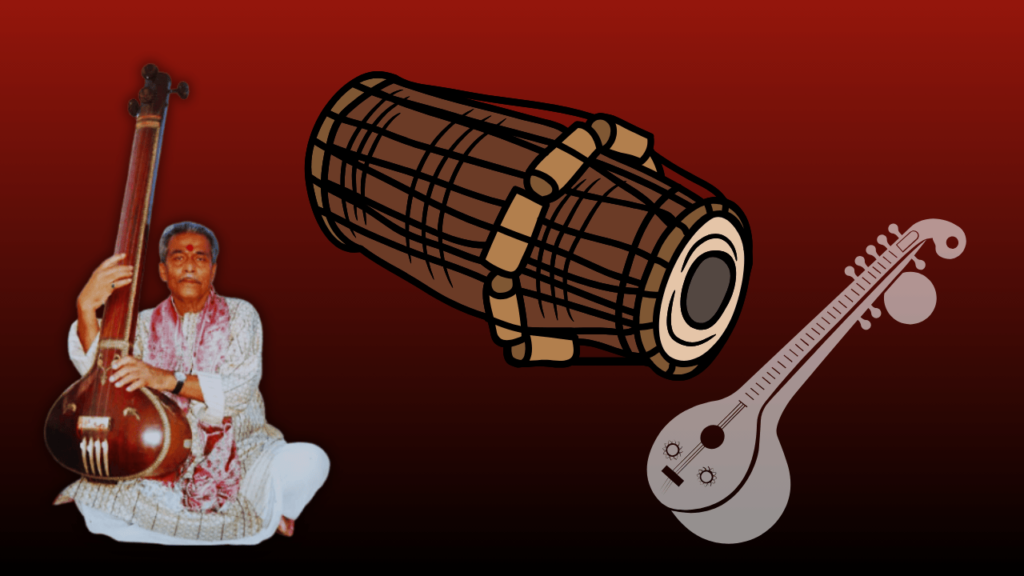
Dhrupad, the older of the two, dates back over 500 years and is considered the most ancient surviving form of Indian classical vocal music. It originated in the temples and was primarily devotional, sung in praise of deities, using Sanskrit or Braj Bhasha. The music was meant to elevate both the listener and the performer spiritually. Dhrupad is known for its meditative and austere character, relying on precise intonation, a slow and gradual elaboration of the raga in the alaap (non-rhythmic introduction), and strict adherence to rhythm in the composition (bandish). The pakhawaj, a barrel-shaped drum, traditionally accompanies Dhrupad.

Khayal, meaning “imagination” in Persian, evolved later, flourishing during the Mughal era. It is more flexible and ornate than Dhrupad, allowing greater freedom of improvisation and emotional expression. Khayal compositions are generally shorter, with a faster tempo, and are set to tabla accompaniment. The style emphasizes lyrical beauty, rhythmic intricacy, and expressive vocal ornamentation (taans, gamaks, and murkis).
While Dhrupad embodies stillness, discipline, and spiritual gravity, Khayal captures a broader emotional spectrum with its artistic freedom and romantic appeal. Today, both styles coexist, with Dhrupad experiencing a revival through dedicated practitioners and institutions. Together, they form the bedrock of Hindustani classical music, offering listeners a profound journey into the soul of India’s rich musical heritage.
1. Introduction to Dhrupad and Khayal
Indian classical music is rooted in two profound vocal traditions Dhrupad and Khayal. While Dhrupad is the oldest surviving form, known for its spiritual depth and rigid structure, Khayal (meaning “imagination”) offers flexibility and emotional expression. Both styles have shaped Hindustani music for centuries, influencing countless artists and healing listeners through their meditative and therapeutic frequencies.
Dhrupad and Khayal: A Tale of Two Pillars of Indian Classical Music
Dhrupad and Khayal are the two major vocal traditions in Hindustani classical music, each with a unique aesthetic, historical lineage, and spiritual depth. While both are rooted in the same raga system and aim to express the emotional essence (rasa) of a raga, they differ significantly in form, expression, and historical evolution.
2. History of Dhrupad: The Ancient Foundation

Dhrupad is the oldest surviving form of Hindustani classical music, with origins tracing back over 2,000 years. The word Dhrupad is derived from “Dhruva” (meaning immovable or eternal) and “Pada” (meaning verse), symbolizing a form of music that is both timeless and structured. Dhrupad evolved as a spiritual and meditative practice, originally sung in temples as a form of devotional offering to deities.
In ancient times, Dhrupad was closely linked with Samaveda, the Vedic text that emphasized musical chants. Over time, these chants transformed into more formalized melodic expressions. During the medieval period, Dhrupad became an essential part of the Haveli Sangeet tradition, where it was sung in temples (havelis) across North India, especially in praise of Lord Krishna.
By the 15th and 16th centuries, Dhrupad reached its golden age under the patronage of royal courts. The music flourished in the Mughal era, particularly under Emperor Akbar, who greatly admired the legendary Dhrupad vocalist Miyan Tansen. Tansen’s music, deeply rooted in the Dagar bani (style), played a crucial role in shaping the court music of India. His influence elevated Dhrupad to a sophisticated art form appreciated both for its aesthetic beauty and spiritual depth.
Dhrupad is traditionally performed in four banis or stylistic schools: Dagarbani, Gauharbani, Khandarbani, and Nauharbani—each with its own unique approach to rhythm, melody, and improvisation. Among these, the Darbhanga Gharana, with its robust and expressive style, is one of the most recognized lineages keeping the tradition alive.
Though the emergence of Khayal later overshadowed Dhrupad due to its lighter and more flexible structure, the last few decades have seen a global resurgence of interest in Dhrupad, especially for its healing qualities, meditative alaap, and spiritual connection. Today, institutions and artists across India and Nepal such as Manasukh Dhvani are preserving and teaching this ancient art form.
Dhrupad remains not just a music genre, but a sacred path to inner stillness and self-discovery.
Key Features of Dhrupad:
- Four sections: Alap, Jor, Jhala, and Bandish
- Devotional themes: Often praises deities like Vishnu and Shiva
- Minimal ornamentation: Focus on purity of notes (Shuddha Swara)
Dhrupad was the dominant form until the 18th century, when Khayal began gaining prominence.
3. Evolution of Khayal: From Dhrupad to Modern Expression
Khayal, the most popular form of Hindustani classical vocal music today, finds its roots deeply embedded in the ancient and austere tradition of Dhrupad. While Dhrupad is known for its meditative depth, structured discipline, and spiritual intensity, Khayal emerged as a more flexible, expressive, and romantic evolution of that tradition.
The word Khayal means “imagination” in Persian, and this reflects the very essence of the style one that allows freedom of expression, emotional nuance, and intricate ornamentation. Khayal began to take form in the late medieval period, particularly between the 13th and 17th centuries, when Persian and Central Asian influences began blending with Indian music traditions. This synthesis was facilitated by the cultural exchanges during the Delhi Sultanate and Mughal rule, where artists from diverse regions coexisted.
Khayal’s foundation lies in Dhrupad, especially in terms of raga structure, discipline, and tala (rhythmic cycles). However, while Dhrupad maintains a slow, spiritual unfolding of the raga, Khayal introduced lighter, more melodic, and lyrical elements. The bandish (composition) in Khayal is shorter and serves as a base for extensive improvisation, unlike the more fixed verses in Dhrupad.
It was under the Mughal emperor Muhammad Shah Rangile in the early 18th century that Khayal was fully developed and given a prestigious platform. Sadarang and Adarang, two great court musicians, played a crucial role in shaping Khayal into a formal genre, composing many bandishes still sung today.
With time, Khayal grew into several gharanas (musical lineages), each with distinct improvisational styles, ornamentations, and emotional interpretations — such as Gwalior, Jaipur, Kirana, Patiala, and Agra gharanas. These schools preserved Khayal while also giving it dynamic regional expressions.
Today, while Dhrupad continues as a sacred and rare tradition, Khayal has become the mainstream vocal form in North Indian classical music, known for its beauty, complexity, and emotive power. Its evolution from Dhrupad reflects the adaptability of Indian music — where structure and imagination meet to create timeless art.
Khayal emerged as a more flexible, romantic alternative to Dhrupad, blending Persian influences with Indian classical traditions.
Key Milestones in Khayal’s Evolution:
- Amir Khusro (13th century): Introduced Persian elements
- Sultan Hussain Sharqi (15th century): Formalized Khayal structure
- Niyamat Khan (Sadarang) in Mughal courts: Popularized Khayal as we know it today
Khayal’s improvisational nature (taans, sargam, bol-baant) made it more accessible, leading to its dominance in modern Hindustani music.
4. Key Differences Between Dhrupad and Khayal
| Aspect | Dhrupad | Khayal |
|---|---|---|
| 1. Origin | Ancient; dates back over 1,000 years | Evolved around the 13th–18th century from Dhrupad |
| 2. Meaning | ‘Dhrupad’ means “fixed words” or “pillar of music” | ‘Khayal’ means “imagination” in Persian |
| 3. Style | Serious, meditative, spiritual | Expressive, romantic, and emotional |
| 4. Structure | Very rigid, follows fixed format (Alap–Jor–Bandish) | Flexible format with faster improvisation |
| 5. Alap (Intro) | Long, unmetered, and deeply meditative | Shorter, sometimes rhythmic, with use of taans |
| 6. Composition (Bandish) | Sung in four parts: sthayi, antara, sanchari, abhog | Usually two parts: sthayi and antara |
| 7. Lyrics | Mostly in Brajbhasha; devotional themes, especially on deities | More varied themes: love, devotion, seasonal, philosophical |
| 8. Rhythm (Tala) | Often in slow and complex talas like Chautal, Dhamar | Uses a wide range including Teentaal, Ektaal, Jhaptaal |
| 9. Accompaniment | Pakhawaj, tanpura | Tabla, harmonium/sarangi, tanpura |
| 10. Ornamentation | Uses gamak (forceful oscillation), meend | Uses taan, murki, khatka, sargam, and bol-taan |
| 11. Presentation Time | Longer duration, one raag per performance | Multiple ragas can be performed in one sitting |
| 12. Gharana Influence | Primarily Darbhanga, Dagar, Bettiah gharanas | Gwalior, Kirana, Jaipur, Patiala, Agra, etc. |
5. Major Gharanas of Dhrupad and Their Legendary Singers
Darbhanga Gharana of Dhrupad
The Darbhanga Gharana is one of the foremost and distinctive lineages in the Dhrupad tradition of Hindustani classical music. Originating in the royal court of Darbhanga in Bihar, this gharana emerged prominently during the 18th and 19th centuries, flourishing under royal patronage. It is known for its unique blend of powerful layakari (rhythmic play), emotive expression, and dynamic vocal delivery, making it one of the most vibrant expressions of Dhrupad gayaki.
Unlike the Dagar Bani, which emphasizes meditative and alap-dominant styles, the Darbhanga Gharana incorporates both the nom-tom alap and compositions in various talas such as Chautaal, Dhamaar, and Sultaal, with a strong emphasis on the bol-baant (syllabic improvisation). This gharana is especially admired for its fast-paced, rhythmically complex performances and powerful voice projection, deeply rooted in the temple and royal haveli traditions of Dhrupad.
Prominent figures from this gharana include Pandit Ram Chatur Malik, who was one of the most renowned exponents of the gharana in the early 20th century. He passed on the tradition to many disciples, ensuring the survival of the style even as Dhrupad faced decline in public popularity. Other notable exponents include Prem Kumar Mallik, Indra Kumar Mallik, and the younger generation like Abhay Narayan Mallik and Bishnu Prasad Acharya, who are keeping the legacy alive today.
The gharana has also gained international attention through workshops, concerts, and collaborations, especially in recent years, thanks to the global resurgence of interest in ancient healing arts and classical traditions. Today, institutions like Manasukh Dhvani in Nepal are playing a pivotal role in preserving and promoting this powerful and healing form of music.
Dagar Gharana
The Dagar Gharana is arguably the most renowned and influential Dhrupad gharana, known for its deep spiritual approach and meditative quality. Tracing its origins back over 20 generations, this gharana has preserved the ancient art of Dhrupad with great authenticity. The Dagar style emphasizes the Alaap—the slow, improvisational unfolding of the raga—which serves as a tool for inner exploration and reflection. Their style focuses on microtonal precision, clarity of notes (swara), and a smooth, unhurried melodic progression.
A distinctive hallmark of the Dagar Gharana is the practice of Jugalbandi or duet performances, especially by the legendary Dagar brothers: Ustad Nasir Aminuddin Dagar and Ustad Nasir Moinuddin Dagar (Senior Dagar Brothers), followed by Ustad Zia Fariduddin Dagar and Ustad Zia Mohiuddin Dagar (younger generation). These artists played a key role in reviving and globalizing Dhrupad after its decline during the colonial period.
Globally, the Dagar Gharana has inspired musicians and listeners through workshops, concerts, and residencies in Europe, the U.S., and Japan. Ustad Zia Mohiuddin Dagar, a Rudra Veena maestro, contributed significantly by redefining instrumental Dhrupad and establishing institutions like the Dhrupad Gurukul in Mumbai.
Contemporary torchbearers include Ustad Wasifuddin Dagar, Ritwik Sanyal, and the Gundecha Brothers, who expanded the reach of Dhrupad through modern pedagogy and digital platforms. The Dagar Gharana’s influence is felt across both vocal and instrumental forms, preserving the spiritual essence of Dhrupad while adapting to contemporary times.
This gharana’s contribution remains pivotal in the healing arts of sound and frequency-based therapy, with its slow, resonant rendering aiding in meditation and mental well-being, aligning seamlessly with the ethos of initiatives like Manasukh Dhvani.
Bettiah Gharana
The Bettiah Gharana of Dhrupad is one of the oldest and most historically significant gharanas in the tradition of Hindustani classical music. Originating in the princely state of Bettiah in Bihar, this gharana was nurtured under royal patronage for centuries. It is believed to have been established in the 17th century, making it a crucial part of the lineage that kept the Dhrupad tradition alive during times when other forms like Khayal started gaining popularity.
Bettiah Gharana is particularly known for its temple-based tradition of Haveli Sangeet, a style of Dhrupad sung in devotion to deities, especially Lord Krishna. This sacred form emphasized not just musicality but also spiritual purity. Unlike the more meditative and elaborate approach of the Dagar Gharana, Bettiah gharana includes a greater focus on composition-based presentation. It maintains a rich repository of ancient compositions in Braj and Sanskrit, many of which are unique to this lineage.
The vocal style of Bettiah is marked by clarity of rhythm and lyrical pronunciation, strong use of layakari (rhythmic play), and a distinct approach to Alaap and Dhrupad bandish. While the gharana has been less globalized compared to others, it has produced several stalwart musicians who have left an indelible mark on Dhrupad.
Among the renowned exponents are Pandit Indra Kishore Mishra, Pandit Vimal Kishore Mishra, and Pandit Abhay Narayan Mallick, all of whom have worked to preserve the traditional compositions and style of the gharana. These artists have taught students across India and Nepal, and some of them continue the tradition in academic institutions and gurukuls.
Today, the Bettiah Gharana holds a vital place in reviving Dhrupad through both scholarly and performance-based platforms. Its emphasis on structured, devotional Dhrupad makes it a beautiful fit for modern healing practices, resonating with the work of initiatives like Manasukh Dhvani.
Bishnupur Gharana
The Bishnupur Gharana holds a unique place in the tradition of Dhrupad music, being the only Dhrupad gharana to have emerged from Eastern India, particularly from Bishnupur in West Bengal. This gharana was established during the 18th century under the patronage of the Malla kings of Bishnupur, who were passionate supporters of art and culture. The gharana traces its lineage to Ustad Bahadur Khan, a descendant of the famous Tansen, who migrated from Delhi to Bishnupur and trained the musicians of the royal court.
The style of the Bishnupur Gharana differs significantly from the Dhrupad traditions of Central and Northern India. It incorporates a more lyrical and gentle approach to alap and rhythm, often blending the rigid frameworks of Dhrupad with regional aesthetics and subtle emotional expression. The gharana also emphasizes clarity of swaras (notes) and Bhakti Rasa (devotional sentiment), which reflects its strong Vaishnavite roots.
Unlike the Dagar and Bettiah gharanas, Bishnupur Gharana evolved in a more isolated and less court-influenced environment, allowing it to preserve certain unornamented and pure aspects of Dhrupad, while also adapting to Bengali cultural sensibilities. It played a major role in keeping the Dhrupad tradition alive in Bengal during times when Khayal and lighter genres became more prominent elsewhere.
Some prominent artists of this gharana include Ramshankar Bhattacharya, Gopeswar Banerjee, Jadu Bhatta, and Satyakinkar Banerjee, who also influenced Rabindranath Tagore’s musical thinking. In the modern era, the gharana has contributed significantly to both Dhrupad and Rabindra Sangeet traditions.
Today, the Bishnupur Gharana continues to be a vital thread in India’s musical heritage, representing the spiritual and intellectual legacy of Dhrupad in Eastern India. It also finds relevance in modern wellness practices, with its melodic depth aiding meditative and healing experiences.
6. Major Gharanas of Khayal and Their Maestros

Below is an in-depth exploration of five major Khayal gharanas in Hindustani classical music, each with its distinctive style and prominent exponents.
1. Gwalior Gharana
The Gwalior Gharana is one of the oldest and most revered traditions in Hindustani classical music. Its origins trace back to the 19th century and are attributed to Ustad Hassu Khan, Ustad Haddu Khan, and Ustad Nathu Khan. This gharana emphasizes clarity, simplicity, and a structured approach to raga presentation.
Characteristics:
- Vistaar (Elaboration): The Gwalior style is known for its detailed and systematic elaboration of ragas, focusing on slow development and gradual build-up.
- Compositional Forms: It employs traditional compositions like bandish in vilambit (slow) and drut (fast) tempos, highlighting lyrical clarity.
- Voice Modulation: Singers often use a controlled and steady voice, with emphasis on tonal purity and enunciation.
Prominent Exponents:
- Pandit Vishnu Digambar Paluskar: A pivotal figure in the revival of classical music in the early 20th century, he founded the Gandharva Mahavidyalaya.
- Pandit Omkarnath Thakur: Renowned for his deep understanding of ragas and their emotional expressions.
- Veena Sahasrabuddhe: A contemporary exponent known for her graceful renditions and adherence to traditional forms.
2. Agra Gharana
The Agra Gharana is distinguished by its emphasis on powerful voice production and intricate layakari (rhythmic play). It evolved in the city of Agra and is characterized by its robust and forceful style.
Characteristics:
- Layakari: Complex rhythmic patterns and improvisations are central to this gharana, showcasing the singer’s command over rhythm.
- Voice Strength: A deep, resonant voice is cultivated, with a focus on volume and projection.
- Dhrupad Influence: The gharana retains elements from Dhrupad, such as slow elaboration and emphasis on tonal purity.
Prominent Exponents:
- Ustad Faiyyaz Khan: A legendary figure known for his powerful renditions and mastery over rhythm.
- Ustad Latafat Hussein Khan: Renowned for his deep voice and intricate rhythmic improvisations.
- Ustad Dinkar Kakini: Noted for his scholarly approach and contributions to the gharana’s repertoire.
3. Kirana Gharana
Originating from the town of Kirana, this gharana is celebrated for its emphasis on melody (swar) and emotional depth (bhava). It gained prominence in the 20th century through the efforts of Ustad Abdul Karim Khan and Ustad Abdul Wahid Khan.
Characteristics:
- Emotional Expression: The Kirana style focuses on conveying deep emotions through the rendition of ragas.
- Swar Emphasis: There is a strong focus on the purity of notes and their melodic progression.
- Slow Development: Ragas are elaborated slowly, allowing for a deep exploration of their mood and essence.
Prominent Exponents:
- Pandit Bhimsen Joshi: A stalwart of the gharana, known for his powerful voice and emotive renditions.
- Gangubai Hangal: Renowned for her soulful voice and expressive performances.
- Prabha Atre: A contemporary artist known for her scholarly approach and innovative interpretations.
4. Delhi Gharana
The Delhi Gharana is noted for its graceful and refined style, with a focus on aesthetic appeal and melodic beauty. It developed in the cultural milieu of Delhi and is characterized by its elegant presentation.
Characteristics:
- Graceful Ornamentation: The use of delicate ornamentations and embellishments adds to the aesthetic quality of the music.
- Melodic Refinement: There is a focus on the smooth and refined rendering of ragas.
- Expressive Phrasing: Phrasing is done with an emphasis on emotional expression and melodic beauty.
Prominent Exponents:
- Ustad Chand Khan: Known for his refined style and contributions to the gharana’s development.
- Ustad Nasir Ahmed Khan: Renowned for his expressive renditions and mastery over ragas.
- Ustad Krishna Bisht: Noted for his elegant presentations and contributions to the gharana’s repertoire.
5. Benaras Gharana
The Benaras Gharana is unique for its fusion of Khayal and Thumri styles, reflecting the cultural richness of Varanasi. It is characterized by its lyrical beauty and emotional depth.
Characteristics:
- Thumri Influence: The gharana incorporates elements of Thumri, such as light classical compositions and emotional expression.
- Lyrical Beauty: There is a focus on the poetic and lyrical aspects of the compositions.
- Emotional Depth: Performances are imbued with deep emotional expression, capturing the essence of the lyrics.
Prominent Exponents:
- Girija Devi: Known as the “Queen of Thumri,” she brought international acclaim to the gharana with her emotive performances.
- Rajan Mishra and Sajan Mishra: Renowned for their collaborative performances and contributions to the gharana’s legacy.
- Pandit Gopal Mishra: A key figure in the gharana’s development, known for his scholarly approach and contributions.
7. The Evolution of Dhrupad and Khayal in Modern Times
Dhrupad: Tradition Meets Innovation
Dhrupad, one of the oldest forms of Hindustani classical music, has experienced a resurgence in India, particularly among the younger generation. Institutions like the Dhrupad Sansthan in Bhopal and the Dhrupad Kendra in Varanasi have been pivotal in this revival. The Gundecha Brothers, Umakant and Ramakant, played a significant role in this movement by introducing compositions by Hindi poets and setting up a gurukul-style institute to train new artists. Following Ramakant’s passing in 2019, his son Anant Gundecha has continued this legacy, ensuring the gharana’s continuity .
Contemporary exponents like Pandit Ritwik Sanyal and Dr. Priyanka Mallick have further enriched Dhrupad by incorporating elements from other classical traditions, thus broadening its appeal. The Darbhanga gharana, known for its energetic performances and balanced approach between alap and bandish, has also seen a revival, with artists like Pandit Siyaram Tiwari leading the way .
In Nepal, Dhrupad’s presence is limited but growing. Institutions such as the Tribhuwan University Department of Music offer courses in classical music, including Dhrupad, aiming to preserve and promote this art form. Many Dhrupad institutes as well as schools are also promoting the practices of dhrupad as well as khayal.
Khayal: Contemporary Interpretations
Khayal music, characterized by its improvisational nature, has evolved significantly in modern India. Artists like Pandit Jasraj and Ustad Rashid Khan have introduced innovative interpretations, incorporating elements from various musical traditions while maintaining the core principles of Khayal. The younger generation, including artists like Shubha Mudgal and Kaushiki Chakraborty, are experimenting with fusion genres, blending Khayal with genres like jazz and electronic music, thus expanding its reach and appeal.
In Nepal, Khayal is less prevalent but is gradually gaining recognition. Institutions such as the Nepal Music Center and the Department of Music at Tribhuvan University offer programs that include Khayal as part of their curriculum. Young Nepali artists are beginning to explore Khayal, often integrating it with traditional Nepali instruments and themes, creating a distinctive fusion that appeals to both classical purists and contemporary listeners.
8. The Mental and Emotional Benefits of Learning Dhrupad and Khayal
- Stress Relief: Slow alaps in Dhrupad induce alpha brainwaves (relaxation).
- Emotional Balance: Khayal’s improvisation enhances creativity and focus.
- Therapeutic Ragas: Bhairavi (calmness), Yaman (joy), Malkauns (deep healing)
9. Prominent Artists of Dhrupad and Khayal
Prominient Dhrupad Artist
1. Ustad Zia Fariduddin Dagar
A legendary figure in the Dagar tradition, Ustad Zia Fariduddin Dagar was instrumental in popularizing Dhrupad globally. Born in Udaipur, he trained under his father and elder brother, Ustad Zia Mohiuddin Dagar. His performances were marked by profound depth and meditative quality, earning him numerous accolades and a lasting legacy in the Dhrupad community
2. Ustad Faiyazuddin Dagar
A prominent exponent of the Dagar tradition, Ustad Faiyazuddin Dagar was known for his powerful voice and intricate renditions. He was the younger brother of Ustad Zia Fariduddin Dagar and contributed significantly to the propagation of Dhrupad music. His performances were characterized by their emotional intensity and technical prowess.
3. Ustad Wasifuddin Dagar
Representing the 20th generation of the Dagar family, Ustad Wasifuddin Dagar has been a leading figure in Dhrupad music. He trained under his father, Ustad Faiyazuddin Dagar, and his uncle, Ustad Zahiruddin Dagar. His solo performances are renowned for their depth and clarity, earning him the Padma Shri award in 2010.
4. Gundecha Brothers (Umakant & Ramakant)
The Gundecha Brothers revitalized the Dhrupad tradition by incorporating Hindi poetry into their performances. Trained under the Dagar brothers, they have performed extensively worldwide and have been honored with awards like the Kumar Gandharva Award and the Dagar Gharana Award.
5. Pt. Vinod Kumar Dwivedi
A distinguished Dhrupad-Dhamar vocalist, Pt. Vinod Kumar Dwivedi has been recognized with numerous awards, including the Central Sangeet Natak Academy Award in 2023. He is known for his powerful vocal renditions and contributions to the Dhrupad-Dhamar genre.
6. Pt. Uday Bhawalkar
A leading figure in the Dagar tradition, Pt. Uday Bhawalkar is known for his deep, resonant voice and meditative style. He has performed at prestigious festivals worldwide and has been a prominent teacher, passing on the Dhrupad tradition to new generations.
7. Chintan Upadhyay
Trained under Pt. Uday Bhawalkar, Chintan Upadhyay is a contemporary Dhrupad vocalist from Gujarat. He has received scholarships from the Government of India and has performed at various national and international platforms, contributing to the modern evolution of Dhrupad.
8. Dr. Ritwik Sanyal
A renowned Dhrupad vocalist and scholar, Dr. Ritwik Sanyal has been instrumental in blending traditional Dhrupad with contemporary elements. He has performed at various international festivals and has been a prominent figure in the Dhrupad revival movement.
9. Ustad Zia Mohiuddin Dagar
A master of the Rudra veena and a key figure in the Dagar tradition, Ustad Zia Mohiuddin Dagar was known for his deep, resonant performances. He was instrumental in preserving and propagating the Dhrupad tradition through his teachings and performances.
10. Ustad Rahimuddin Khan Dagar
A revered Dhrupad vocalist, Ustad Rahimuddin Khan Dagar was known for his profound renditions and contributions to the Dagar tradition. He played a significant role in mentoring and shaping the careers of several Dhrupad artists.
Prominent Khayal Artists from India
1. Pandit Bhimsen Joshi (Kirana Gharana)
A legendary vocalist known for his commanding voice, soulful raga development, and powerful taans. Awarded the Bharat Ratna, his performances of ragas like Miyan Ki Todi and Multani remain benchmarks in Khayal singing.
2. Ustad Amir Khan (Indore Gharana)
Founder of the Indore Gharana, Amir Khan blended slow-tempo elaboration with lyrical beauty. His approach emphasized emotional depth, delicate ornamentation, and long meends (glides), transforming Khayal into a meditative art.
3. Ustad Rashid Khan (Rampur-Sahaswan Gharana)
A modern torchbearer of the Khayal tradition, Rashid Khan is known for his seamless blend of traditional depth with contemporary appeal. His voice control and innovative improvisations have earned him global recognition.
4. Pandit Jasraj (Mewati Gharana)
Known for blending devotion with classical technique, Pandit Jasraj popularized the Mewati gharana. His Khayal performances often carried a bhakti (devotional) flavor and featured rich use of bol alap and bol taans.
5. Vidushi Kishori Amonkar (Jaipur-Atrauli Gharana)
Renowned for her deeply introspective renditions, she redefined Jaipur Gharana’s structured style with emotive expressiveness and philosophical interpretation. Her Khayals were known for profound melodic depth.
6. Ustad Bade Ghulam Ali Khan (Patiala Gharana)
A charismatic and technically brilliant vocalist, Bade Ghulam Ali Khan fused styles from different gharanas. His gayaki was fast-paced, with stunning taans and gamaks, and he had a magical command over both classical and semi-classical forms.
7. Dr. Prabha Atre (Kirana Gharana)
A scholarly vocalist, she is known for her creative compositions and insightful interpretations of ragas. Dr. Atre has written extensively on music and contributed to evolving Khayal through innovation while respecting tradition.
8. Ustad Abdul Karim Khan (Kirana Gharana)
One of the pioneers of the Kirana Gharana, his renditions focused on swara purity and emotional expression. He was a guru to several notable artists and helped shape modern Khayal’s melodic aesthetics.
9. Pandit Mallikarjun Mansur (Jaipur-Atrauli Gharana)
Celebrated for his command over rare and complex ragas, Mansur brought scholarly depth and spontaneous creativity to his performances. He was particularly noted for his mastery of intricate bandishes.
10. Kaushiki Chakraborty (Patiala and fusion styles)
A leading contemporary vocalist, she blends the traditional Khayal form with innovative presentation. Trained under her father Ajoy Chakraborty, she is known for her expressive gayaki and global appeal among younger audiences.
10. Manasukh Dhvani: Preserving the Tradition
At Manasukh Dhvani, we teach Dhrupad and Khayal with a focus on:
✅ Authentic Guru-Shishya Parampara
✅ Therapeutic Applications of Ragas
✅ Personalized Training for All Levels
Join us to experience the healing power of Indian classical music!
11. Conclusion: Why Dhrupad and Khayal Matter Today
Conclusion: The Relevance of Khayal and Dhrupad in the Contemporary World
In today’s rapidly evolving musical and cultural landscape, Khayal and Dhrupad, the two primary genres of Hindustani classical vocal music, continue to hold profound relevance—not just as traditional art forms, but as deeply reflective practices of inner harmony, discipline, and emotional expression. While the fast-paced modern world increasingly favors instant gratification and surface-level entertainment, the slow unfolding, meditative depth, and philosophical undercurrents of these traditions offer a necessary counterbalance.
Dhrupad, the more ancient of the two, traces its roots back to the Samvedic chants and evolved through the devotional traditions of temples and royal courts. It is characterized by its austerity, spiritual grounding, and emphasis on swara shuddhi (purity of notes). The alap in Dhrupad—often long and unmetered—serves not just as a musical exploration but as a meditative journey, echoing the performer’s internal state. This makes Dhrupad not merely a genre of music but a form of sonic yoga, wherein the listener too is drawn into a trance-like awareness.
Khayal, on the other hand, emerged around the 18th century as a more romantic, flexible, and expressive form of singing. It incorporated aesthetic richness and allowed for emotional and lyrical interpretations through elaborate improvisations, bol-taans (syllabic patterns), and gamaks (oscillations). Where Dhrupad is rooted in silence and gravity, Khayal embraces fluidity, imagination, and emotional nuance.
Despite their distinct styles, both Dhrupad and Khayal serve a shared purpose in today’s world: they promote inner awareness, discipline, mindful listening, and emotional intelligence—qualities that are often overshadowed in the digital and attention-fragmented age.
The Role of Manasukh Dhvani
A profound philosophical and aesthetic aspect connecting both Dhrupad and Khayal is the concept of Manasukh Dhvani—the “sound that brings joy to the mind.” This Sanskrit idea emphasizes that the ultimate aim of music is not technical brilliance or display but ānanda (bliss). Manasukh Dhvani reminds us that music must resonate internally, create harmony within the listener, and evoke a sense of peace and fulfillment.
In Dhrupad, the slow elaboration of ragas is precisely designed to awaken Manasukh Dhvani. The note-by-note unfolding, the silence between phrases, and the steady breath all work in tandem to still the mind and elevate the spirit. Similarly, in Khayal, when the artist sings a bandish (composition) with deep bhava (emotion), it is not the complexity of the taans but the mood it evokes that connects with the listener’s heart. In this way, both forms fulfill a deeper human need—emotional and spiritual nourishment through sound.
Cultural Continuity and Global Resonance
In India and neighboring countries like Nepal, Dhrupad and Khayal are now witnessing a quiet but steady resurgence. Younger generations are embracing these forms, not just as performers but as seekers of a more meaningful cultural identity. The integration of these traditions into academic institutions, digital platforms, and cross-cultural collaborations has expanded their reach beyond traditional audiences.
In global music contexts—from Tokyo to Berlin—listeners are increasingly drawn to the meditative quality of Dhrupad and the emotional range of Khayal. International students are taking up these styles not as exotic curiosities, but as genuine spiritual practices and art forms that speak to the universal human experience.
In Conclusion
Khayal and Dhrupad matter today not only as carriers of ancient musical heritage but as antidotes to modern anxiety, fragmentation, and noise. They offer a contemplative, structured, and beautiful path to reconnect with oneself. In a world where speed and superficiality often dominate, the stillness of Dhrupad and the emotional sweep of Khayal, imbued with the essence of Manasukh Dhvani, remind us that true art is timeless and healing.