If you’ve been searching for a structured way to learn Indian classical singing, “how long does it take to learn classical vocal” is probably a question you’ve already asked yourself. At Manasukh Dhvani, the answer for most students who’ve already covered the basics is our 6-month intermediate program, Raag Parichaya, one of the three structured vocal courses listed on our Courses page.
This blog walks you through exactly what this 6-month course covers, month by month, who it’s designed for, and what you’ll actually be able to sing by the end of it, whether your goal is soulful light music and devotional songs, or a deeper, disciplined path into classical raga singing.
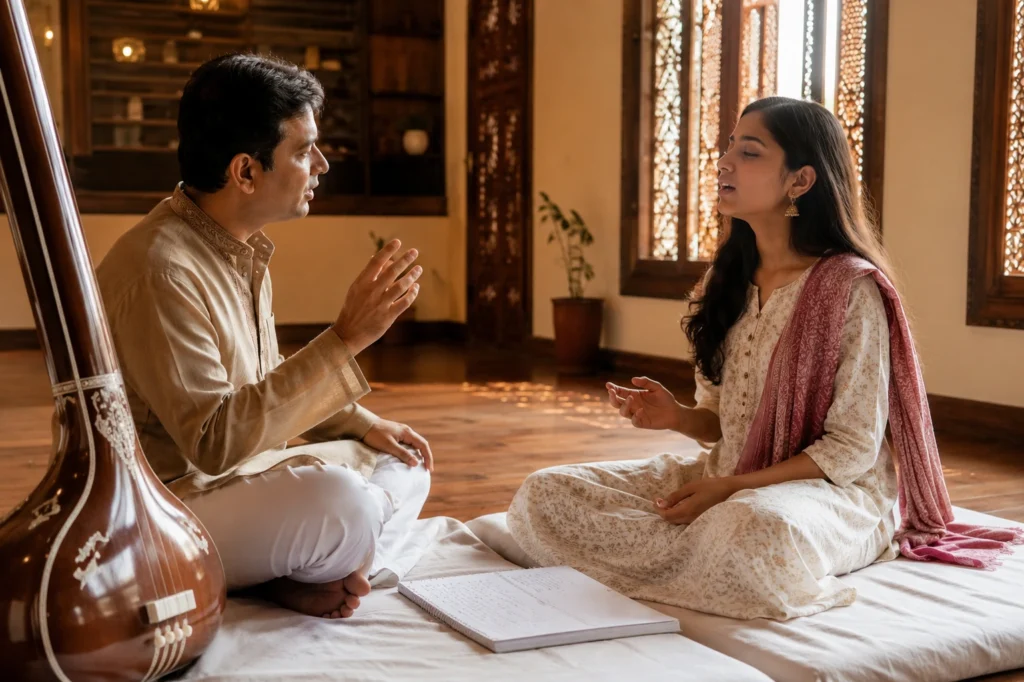
Who Is This 6-Month Course For?
Raag Parichaya sits between our two other vocal programs, and it’s built for a specific stage of learning:
- Students who’ve completed Naad Arambha (our 3-month beginner course) or already have a working knowledge of basic swaras, taal, and pitching.
- College students studying music as part of a diploma or bachelor’s degree, who need structured raga exposure alongside their academic coursework.
- Anyone wanting a genuine introduction to raags, not just songs, after already building a vocal foundation.
If you’re completely new to singing, we’d recommend starting with our beginner course first. It covers taal recognition, alankars for pitching, breath control, and basic music theory, everything Raag Parichaya assumes you already know. You can read more about how that foundation is built on our Courses page.
Course Structure and Duration
Raag Parichaya is designed as a 6-month, part-time program with a clear weekly rhythm:
| Detail | What It Looks Like |
|---|---|
| Duration | 6 months |
| Weekly classes | 5 classes per week |
| Performance practice | 1 dedicated performance day weekly |
| Format | Available online (1-to-1) or in person, in small groups |
| Focus | One raag studied in depth each month |
This pace is intentional. Indian classical music isn’t learned by cramming; it’s absorbed slowly, through repetition, listening, and consistent daily practice. One raag a month gives you enough time to actually internalize its mood, structure, and grammar, not just memorize it.
Month-by-Month: What You Actually Learn
Each raag you study during the 6 months follows the same structured teaching sequence, so by month six, you’ll have gone through this process independently, six separate times:
- Raag Parichaya (Introduction) – Understanding the raag’s identity: which notes it uses, its mood (rasa), and the time of day it’s traditionally sung. If you want to understand why timing matters in raga singing, our post on the Time Theory of Raga explains this in more depth.
- Aroha and Avroha – Learning the ascending and descending note patterns that define the raag’s skeleton.
- Sargam in Class – Practicing the raag using solfa syllables (Sa Re Ga Ma Pa Dha Ni) to build accuracy before adding lyrics.
- Bandish of the Raag – Learning a fixed traditional composition set in that raag, the actual “song” built on the raag’s rules.
- Bol Alaap – A slow, exploratory unfolding of the raag using the bandish’s own words, building the improvisational sense that comes before faster taans.
- Basic Taans – Introductory fast, ornamented note runs within the raag.
- Songs Based on the Raag – Applying what you’ve learned to actual songs composed in that raag, connecting theory to something you can perform.
- Performance Practice – Weekly stage time to build confidence and receive real feedback, not just classroom correction.
By the end of the program, you’ll have gone through this full cycle for six different raags, giving you both depth in each one and a repeatable method for learning any new raag on your own afterward.
Two Paths Within the Same Course: Light Music or Deep Classical
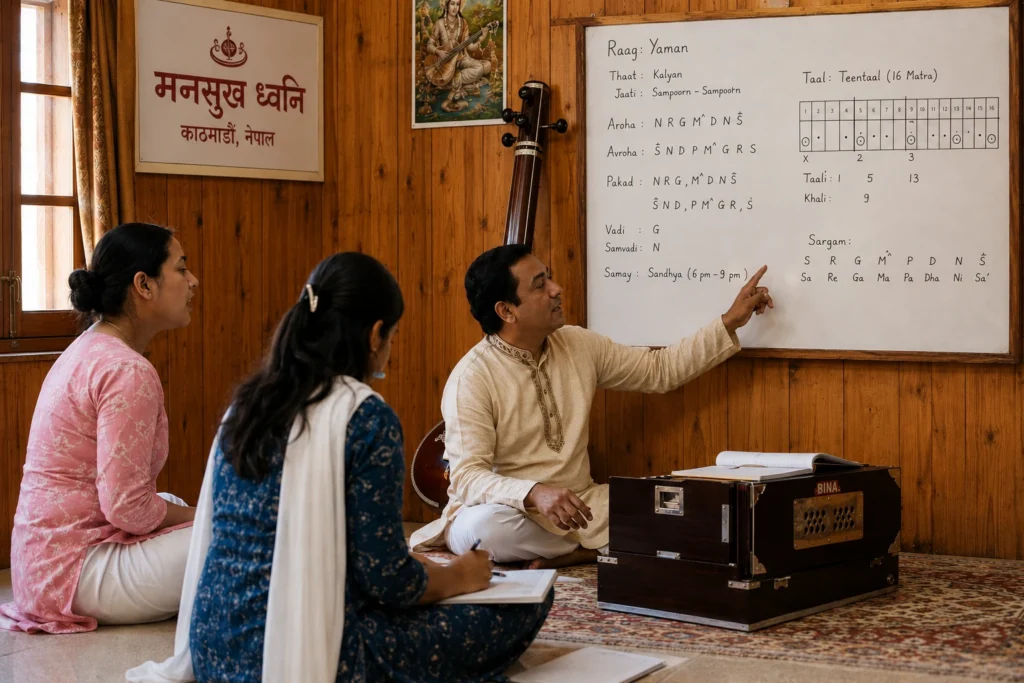
One thing that makes this course genuinely useful for different kinds of learners is that it isn’t one-size-fits-all. Depending on your goals, your lessons are shaped in one of two directions:
If your interest is light music and songs: Your teacher will lean your raag-based training toward melodic, devotional, and cultural repertoire, bhajans, film-style light classical pieces, and songs suited for cultural events or personal singing. You’re still learning the same raag grammar, just applied toward accessible, singable music rather than pure classical performance.
If your interest is deep classical singing: Your training leans further into the Khayal style, Hindustani classical music’s most widely performed form, with more emphasis on ornamentation, improvisation, and vocal technique. Students drawn to an even older, more meditative approach often continue toward Dhrupad, the oldest surviving classical vocal tradition, taught at Manasukh Dhvani through the traditional Guru-Shishya Parampara. If Dhrupad interests you specifically, our page on Dhrupad training in Nepal and our article on how Dhrupad and Khayal evolved from one classical soul explain the difference in detail.
Neither path is “better.” They’re simply two directions the same raag foundation can grow toward, and your teacher adjusts your monthly repertoire based on which one genuinely interests you.
The Listening and Ear-Training Skills You’ll Build
A large, often underestimated part of this course is training your ear, not just your voice. Alongside singing, you’ll build the ability to:
- Recognize a raag by ear, a skill our guide on how to recognize a raag for beginners breaks down step by step.
- Understand microtones (shruti), the subtle in-between notes that don’t exist on a piano but define authentic Indian classical pitching, covered in our post on 22 shruti explained.
- Notice how morning and evening raags feel different, connecting your practice schedule to the raag’s traditional time, a concept explored further in Morning Ragas & Evening Ragas.
- Identify well-known raags in songs you already listen to, using patterns from our roundup of the 10 most famous classical raags every music student should know.
This ear-training runs alongside your vocal lessons every week and is part of why students finish the course able to identify raags in music they hear outside the classroom, not just perform the six they studied.
Daily Practice (Riyaz): What’s Expected Between Classes
Classes alone won’t get you through six raags in six months. Consistent daily practice, called riyaz, is built into the program’s expectations from day one. If you’re wondering what that practice should actually look like day to day, our detailed post on a daily riyaz routine for Eastern classical vocalists lays out a realistic structure you can follow between lessons, covering warm-ups, sargam practice, and how long to actually sit with a single note before moving on.
Your teacher will also correct your breathing and vocal placement as part of this process. If you’ve ever been told to “sing from the navel, not the throat,” our article on the meditative voice and singing from the navel (nabhi) explains exactly what that means and why it matters for tone and stamina.
Certification and What You’ll Be Able to Do
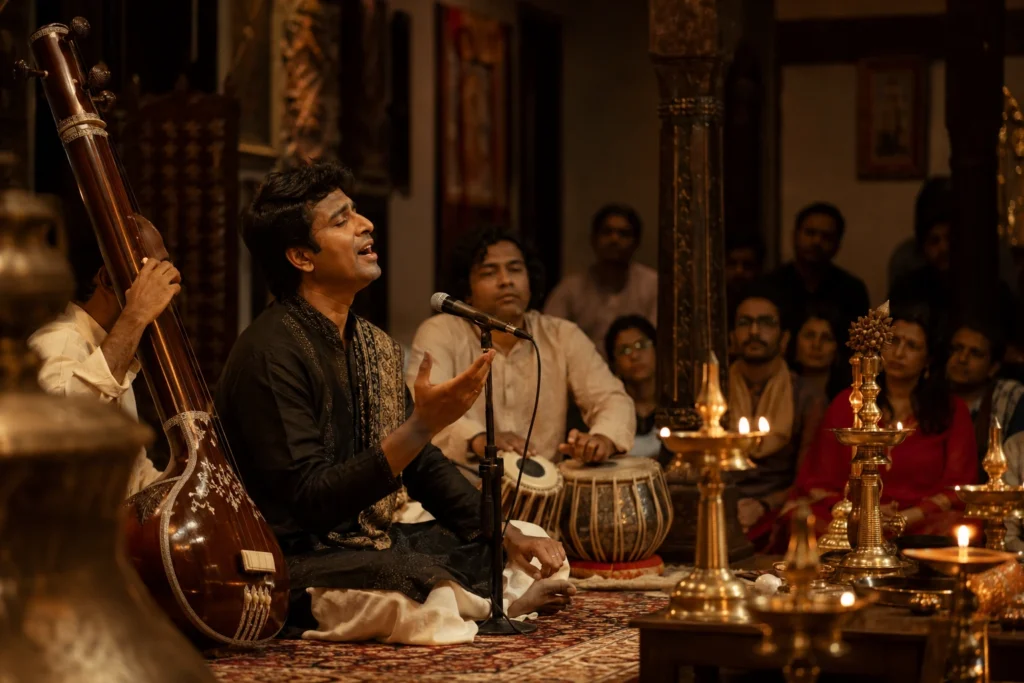
By the end of the 6 months, if you’ve kept up with weekly classes and consistent riyaz, you should be able to:
- Guess the raag of practiced-style songs by ear
- Sing the aroha and avroha of all 6 raags studied
- Sing the sargams of each raag according to its correct chalan (movement)
- Perform the bandish of all 6 raags with reasonable confidence
- Approach a new, unfamiliar raag using the same learning method you’ve now practiced six times over
You’ll also receive a digital certification from Manasukh Dhvani, and the option to be featured on our website, the same recognition offered across all our vocal courses, as listed on the Courses page.
What Comes After: Going Deeper
Many students who complete Raag Parichaya move on to our advanced program, Raag Vistaar, a 1-year course focused on going deep into individual raags, including full vilambit (slow-tempo) presentation in Khayal style, or four-charan alaap in Dhrupad style, along with composing and improvisation skills. It’s designed for students ready to genuinely perform, teach, or pursue music further, details are on the same Courses page.
If you’d rather stay in touch with your progress through our student community, you can also look into Dhvani Baithak participation, our informal performance gathering, or the Vocal Class Scholarship if cost is a barrier to starting.
Online or In-Person: Both Work
This course is taught both online, through 1-to-1 private classes available globally, and in person at our Pulchowk, Lalitpur studio. If you’re based outside Nepal and wondering whether online classical training actually works, our posts on learning Indian classical vocal online while living abroad and the top 5 benefits of learning raga online cover this directly. We also work with Nepali families abroad who want their children to stay connected to this tradition, more on that in our guide to online raga classes for Nepali kids born abroad.
Getting Started
If Raag Parichaya sounds like the right next step for you, whether you’re aiming for soulful devotional singing or a serious classical foundation, you can see class timings and apply directly through our enrollment page, or start with a free demo class to see how your teacher would structure your specific 6 months. You can also reach us directly at manasukhdhvani@gmail.com with any questions about which course fits your current level.
Six months is enough time to genuinely understand six raags, not just perform them. What you do with that foundation afterward, light music, Khayal, or Dhrupad, is entirely up to where your voice wants to go next.