What is dhrupad
Dhrupad simply means “Satya Padh”(सत्य पद). It is the true wordings that are sung in the rhythmic patterns with the deep control to the singing notes considering the purity of raga. Thus wordings are specially related to the god goddess praises,earniest plea etc. It is the most ancient form of North Indian Classical music. I’ts origin can be traced back to the chanting of vedic hymns and mantras. It is said to be a form of the Gandharva Veda, the Vedic science of music, which is a branch of Sama Veda. The Sama Veda was chanted with the help of melody and rhythm called Samgana. Gradually this developed into other vocal styles called ‘Chhanda’ and ‘Prabandha’ with introduction of verse and meter. The fusion of these two elements led to the emergence of Dhrupad.
The birth of Dhrupad as we know it today coincided with the Bhakti movement (particularly that of the Vallabh Sampradaya) and consequently was more devotional in nature. It was rendered in temples facing Divinity, full of devotion and bhaav, this was the genesis of what became known as Haveli Dhrupad/Sangeet.
Famous proponents of this style- Ashta chaap (8 primary poets of the Vallabh Sampradaya), Swami Haridas (Nimbarka Sampradaya), Gurbani (Sikh Tradition)
This then evolved into a sophisticated classical form of music and in the 1500’s came to be patronized by the royal courts. Raja Man Singh (King of Gwalior) in particular gave Dhrupad immense encouragement and introduced many refinements, being a musician himself. This style came to be known as the Darbar Dhrupad.
COMPONENTS OF A DHRUPAD
There are two main components to a Dhrupad (Darbari) performance; the alaap and composition.
1. Alaap
One of Dhrupad’s distinct characteristics is its long elaborate alaap which can last up to an hour. It is generally broken up into 3 sections; alap (unmetered), the jor (with steady rhythm) and the jhala (accelerating strumming). Here specific syllables are used rather than Aakar (Aa) or sargams (S,R,G,M,P,D,N).
“The exclusive use of aakar (producing an “Aa” sound while singing) and sargam (singing notes by their names: Sa, Re, Ga, Ma, Pa, Dha, Nee) is avoided. Aalap calls for a subtle and delicate treatment of notes in the raag, while also allowing them complete freedom of expression. Different shades of the raag manifest in the renditions of the jod and jhala following the aalap.” – Uday Bhawalkar – Ek Vichar
The main syllables used in Dhrupad alaaps are : Aa – Ra Na – Naa, Ra Naa, Num Na, Te Ta – Ra Na Na, Ri Naa Ra NaNa, Ta Ra Ra Na, Ri Ra – Ra Na Na, Num – Ra Na Na, Naa – Ra Na Na, A Na Na, Te Ta – Ra Na Na, Taa Ra Na Na, Ri Naa Num – Ra Na Na, Ta Na, Tum Na.
These syllables were derived from Sanskrit mantras for example Ri- Hari , Narayana – Na Ra Na Naa, Num – OM. This syllable construction has been attributed to Behram Khan Dagar (Dhrupad Gharanas section)
The alaap is a skilful unfolding of the raga, where the artist slowly reveals its form, carefully rendering each note in a progressive fashion whilst also working in its key phrases. Much emphasis is placed on note purity and clarity in Dhrupad and this takes a lifetime of dedication and practice to develop.
“Application of right pitch. Every note has a correct placement ( ‘sahi jagah’) , a specific distance (‘shrutiantar’) from the ones preceding and following it and a specific movement (‘meend’) by which it arrives. It is only when these very subtle conditions are met that the combination of notes creates a certain raga: their beauty and true character emerge and the intended mood or ‘rasa’ of the raga is established.” – Understanding Dhrupad by Pandit Ramakant Gundecha Bhopal, March 3rd to 6th 2009.
The artist can also playfully tease by deliberately delaying the revealing of some aspects of the raga, leaving the listener often on edge eagerly awaiting it. This concept is called Tirobhav – concealed aspects of the raga and the opposite being Avirbhav – exhibiting aspects.
This slow and deliberate melodic development gradually introduces a rhythmic pulse which slowly increases in pace. When a steady pulse is introduced into the alap, it is called jor; when the tempo has been greatly increased, or when the rhythmic element overtakes the melodic, it is called jhala also sometimes refered to as nomtom.
2. Composition
The climax of a Dhrupad performance is the composition which traditionally consists of 4 main sections (although there are some with just 2):
- Sthaayi (Base) – Named as the artist returns back to it after rendering each component
- Antara (Different / Intermediate) – This comes between Sthaayi and Sanchari.
- Sanchari (free flowing) – In this section the singers has freedom to sing it in any register, hence its name.
- Aabhog (Completion) – This feature the poet/writers name.
The Tālas or cycles of beats commonly used are Choutāla (12 beats), Dhamāra (14 beats), Jhaptāla (10 beats), Sūltāla (10 beats) and Tīvrā (7 beats).
“The predominant themes are Bhakti (devotion), Shringar (love) or descriptions of sangeet shastra. Performance of the bandish, comprises largely of spontaneous improvisations within the taal framework, called upaj.
Upaj gives the musician plenty of scope to creatively paint the mood of the Raag and composition using the lyrics, notes and rhythm. It is hence not limited to doubling or tripling the rhythm, or even just finishing on the sam (first beat of the taal).”
Uday Bhawalkar – Ek Vichar
There is also a more playful form called Dhamara, as it is set to the 14-beats taal Dhamara. The compositions are associated with the play between Lord Krishna and the Gopi’s of Vraj during Holi , the Spring Festival of colours celebrated in India.
DHRUPAD GHARANAS
The Guru- Shishya Parampara
The teaching of Dhrupad is very closely tied to the ancient system of guru-shishya parampara (the teacher-disciple tradition). It is an oral tradition that dates back thousands of years, where the students lived in the home of their Guru and devoted themselves to riyaz (practice) of music. The lives of students were focused on learning music and helping with the household chores of their teacher. This is what has
Classical texts mentioned four branches of Dhrupad sangeet are famous:
- Gobarhani bani – according to Krishna tradition. Associated with Haveli Sangeet
- Nauhaari bani – according to Shankar tradition.
- Daguri bani – according to Bharat tradition.
- Khandaari bani – according to Hanumat tradition.
Why Westerners attracted to dhrupad style
Dhrupad is not just music, it’s a form of worship. The way it is sung it is the most meditative way of singing.Westerners are increasingly turning to Dhrupad, the oldest surviving form of North Indian classical music, for voice training because it offers a deeply meditative, therapeutic, and disciplined approach to sound, contrasting with the often fast-paced, high-tech nature of modern Western music. It is sought after not just for vocal technique, but for healing, emotional grounding, and a spiritual connection through “Nādopāsanā” (worship through sound).
Practitioners and listeners often describe Dhrupad as a profound, soulful experience that facilitates a direct connection with the divine and acts as a powerful, stress-reducing meditation. It is highly regarded as a unique blend of ancient Vedic vibrational science and deep aesthetic beauty.
Why Dhrupad?
- Pitch Precision & Pure Intonation: Dhrupad uses Just Intonation (tuning based on natural harmonic ratios) rather than the “Equal Temperament” of a standard piano. These pure intervals resonate differently in the body and mind, creating a deep sense of sonic stability.
- Stretching of Time: The exceptionally slow, unhurried development of the Alap (introductory section) allows listeners to immerse themselves in the “true heart” of a raga. This suspension of time is highly valued by those seeking a transcendental or healing experience.
- Rigorous Discipline: Western musicians, especially those from classical or avant-garde jazz backgrounds, are often drawn to the extreme technical difficulty and decades-long training required to master its microtonal nuances and breath control.
- Minimalism & Authenticity: In a world of over-produced music, the sparse instrumentation of Dhrupad—typically just a voice, a tanpura drone, and a pakhawaj drum is seen as an authentic, “soulful” expression of ancient tradition.
Key Reasons for the Shift to Dhrupad
- Deeply Meditative & Spiritual: Dhrupad acts as a meditative “sound yoga” that clears the mind and body. It provides a spiritual, emotional, and psychological escape from the stress of modern, technology-driven life.
- Vocal Health and Technique: The slow, deliberate nature of Dhrupad alap (improvisation) helps singers build, sustain, and control their voice naturally, without strain. It focuses on the pure, raw power of the voice rather than technical manipulation.
- A “Slow Music” Antidote: As modern music becomes faster and more digital, Dhrupad offers a slow, steady, and unhurried experience, akin to “majestic elephant walk,” which provides a calming influence, practitioners note.
- Focus on Process over Product: Western musicians often feel burnt out by the commercial “product-oriented” music industry, finding that the intense, process-driven discipline of Dhrupad allows them to reconnect with the “heart” of music.
- Universal Spiritual Connection: Many practitioners, such as those mentored in the Dagar lineage, describe it as the most soulful form of music, allowing for a direct connection to a “higher power”
Dhrupad Thoughts
“Dhrupad is an experience that goes beyond the simple concept of singing and music, it is the Sublime. I started practicing Dhrupad four years ago and I met some Indian Teachers of Dagar tradition. Dhrupad vocal is an experience of no return, and Alaap is the expression of pure aesthetics of sound. Listening more and more practical, more feel the vastness of this sound soul. “
– Serena, student of Indian singing at the Conservatory of Vicenza – Italy
“Dhrupad is perhaps one of the most pure forms of music I have ever encountered. It is elegantly simple, clear, and harmonious, and yet also capable of great complexity. Singing Dhrupad is like eating healthy food or spending time in beautiful nature or with loved ones. It nourishes the soul, and makes life seem ever so glorious and perfect. Since I committed to making Dhrupad a major part of my life I have noticed a much greater feeling of peace and grounding. And I am deeply honored to study with the great Gundecha Brothers. They are not only virtuoso performers, but master teachers as well.”
– Dr. Payton MacDonald
Associate Professor of Music, William Paterson University, Wayne, NJ, USA
“Dhrupad to me is the most soulful form of music. There is an immediate & deep connection with the Divine. The meditative aspect of the music consistently decreases stress indices both mentally & physiologically.”
– Anil Sharma
“Dhrupad is a study of the subtlest aspects of music. In order to tune into the finest nuance, the mind must become quiet and focused and the music in turn quiets and focuses the mind. In this way, Dhrupad is a meditation for both the musician and the listener.”
– Hany
“In Dhrupad singing I especially love the alap, the very slow unfolding of the notes from low to high. The beautiful alap is a meditative, spiritual, stretching of time that shows us the true heart of a raga. On the other hand the rhythm on the pakawaj is exceptional too! Dhrupad is healing music of the soul.”
– Rose Okada
“How can I say in 2-3 lines what dhrupad means to me? I’ll try:
Dhrupad is what give my life joy and meaning. When I first came to India in 1982, I had no idea what is dhrupad. But as soon as I heard Sanyal Guruji sing Bhairaw alap, I knew that I must give up my career in Western music and learn dhrupad on my cello. And that is what I’ve been doing for the last 30 years. I know no words to express the love and gratitude I feel for my gurus ZM Dagar, ZF Dagar and Dr. Ritwik Sanyal, and the strong bond I have with my gurubhais and all those who love dhrupad!”
– Nancy Kulkarni
“For me, Dhrupad means: receiving knowledge passed down by 20 generations of the Dagar lineage; playing long alaps on Rudra Vina; making a direct connection between the source of inspiration and sound-creation.”
– Daniel Shurman
“Dhrupad contributes to the granularity of Indian art music.
It is spiritual and a counterweight to Khayyal which is in constant change.
It is an affirmation of the roots of a great tradition.”
– Surinder Chowdhury
“Dhrupad is some of the most profound music ever created in the world. To me, it manifests the highest unity of Vedic vibrational science, along with a rich and subtle beauty unmatched anywhere. It is almost too perfect, and therein lies it’s magic–one can feel both human and divine at the same time.”
– Marc Rossi, Composer/Performer, Professor Berklee College of Music
FAQS about Dhrupad
How does one learn to sing Dhrupad?
One learns this music directly from a guru, or teacher. Dhrupad can’t be learned from books or audio tapes or YouTube videos. One must apprentice under a master teacher for several years to gain the proper understanding and techniques.
Is Dhrupad Music it difficult?
It is not as difficult as thought.For a regular Practitioner the dhrupad music seems the easier one. If you are pursuading the indian music class and you are unknown about anything than starting the music by the lessons of dhrupad and the voice culture of dhrupad, than this seems the easiest one. As per my view , I started the indian classical music by the dhrupad and its voice culture now i find the dhrupad music the easiest one. But for the one who has already soaked up music by listening to the social media and had got the diversed opinion than it is found that many people are considering dhrupad as the most difficult one. Dhrupad should be given from the base way of learning the insian classical music to learn as well as to listen the dhrupad.
Can a non-Indian learn this music?
Yes! There are many non-Indians performing Dhrupad at a high level all over the world. The color of one’s skin or country of origin is no matter. Just as people from Asia or South America have become virtuoso Western classical or jazz musicians, so have many Westerners become virtuoso Dhrupad performers.
The singing style is different than Western classical singing, right?
Yes, it is. It is a totally different voice culture. Dhrupad singers never use vibrato, as that would destroy the pitch precision. We also use more resonance in the nasal cavity, though a proper Dhrupad voice should always be rooted in the throat.
Does Dhrupad include improvisation?
Yes, though it is of a highly codified and sophisticated sort. One doesn’t just “jam out” on a mode. It takes years and years of dedicated to practice to learn to improvise correctly in the Dhrupad style.The improvisation uses the jod, jhala, upaj, layakari,Tihai etc.
What is the drone instrument and why do you use it for Dhrupad?
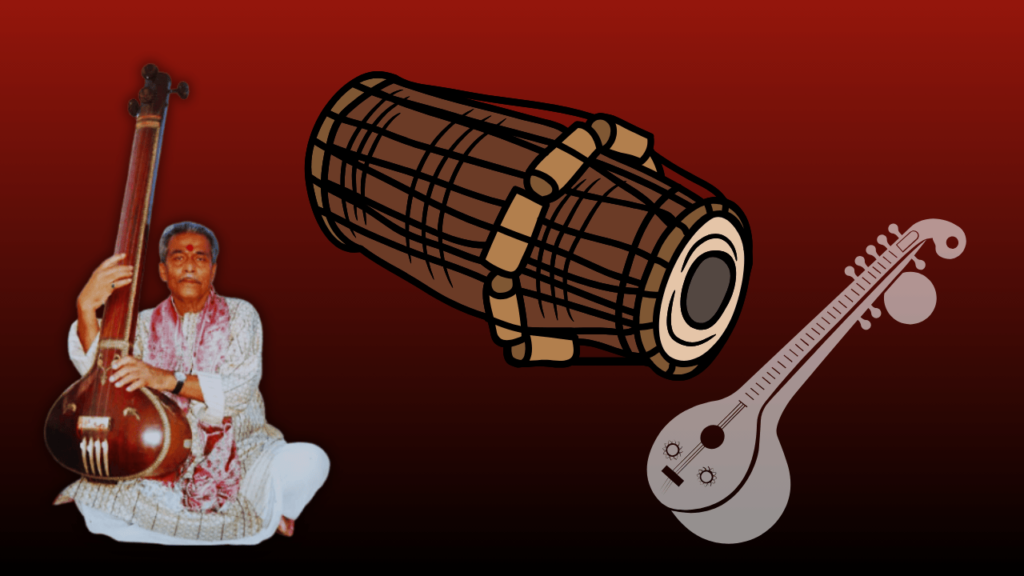
The drone instrument is called a tanpura. It is the large, guitar-like instrument with four strings. Typically one of the lead performer’s students will play it, seated behind the soloist. The strings are tuned so as to emphasize the root note of the raga, the tonic, or the shaddhaj. Tanpuras are magical instruments. When tuned properly they emit a whole rainbow of fundamentals and overtones, producing a highly complex sound field called a drone. This drone is essential for Dhrupad performance. Every note a Dhrupad performer sings or plays must either disappear into the drone or bounce back from it in a very specific way. The pitch precision of Dhrupad is only meaningful in combination with a tanpura; one needs the tanpura as a reference point for each note. Some performers also use electronic tanpuras, especially for practicing or performances where it isn’t possible to use a real instrument.
Is Dhrupad “hippie” music?
Many Westerners associate Indian classical music with Ravi Shankar and the “hippies” of the 1960s, and the attendant drug and free-love culture. This is regrettable. Most Indian classical musicians are highly disciplined people who work very hard at their art form and live a conservative lifestyle. Indeed, Ravi Shankar himself was such a disciplined musician and while he was glad that Westerners were interested in his music, he discouraged his Western students from using drugs and leading a sloppy lifestyle. This music is far too difficult to practice or perform while stoned or tripping.
Is Dhrupad a kind of meditation?
Yes it is. Listening to Dhrupad will clear your mind and body and open up you to higher levels of thinking and feeling. And it will also energize you if you listen carefully. When I hear a good Dhrupad performance I have tremendous amounts of energy for days. It is both calming and energizing. Dhrupad music is the fastest medium to trigger the chakras of your body ultimately works as a healing if sung in a right way or listened in a right way.
Manasukh Dhvani- Online music school in nepal
At manasukh Dhvani we provide the lessons for the dhrupad music also. As dhrupad directly relates to the naad yoga and it is also the sound for the heart. Our Institution is also named accordingly-“Manasukh Dhvani” means
Manasukh- Bless for the heart
Dhvani- Sound