1. Melody: The Horizontal Line
The melody is often referred to as the “tune.” It is a linear sequence of musical tones that the listener perceives as a single entity. It moves horizontally one note after another over time.
- Linearity: It is built on intervals and rhythm. When you hum or whistle a song, you are usually humming the melody.
- Focus: It is typically the “protagonist” of a song, designed to be the most memorable part.
- Construction: Melodies are often constructed from scales (like Major, Minor, or Pentatonic).
In Indian Classical Music (ICM), melody is not just a sequence of notes; it is a living, breathing entity defined by Raga. While Western melody often relies on fixed pitches and clear intervals, ICM treats the space between the notes as being just as important as the notes themselves.
Here is how melody is refined through the lens of the Eatern Classical music:
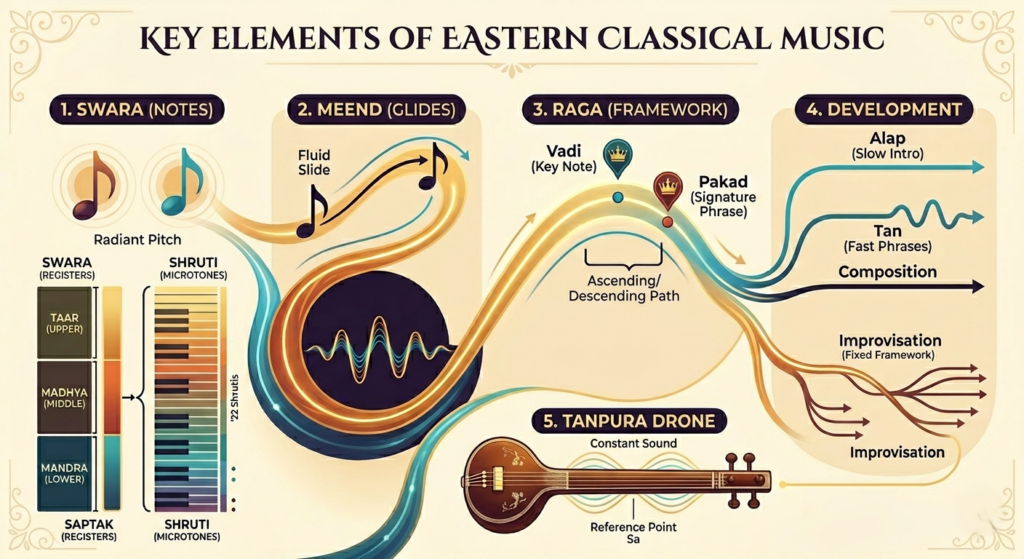
1. The Concept of Swara (Musical Note)
In ICM, a note is called a Swara. However, a Swara is rarely treated as a “flat” or static point of sound. It is seen as a radiant pitch that has its own internal resonance.
- Saptak: The melody moves through three primary registers—Mandra (lower), Madhya (middle), and Taar (upper).
- Shruti: These are the microtonal intervals. While there are 12 semitones in a scale, Indian theory identifies 22 Shrutis. A melodic line gains its unique character based on which microtonal “shade” of a note is used.
2. Meend and Gamak (The “Connective Tissue”)
The hallmark of Indian melody is its fluidity. Notes are seldom attacked in isolation; they are connected through ornaments that create a seamless curve of sound.
- Meend (Glissando): This is a smooth glide from one note to another. It ensures there is no silence or “break” between pitches, mimicking the human voice’s natural ability to slide.
- Gamak (Oscillation): This involves a fast, controlled oscillation or “shaking” of a note. In genres like Dhrupad, Gamaks are often heavy and deep, emerging from the core (the navel) to create a powerful, resonant melody.
3. The Raga: The Melodic Framework
A Raga is more than a scale; it is a melodic blueprint that dictates how a performer must move.
- Aroh and Avroh: The specific ascending and descending patterns.
- Vadi and Samvadi: The “King” and “Queen” notes. These are the most important pitches in a melody; the performer returns to them frequently to establish the Raga’s identity.
- Pakad: A short, characteristic melodic phrase that instantly identifies the Raga.
4. Melodic Development: From Alap to Bandish
The way a melody unfolds is a journey of discovery, particularly in the contemplative styles:
- Alap: This is the slow, rhythm-free introduction. The melody is explored note-by-note, focusing on resonance and the emotional “flavor” (Rasa) of the Raga.
- Tan: These are rapid melodic flourishes used in faster sections (like Khayal) to show technical brilliance.
- Bandish/Composition: This is the fixed melodic framework. Even within a fixed composition, the performer uses Vistar (expansion) to improvise around the melody, ensuring it never feels static.
5. The Role of the Tanpura
While the melody is the focus, it is always performed against the Tanpura’s drone. This isn’t just a background sound; it provides a constant reference point for the “Sa” (Tonic). This allows the listener and the performer to perceive the exact melodic relationship and tension of every single note being played.
2. Harmony: The Vertical Stack
In Indian Classical Music (ICM), harmony does not exist in the same way it does in Western classical music. Western music is largely harmonic, meaning it is built on chords and their progressions. In contrast, Indian classical music is entirely melodic and modal.
However, that doesn’t mean harmony is absent from ICM. Instead, the concepts of harmony are applied differently, often woven into the melodic structure.
Here is a breakdown of harmony, how it functions in Western music, and its distinct application in Indian Classical Music:
What Is Harmony?
Harmony is the simultaneous combination of two or more musical tones (or notes) to produce chords, chord progressions, and a sense of tonal resolution. While melody refers to the sequence of notes over time (horizontal), harmony refers to the combination of notes that occur at the same point in time (vertical).
The relationship between harmony and melody is vital in music. Think of harmony as the “vertical” dimension that supports and colors the melody, which is the “horizontal” dimension.
Harmony functions by establishing relationships between notes and chords, creating a sense of tension and release. In Western music, this is often achieved through:
- Chords: A collection of notes played simultaneously. A basic triad consists of a root note, a third, and a fifth.
- Chord Progressions: A sequence of chords that follow a specific harmonic structure (e.g., I-IV-V-I).
- Tonal Resolution: The movement from tension (a dissonant chord) to rest (a consonant chord, typically the tonic).
The Classical Approach to Harmony
The core philosophy of Indian Classical Music is melodic exploration. A single melodic line, called a Raga, forms the foundation of all musical activity. Because the music is modal, not based on fixed chord structures, the concepts of “harmony” are applied very differently.
Here’s how harmony is understood and incorporated into ICM:
1. The Tanpura: The Fundamental Drone
The most significant and omnipresent element of harmony in Indian Classical Music is the Tanpura. This four-string drone instrument is the constant vertical underpinning of the entire performance.
The Tanpura continuously sounds the tonic (Sa), the fifth (Pa, in most Ragas), and often the fourth (Ma). This drone provides a rich, harmonic context. The vocalist or instrumentalist must continuously tune their melodic line to the Tanpura’s sound, ensuring they remain “in tune” with the primary harmonic relationship.
The Tanpura doesn’t play chords. It plays a sustained interval that is the reference point for the whole piece.
2. The Interaction Between Soloist and Drone
The soloist is constantly and dynamically interacting with the Tanpura’s sound. The pitches chosen in the melody must align, resonate, and harmonize with the sustained drone. This creates a type of internal harmony, where every single melodic choice is made relative to the tonic.
For example, when a performer sings or plays the note Ga (the third), they are not just playing a single note. They are creating a harmonic interval—a major or minor third, depending on the Raga—against the drone.
3. Heterophony (Simultaneous Variation)
In ensemble settings, ICM often uses heterophony. This occurs when the main melody is simultaneously embellished or varied by other instruments or a vocal accompanist (the Samvadi).
For instance, in a vocal performance, the Samvadi (a secondary singer) will sing the same melody but with slight variations, or follow slightly behind the main melody. This simultaneous sounding of multiple versions of the same melody is a form of harmony, but a melodic, not a chordal, form.
4. The Melodic Contour of the Raga
The structure of the Raga itself has inherent harmonic implications. The rules governing ascending (Aroh) and descending (Avroh) melodic lines, the dominant (Vadi) and subdominant (Samvadi) notes, and the core phrases (Pakad) all ensure that the melody remains tonally consistent. This is, in effect, a highly sophisticated form of harmonic regulation.
5. Rhythm as a Form of “Harmonic” Structure
While rhythm is distinct from pitch, the repetitive, cyclical nature of Indian rhythmic cycles (like Tala) acts as a unifying structure that can be thought of as akin to a harmonic framework in Western music. Tala provides a “time-structure” that the melody and harmony must navigate and align with.
Fusion and Modern Applications
In modern times, musicians have experimented with integrating Western harmony into Indian classical frameworks, leading to a vibrant fusion of styles.
Artists like Ravi Shankar explored this space, collaborating with Western classical orchestras. In fusion music, Indian instruments like the sitar and tabla might interact with a Western string section or a jazz combo, where Western harmonic principles are overlaid onto Indian melodic improvisations.
Furthermore, some modern composition within Indian light classical and contemporary music utilizes keyboard and guitar accompaniment that plays chords, creating a harmonic bed for the Raga-based melody.
Comparison Table: Western vs. Indian Harmony
| Feature | Western Classical Harmony | Indian Classical Harmony |
|---|---|---|
| Foundation | Chords and chord progressions. | Melody and Raga. |
| Drone | Rarely, if ever, used. | Omnipresent Tanpura. |
| Orientation | Vertical (notes stacked simultaneously). | Melodic/Modal (focused on the horizontal line). |
| Texture | Homophony or Polyphony. | Monophony or Heterophony (against a drone). |
| Function | Creates tonal resolution (tension/release). | Focuses on microtonal shading and internal resonance. |