Introduction
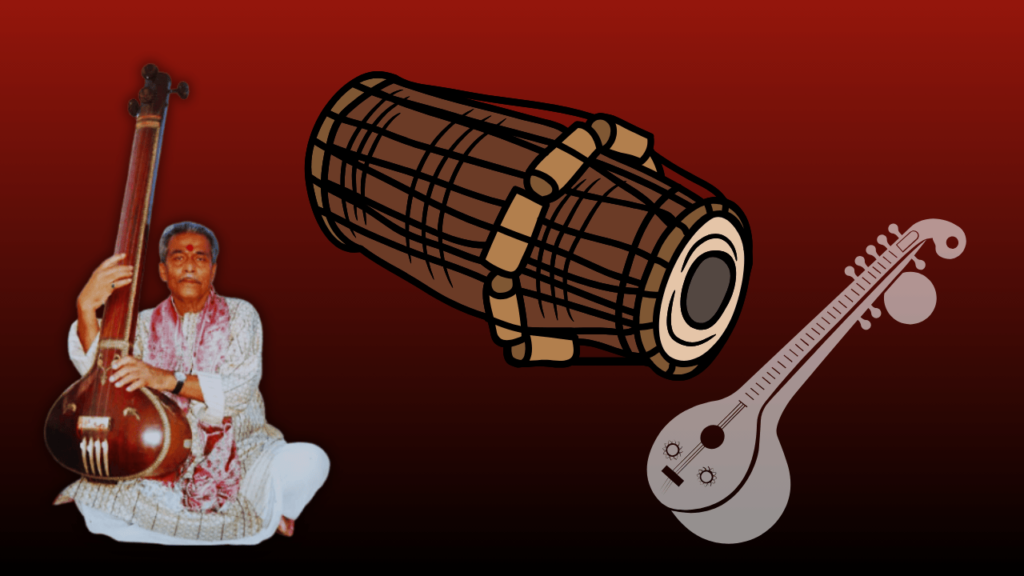
Dhrupad music is one of the oldest and most abundant styles of Hindustani classical music. It finds mention in the Natya Shastra of Bharata Muni (200 BC–200 AD). The traditional male singing style is prevalent to date. The music, originally composed in Sanskrit, is now frequently sung in Braj Bhasa. This Eastern Indian language was spoken in the Middle Ages and combined North and East Indian languages. The accompanying musical instruments are Pakhawaj and a Tampura.
What is Dhrupad Music?

Dhrupad is a chanting or worshipping style in which a vocalist prays to the Lord using Nada or sounds. Dhrupad music uses sound to highlight the raga’s purity. The preferred language for this music style, Brij Bhasha, was replaced by Sanskrit in the middle of the 12th through the 16th centuries.
This type of devotional music has its roots in the old Sama Vedic literature. Samgana, a rhythm and melody, was used to chant this book. From the same root, vocal genres like Prabandha and Chhanda evolved. Drupad emerged because of the powerful metre and verse of these vocal styles.
Dhrupad is monophonic and modal, having a single melodic line and no harmonic elements, like other classical Indian vocal music. Raga is the name given to the modes, and each raga is a complex system of melodic laws.
Dhrupad music is sung by a single vocalist or a small group of singers in unison to the beat of a mridangam, pakhawaj, or barrel drum. A sitar may also be used as an accompaniment. The majority of the songs are religious adorations of Hindu deities.
| Genre | Hindustani classical music. |
| Form | Devotional and meditative form of music |
| Origin | Its origin can be traced back to ancient text Samveda |
| Originator | Tansen |
| Musical Instruments | Tanpura, Pakhawaj, Rudra Veena |
| Purpose | The purpose of the Dhrupad music is to worship. |
| Major Gharanas | Darbhanga Gharana, Dagar Gharana ,Bettiah Gharana, Talwandi Gharana. |
History and Evolution of Dhrupad Music
The Sanskrit words “Dhruvapada,” which means “structured/unmoving,” and “pada,” which means word or poem, are combined to make the Hindi word “Dhrupad.” The oldest classical music in Indian history is allegedly dhrupad music.
The singing of hymns and mantras, a component of Sam Veda’s Gandharva Veda, can be linked to the genesis of Dhrupad music. Samgana, the initial name for the melodic and rhythmic chanting of the Sam Veda hymns, later evolved into Prabandha and Chhanda, which came together to become Dhrupad.
The modern form of Dhrupad music, as we know it today, has been traced to the Bhakti movement and was devotional. This led to the evolution of devotional music, sung in the temples and termed Haveli Dhrupad/ Sangeet, sung in Sanskrit in Vaishnava temples across the North Indian subcontinent.
Its survival in the medieval period can be attributed to the support of the Mughal and Rajput kings. The music art has continued to survive the onslaught of times, and its Haveli and Darbari form performances can be seen in concerts.
Effectiveness of dhrupad by reading sheet
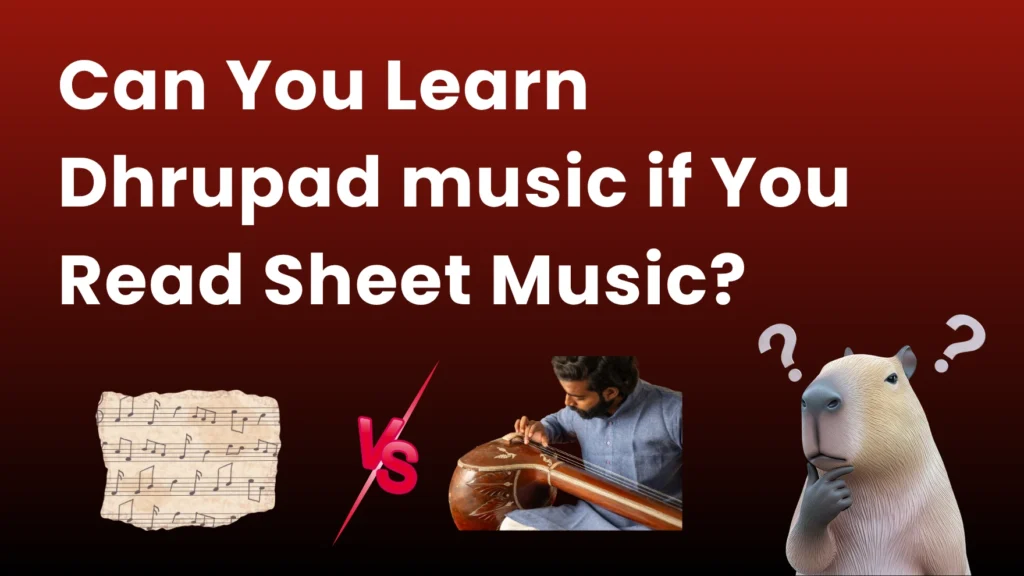
You cannot effectively learn Dhrupad from traditional Western sheet music. Dhrupad relies on an oral tradition, microtonal scales (just intonation), and fluid ornamentation (gamak/meend) that cannot be captured on a Western staff.
Why Sheet Music Fails for Dhrupad
- Microtones: Western notation is built on an equal-tempered \(12\)-tone scale, while Dhrupad utilizes microtonal shifts (e.g., in a \(22\)-shruti system) to establish the mood of a Raga.
- Fluid Embellishment: The signature meend (slow glissando) and heavy oscillations require listening and muscle memory, not rigid notes.
- No Metronomic Meter: Rhythmic cycles (talas) like Dhamar (14 beats) or Chautal (12 beats) pulse in cycles rather than measures, evolving organically in density (dugun, tigun).
The Unlearning Process
Transitioning from Western notation to Dhrupad requires a total shift in how you process music:
- The Guru-Shishya Tradition: You must learn by imitating a teacher. The tradition depends heavily on active listening and vocalizing.
- Sargam: Instead of reading C-D-E-F, you will use Indian solfège syllables ((Sa, Re, Ga, Ma, Pa, Dha, Ni)).
- Singing from Within: Reading music anchors you to the visual page. To play Dhrupad, you must close your eyes, internalize the tonic drone (usually played on a Tanpura), and learn to improvise within the strict structural rules of the Raga.
Learning as process of guru shisya parampara

The teaching of Dhrupad is very closely tied to the ancient system of guru-shishya parampara (the teacher-disciple tradition). This is an oral tradition that dates back thousands of years. The students lived in the home of their Guru and devoted themselves to riyaz (practice) of music. The lives of students were focused on learning music and helping with the household chores of their teacher. The teacher could supervise the students all the time and provide guidance.
The music was taught orally, with teacher singing a phrase and students repeating it until they perfected it. Thus, the learning of Dhrupad music does not involve transcribing the teaching. The leading Dhrupad Ustads strongly believe, as did their ancestors, that learning of music is not possible through text books.
Due to its strict adherence to purity, learning Dhrupad is very difficult. It takes years of rigorous and painstaking practice, involving many hours (8 to 12) of singing everyday, before a Dhrupad student can reach a stage when he will be ready to perform competently. These early years of total devotion to learning also mean total financial dependence, as the student does not have the time to earn a living. In the past, the teacher took care of the needs of students, so that they could commit themselves completely to the study of music. The Guru, in turn, was provided for by the King.
This royal patronage led to the preservation of guru-shishya parampara for centuries, until the abolition of the princely states in India in 1947. In effect, the disappearance of the royal system also led to a decline in the support for Dhrupad music. Great artists were suddenly faced with financial hardship and were left with no support. The guru-shishya parampara was severely impacted by this turn of events. The central and state governments in India are belatedly making limited efforts to revive this tradition.
As the guru-shisya parampara depends upon oral transmission of information, if there is no one to transfer the information, the musical tradition, that is thousands of years old, might simply disappear.
Learn dhrupad online
Experience the profound depths of India’s oldest classical music tradition from the comfort of your home. At Mansukh Dhvni, we bridge ancient wisdom with modern convenience, offering authentic online training in the sacred art of Dhrupad.
The Traditional, Sheet-Free Way
True Dhrupad cannot be captured on paper. Following the sacred Guru-Shishya Parampara (teacher-disciple lineage), our courses strictly avoid sheet music. Instead, you will learn through the traditional oral method: listening, internalizing, and echoing. This direct vocal transmission forces you to look inward, training your ears to catch microtonal nuances (shrutis) and deep resonance that notation completely misses.
Mastery Through Online Learning
Distance is no longer a barrier to authentic learning. Our specialized online curriculum is optimized for digital platforms, ensuring clear audio transmission for real-time guidance. Through structured interactive sessions, we train your breath control, voice culture, and pitch accuracy. We empower you to confidently sing, improvise, and sustain the meditative Alap through virtual means, proving that soulful connection transcends physical space.
Our Unique Approach
Manasukh Dhvani offers a distinct learning experience rooted in Nada Yoga (the yoga of sound). We do not just teach melodies; we teach you how to treat sound as a meditative tool. Our unique methodology focuses on:
- Deep Voice Culture: Developing lower-register resonance (Kharaj Sadhana).
- Microtonal Precision: Mastering the precise emotional spaces between notes.
- Rhythmic Flow: Internalizing complex spiritual rhythms (Talas) like Chautal and Dhamar organically without mechanical counting.