If you’ve ever sat cross-legged on a cushion, trying desperately to silence the mental chatter only to find yourself mentally drafting grocery lists or replaying awkward conversations you’re not alone. Silent meditation can feel like wrestling a hyperactive puppy. But what if I told you there’s an ancient Himalayan practice that makes mindfulness unavoidable? Enter Dhrupad meditation: the 2,000-year-old secret that uses your own voice as a direct pathway to inner stillness.
Dhrupad isn’t just music. It’s audible yoga what ancient practitioners called Nada Yoga, or the yoga of sound. While Western wellness circles have embraced silent meditation, many seekers struggle with the “blank mind” requirement. Dhrupad offers something different: instead of fighting your thoughts, you become the sound. Your voice transforms into a meditation tool, guiding you into states of peace that silent sitting can only dream of.
By the end of this article, you’ll understand how these sacred vocal practices can realign your nervous system, quiet anxiety, and unlock creative flow—all backed by modern neuroscience.
The Science of Sound: How Dhrupad Rewires the Brain
Here’s where ancient wisdom meets modern research. When you practice Dhrupad singing, something remarkable happens in your body. The deep, resonant tones produced from your navel (what yogis call Nabhi) create vibrations that directly stimulate your vagus nerve.
The vagus nerve is like your body’s relaxation superhighway. This nerve helps the body regulate stress responses and is the mechanism by which we can positively influence our health through meditation. When you sing with proper breath support from your diaphragm as Dhrupad requires slow and diaphragmatic breathing increases parasympathetic nervous system activity, which shifts the balance toward relaxation.
Translation? Your heart rate slows. Cortisol (the stress hormone) drops. Blood pressure normalizes. All from making sound.
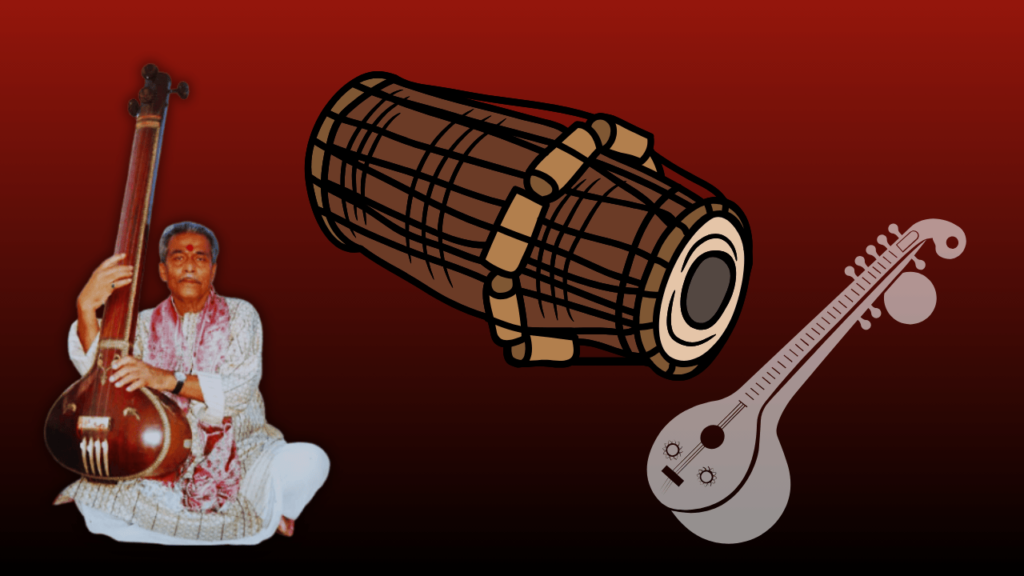
But it gets better. The continuous drone of the Tanpura (the four-stringed instrument that accompanies Dhrupad) creates a sonic blanket that encourages your brain to produce alpha brain waves. Alpha waves signal your brain is in a balanced state of calm and alertness, often called the flow state. This is the same brainwave pattern found in experienced meditators except you’re reaching it through sound, not silence.
Think of it this way: Silent meditation asks you to fight against your nature. Dhrupad works with your body’s design. Your vocal cords, your breath, your entire nervous system they’re all instruments waiting to be played.
Quick Science Summary:
- Deep belly breathing activates your parasympathetic system (rest & digest mode)
- Vocal vibrations massage your vagus nerve from the inside
- Tanpura drones sync your brainwaves to 8-12 Hz (alpha state)
- Result: Forced calm without the mental wrestling match
Why “Active” Meditation Works Better for Modern Minds
Let’s be honest: our brains weren’t designed for the Instagram age. We check our phones 96 times per day. We juggle twelve browser tabs. We’re caffeinated, over-scheduled, and chronically distracted. Asking this kind of mind to “just be still” is like asking a toddler to sit through a five-hour opera.
This is where Dhrupad meditation becomes genius.
Instead of passive observation, Dhrupad demands active participation. You must focus on microtones the subtle pitch variations between notes called Shrutis in Indian music. There are 22 of these microtonal steps in an octave (compared to 12 in Western music). Finding and holding these precise frequencies requires such intense concentration that anxiety, worry, and that embarrassing thing you said in 2014 simply have no room in your awareness.
This is what psychologists call “forced mindfulness.” You’re not trying to empty your mind; you’re filling it so completely with sound that nothing else can squeeze in.
The alap—the improvisational opening of Dhrupad starts from the navel region and moves upward through the throat to the palate, unfolding through the chakras. As you navigate these ancient tonal pathways, your attention becomes laser-focused on the present moment. The past and future dissolve. You’re left with only now, only this breath, only this tone.
Athletes call this “the zone.” Musicians call it “flow.” Dhrupad practitioners have been accessing it for millennia.
Why Active Beats Passive:
- Gives your monkey mind a job (finding the right pitch)
- Creates immediate feedback (you hear when you’re distracted)
- Engages your body physically (breath, posture, sound production)
- Produces tangible results (your voice improves, range expands)
- Makes mindfulness unavoidable, not aspirational
The Himalayan Connection: Dhrupad’s Spiritual Roots in Nepal
Here’s something most wellness articles won’t tell you: not all lineages are created equal.
Dhrupad is the oldest surviving form of Indian Classical music and traces its origin to the chanting of Vedic hymns and mantras. But while this sacred art flourished in the royal courts of India, it has been preserved with particular purity in the Himalayan temples and monasteries of Nepal.
Why does altitude matter? In the thin mountain air, breath becomes precious. Every inhalation is intentional. Himalayan practitioners developed breath control techniques (Pranayama) out of necessity, which then deepened their mastery of Nada Yoga. The result is a tradition that emphasizes inner resonance over external performance sound as spiritual practice, not entertainment.
Learning from a living Parampara (lineage) is fundamentally different from cobbling together YouTube tutorials. Dhrupad singing requires intense practice and mastery of nada yoga to produce vast combinations of notes and tones by flowing sound freely along the navel-to-head axis. This knowledge isn’t transmitted through videos it’s passed guru to student, breath to breath, over years of dedicated practice.
Nepal’s spiritual ecosystem with its unique blend of Hindu and Buddhist traditions, its Vedic Sanskrit roots, and its high-altitude monasteries has created ideal conditions for preserving this ancient wisdom in its most authentic form.
The Nepal Advantage:
- Unbroken lineage preserved in Himalayan temples
- Emphasis on meditation over performance
- High-altitude breath mastery techniques
- Authentic guru-disciple transmission
- Blend of Hindu and Buddhist sound practices
- Quieter, less commercialized teaching environment
A Simple 5-Minute Dhrupad Practice You Can Try Now
Enough theory. Let’s get practical. Here’s a beginner-friendly Om chanting exercise rooted in Dhrupad principles. No musical experience required—just your voice and five minutes.
The Practice: Sacred Om (Aum)
Step 1: Posture Sit with your spine straight. If you’re on the floor, use a cushion to elevate your hips above your knees. If you’re in a chair, plant both feet flat. Roll your shoulders back and imagine a string gently pulling the crown of your head toward the ceiling. Close your eyes or soften your gaze downward.
Step 2: Breath Place one hand on your belly, just below your navel. Take a deep breath through your nose, feeling your belly expand like a balloon. (Your chest should barely move—we’re breathing with the diaphragm, not the shoulders.) Exhale slowly through your mouth. Repeat three times, slowing your breath each cycle.
Step 3: Sound – The “Aum” Transition Now we’ll chant Om, but as the complete syllable “Aum” with three distinct phases:
- A (ah) – Start from your belly. Feel the vibration in your lower abdomen.
- U (oo) – Let the sound rise to your chest and throat. Feel your ribcage vibrate.
- M (mmm) – Close your lips and hum. Feel the vibration in your skull, between your eyebrows.
The entire Aum should last 15-20 seconds. Use one full breath. Don’t rush.
Repeat this cycle 5-7 times. Each time, try to extend the sound a little longer. Notice how the vibration travels through your body like a wave.
Pro Tip: Focus on the vibration in your chest, not just the sound in your ears. Where you feel the resonance matters more than how you sound. Nobody’s grading you here.
Step 4: Silence After your final Om, sit in silence for 2-3 minutes. Notice the ringing sensation in your ears (yogis call this Nada Anusandhana, or “inner sound investigation”). This subtle after-sound is your doorway into deep meditation.
Congratulations you just practiced Nada Yoga, the foundation of Dhrupad.
Who is Dhrupad For? (It’s Not Just for Singers)
“But I can’t sing!”
Good. Perfect, actually.
Dhrupad for mindfulness isn’t about hitting perfect notes or impressing an audience. Many Dhrupad performers make the point that they do not perform to entertain the audience; their singing is more a never-ending quest toward the Godhead. This is about internal resonance, not external performance.
You don’t need:
- A “good voice” (whatever that means)
- Musical training or ability to read notation
- Perfect pitch or prior singing experience
- To perform for anyone (this is personal practice)
You do need:
- Willingness to make sound without judgment
- Patience to work with your breath
- Curiosity about your inner sonic landscape
- A private space where you can practice freely
Dhrupad mindfulness is perfect for:
- Meditation strugglers who can’t quiet their minds with silence
- Yoga practitioners seeking to deepen breath awareness (Pranayama)
- Stressed professionals needing accessible nervous system regulation
- Creative types experiencing blocks (writers, artists, designers)
- Voice workers (teachers, speakers, singers) wanting vocal health
- Wellness seekers interested in sound healing but skeptical of woo-woo claims
- Anyone who finds traditional meditation boring or frustrating
Think of your voice as a tuning fork for your entire being. When you align your vocal vibrations with ancient tonal frequencies, your whole system physical, mental, emotional begins to harmonize. You’re not learning to sing; you’re learning to resonate.
And here’s the beautiful irony: when you stop trying to sound good and start focusing on feeling the vibrations, your voice naturally improves. Stress-induced vocal tension melts away. Breath capacity expands. You discover resonant spaces in your body you never knew existed.
Conclusion: The Bridge Between Music and Meditation
Dhrupad meditation offers something rare in our distracted world: a practice that works with your nature rather than against it. It doesn’t demand superhuman concentration or monk-like stillness. It simply asks you to breathe, to sound, to feel.
The ancient Himalayan masters understood something neuroscience is only now confirming: sound-based practices like meditation and deep breathing can stimulate the vagus nerve, activating the parasympathetic nervous system and leading to a state of relaxation and calm. They didn’t need brain scans to know that sacred tones could heal trauma, dissolve anxiety, and open doorways to transcendent states.
Whether you’re a seasoned meditator looking to deepen your practice, a stressed-out modern human desperate for relief, or a curious soul drawn to ancient wisdom Dhrupad offers a path.
Not the path of silent asceticism. Not the path of rigid discipline. But the path of becoming sound itself.
Ready to Find Your True Voice?
Discover authentic Dhrupad from the Himalayas with Manasukh Dhvani Nepal’s premier music school preserving this ancient tradition.
Located in the spiritual and cultural heart of Na: Tole, Patan, Lalitpur, we offer:
- 1-to-1 Online Private Classes in Dhrupad vocal technique and Nada Yoga
- Group & Private In-Person Sessions for immersive learning
- Traditional vocal training in Indian classical music
- Instrumental classes (tabla, violin, drums, and more)
- Guidance from lineage-trained instructors
Whether you’re seeking stress relief, creative awakening, or spiritual depth, our gurus will meet you exactly where you are—no musical experience required.
Join our global community of students learning authentic sound healing practices rooted in Himalayan wisdom.
Book Your Free Discovery Call Today: manasukhdhvani@gmail.com
Explore Our Programs: dhvani.manasukh.com
Your journey from noise to Nada begins with a single Om.