By the third day, most travelers in Kathmandu reach the same quiet moment.
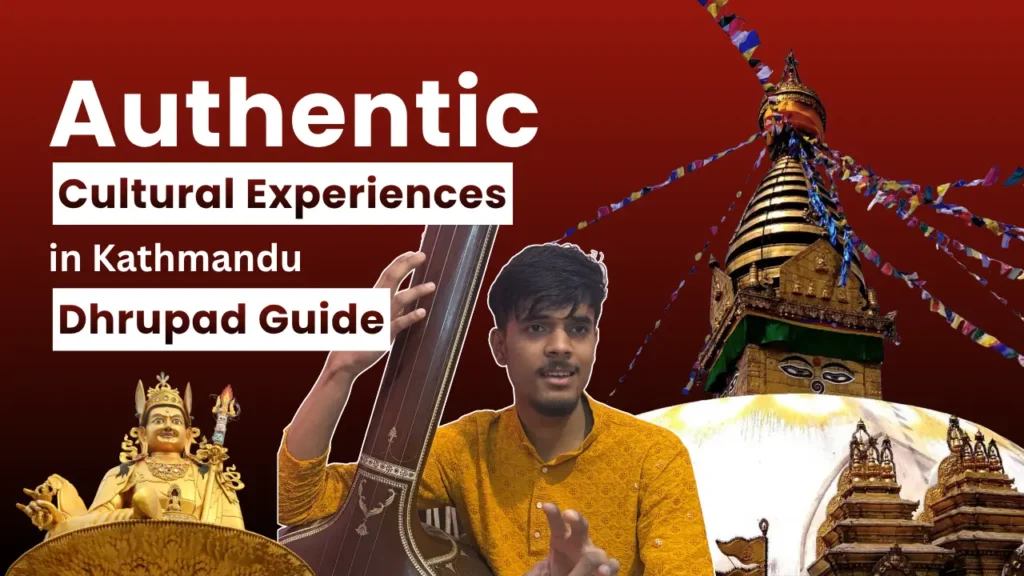
They’ve climbed the 365 steps to Swayambhunath and watched the prayer flags cut across the valley haze. They’ve stood in the smoke at Pashupatinath, close enough to the Bagmati River to understand why it’s sacred. They’ve walked Boudhanath’s kora at sunset with a thousand strangers moving in the same slow circle. They’ve wandered Kathmandu Durbar Square, camera full, feet tired.
And then, somewhere between a rooftop coffee and a look at the map for tomorrow, a different question shows up: I’ve seen so much of this place. But have I actually connected with it?
That question is the real starting point of this guide. Not “what should I see in Kathmandu,” but “what should I feel.” Because the truth is, Nepal’s richest cultural experiences were never only in its architecture. They’re in its sound: in centuries-old chants, temple drums, court music, and one particular tradition that very few travelers ever get to sit inside of, called Dhrupad.
This guide is long on purpose. It’s built to answer every real question a curious traveler has about authentic cultural experiences in Kathmandu, and specifically, about Dhrupad: what it is, where it truly comes from, what the science says about its effects, and how you can experience it yourself.
1. Why Modern Travelers Are Looking for Authentic Experiences Instead of Tourist Attractions
Something has shifted in how people travel. It didn’t happen overnight, but by 2026 it’s unmistakable: travelers are tired of ticking boxes.
The rise of slow travel. Slow travel means spending real time in fewer places instead of racing through a checklist. Instead of “seven cities in seven days,” it’s “one neighborhood, understood properly.” Kathmandu rewards this approach unusually well, because its meaning lives in details: a courtyard shrine, a drum rhythm drifting from a temple, a conversation with a shopkeeper who remembers the 2015 earthquake.
The rise of transformational travel. Where older travel marketing sold relaxation, a newer generation of travelers is explicitly searching for trips that change them, even a little. They want to return home slightly different than when they left: calmer, more aware, more grounded. This is a measurable shift in what people search for and book, not just a marketing buzzword.
The rise of creative and cultural tourism. Instead of watching culture from behind a rope, travelers increasingly want to participate in it: a cooking class instead of a restaurant review, a pottery wheel instead of a museum case, a music lesson instead of a concert ticket. UNESCO itself has long recognized that living traditions, oral histories, performing arts, and craftsmanship are as much “heritage” as stone monuments; Kathmandu Valley’s own UNESCO inscription explicitly credits the cultural traditions of its people, not just its buildings, for its outstanding value.
Overtourism fatigue is real. Kathmandu’s major heritage sites, while genuinely extraordinary, can feel crowded and rehearsed during peak season, with fixed entry fees, repeated guide scripts, and long queues at photo spots. None of this makes the sites less worth visiting. It simply means many travelers now actively look for a second layer of experience alongside the well-known stops, something quieter, smaller, and closer to how locals actually engage with their own culture.
Quick definition box: Slow travel is a travel philosophy that favors depth over speed, prioritizing longer stays, local connection, and mindful pacing over covering the maximum number of sights in minimum time.
This is exactly the gap that a living musical tradition like Dhrupad quietly fills, not as a replacement for the temples and stupas, but as the missing “felt” layer underneath everything you’ve already seen.
2. What Is Dhrupad?
Dhrupad (pronounced “dhroo-pad”) is the oldest surviving vocal style of Hindustani (North Indian) classical music. Where most music you’ve heard is built around melody plus rhythm plus lyrics moving together fairly quickly, Dhrupad strips things down and slows things down. It opens with a long, unaccompanied, wordless exploration of a single melodic scale, called a raga, before rhythm or words even enter. This section is called the alap.
The word itself
“Dhrupad” comes from two Sanskrit words: dhruva, meaning fixed or unmoving, and pada, meaning verse or word. Put together, it roughly means “the fixed composition,” a reference to its structured, unornamented poetic verses, in contrast to the more improvisational lyrics of later styles.
The core instruments
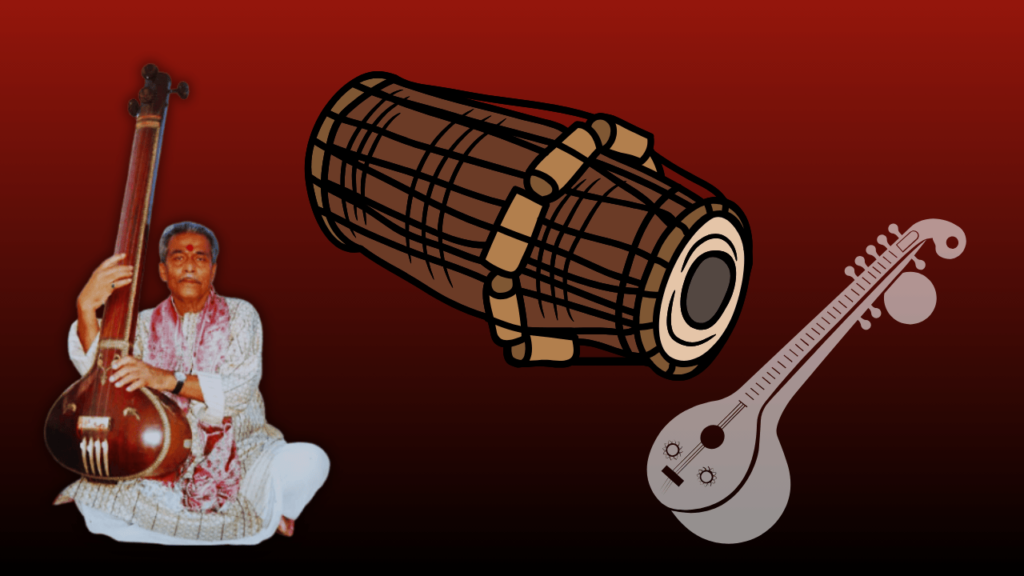
- Tanpura: A long-necked, four-to-six-stringed drone instrument. It doesn’t play a melody; it plays one continuous, humming chord that anchors every note the singer sings. Many listeners say this drone alone is enough to shift their mood within minutes.
- Pakhawaj: A two-headed barrel drum, older and deeper in tone than the tabla used in most other Indian classical styles. It enters only once the alap has fully unfolded.
- The human voice, treated less like an instrument for entertainment and more like a vehicle for sustained, resonant sound.
Nada Yoga and the philosophy behind the sound
Dhrupad’s foundational idea comes from a concept called Nada Yoga, the yoga of sound. In this framework, sound itself, particularly sustained, resonant, “unstruck” sound, is treated as a pathway to focused awareness and inner stillness. This is a philosophical and traditional framework, not a scientific claim, and it’s worth being precise about that distinction. Practitioners describe singing or listening to Dhrupad as closer to meditation than performance; the goal isn’t applause, it’s presence.
The Guru-Shishya tradition
Dhrupad has historically been transmitted almost entirely through Guru-Shishya Parampara, the direct teacher-to-student lineage system, rather than through written notation or classroom instruction. A student doesn’t just learn notes; they absorb the specific tone, pacing, and interpretive choices of their teacher over years of close, often daily, practice. Several living “gharanas” (lineage schools), such as the Dagarbani and Darbhanga traditions, each carry slightly different stylistic signatures passed down this way for generations.
How listening to Dhrupad differs from listening to modern music
| Modern / Popular Music | Dhrupad | |
|---|---|---|
| Typical song length | 2–5 minutes | 20–60+ minutes per raga |
| Structure | Verse-chorus, fast pacing | Slow unfolding: alap → rhythm → composition |
| Lyrics | Central, fast-changing | Minimal, often just a few fixed lines |
| Purpose | Entertainment, emotional hook | Meditative absorption, sustained attention |
| Listener’s role | Passive consumption | Active, quiet presence |
You don’t need to “understand” ragas to feel the effect of a Dhrupad session, the same way you don’t need to understand fluid dynamics to enjoy the sound of a river. It works on you regardless of your musical background.
3. Did Dhrupad Really Begin in the Vedas?
This is one of the most repeated claims about Dhrupad, and also one of the most misunderstood. A careful, honest answer requires separating historically supported facts from traditional belief and oral history, because both exist here, and conflating them does a disservice to a genuinely rich tradition.
What is traditionally believed
Across most Dhrupad schools, teachers describe the tradition’s origin as follows: the Sama Veda, one of the four Vedas of Hindu scripture, composed roughly 1500–500 BCE, was chanted aloud by priests using a specific melodic and rhythmic method called Samagana. This chanting style is said to have evolved, over many centuries, into Chhanda (poetic meter) and Prabandha (structured song forms), which eventually combined into what we now call Dhrupad.
What historical records actually support
- The Sama Veda and Samagana are real and well-documented. Vedic priests genuinely chanted using fixed melodic patterns, prioritizing precision over personal expression, a discipline that does philosophically echo Dhrupad’s values.
- “Dhruva” songs appear in the Natya Shastra, Bharata Muni’s treatise on performing arts, dated roughly 200 BCE to 200 CE. These were fixed compositions used to mark scenes in Sanskrit drama, which is very plausibly the etymological root of the word “Dhrupad.”
- Prabandha forms are documented in the Sangita Ratnakara (13th century CE), written by Sarangadeva, who catalogued around 260 types, including a sub-type called Saalag Suda Prabandha, widely considered the direct structural ancestor of Dhrupad’s format.
- The earliest text to actually name a genre called “Dhrupad” is the Ain-i-Akbari (1593 CE), written by the Mughal court historian Abu’l-Fazl. Notably, it describes Dhrupad as a “desi” (regional, contemporary) form, not an ancient, unchanging “margi” (classical/divine) one.
- Most modern musicologists, including Ritwik Sanyal (a Dhrupad performer and scholar at Banaras Hindu University) and Richard Widdess (SOAS, University of London), conclude that Dhrupad as a defined, structured genre took shape in the royal court of Raja Man Singh Tomar of Gwalior, who reigned from 1486 to 1516 CE. Sitar maestro Ravi Shankar stated the same in his autobiography.
Where historical evidence and tradition diverge
Definition box: Historical evidence means claims supported by dated, cross-referenced written records. Oral or traditional belief means claims passed down through teaching lineages, valued for their spiritual and cultural meaning even without documentary proof.
The honest picture: there is roughly a 2,000-year gap between the Sama Veda’s composition and the first confirmed appearance of Dhrupad as a named genre in the historical record. That gap doesn’t make the Vedic connection false, it makes it philosophical and evolutionary rather than direct and unbroken. Think of it less like “Vedic priests literally performed Dhrupad” and more like “Dhrupad is the great-great-grandchild of Vedic chanting philosophy, formally born five centuries ago in a royal court, then matured through temple devotion and imperial patronage.”
Simple timeline
| Period | Development |
|---|---|
| 1500–500 BCE | Sama Veda composed; chanted via Samagana |
| 200 BCE – 200 CE | Natya Shastra documents “Dhruva” fixed songs |
| 13th century CE | Sangita Ratnakara catalogues Prabandha forms, incl. Saalag Suda |
| 1486–1516 CE | Raja Man Singh Tomar’s Gwalior court structures Dhrupad as a genre |
| 1593 CE | Ain-i-Akbari is the first text to name “Dhrupad,” calling it new/regional |
| 1500s onward | Bhakti movement spreads devotional Haveli Dhrupad in temples |
| 1600s–1700s | Tansen’s lineage carries Dhrupad into the Mughal court |
| 20th–21st century | Preserved through gharanas like Dagarbani and Darbhanga |
In short: the philosophy is ancient. The genre, as performed today, is medieval. Both facts can, and should, be told together.
4. Why Nepal Is an Unexpected Destination for Dhrupad Lovers
Most travelers assume Indian classical music “belongs” only in India. Kathmandu Valley’s own history quietly disagrees.
A valley shaped by musical royal courts, too
During the Malla dynasty (1201–1769 CE), the three kingdoms of the Kathmandu Valley, Kathmandu, Patan, and Bhaktapur, developed one of the most musically sophisticated court cultures in the Himalayas. Malla kings weren’t just patrons; several were composers and musicologists themselves. King Jagatjyoti Malla of Bhaktapur, for instance, is credited with writing or commissioning at least five treatises on music theory, including the manuscript Sangit Chandra Grantha, and with initiating the valley’s own raga-based devotional music tradition.
Dapha music: the valley’s own classical raga tradition
The Newar community, indigenous to the Kathmandu Valley, developed a classical devotional musical form called Dapha, built on the same raga-and-tala (melody-and-rhythm) framework found in North Indian classical music, but performed in temple courtyards by community groups called Dapha Khalah, often tied to traditional guthi (trust) organizations. Certain ragas are still performed only at specific times of day or specific seasons, a scheduling discipline that closely parallels how Hindustani classical music, including Dhrupad, assigns ragas to particular times.
A genuine cross-cultural corridor
The Kathmandu Valley sat directly on the historic trade route between India and Tibet. This geography meant centuries of exchange: Sanskrit musical treatises like the Natya Shastra and Sangita Ratnakara were studied and copied by Newar scholars, Maithil Brahmin priests brought devotional musical traditions from the Mithila region when they settled in the valley under Malla patronage, and Vajrayana Buddhist chant traditions layered in influences from Tibet. Ethnomusicologists studying the valley describe its musical culture as one of the most layered and complex in the Himalayas, precisely because of this centuries-long absorption of outside influence.
Modern preservation efforts
This heritage is fragile. Newar music researchers note that dozens of traditional performing groups have declined sharply since the mid-20th century under pressure from urbanization and changing lifestyles. In response, institutions like Kathmandu University’s Department of Music (established 1996 in Bhaktapur) and independent schools across the valley now work specifically to document, teach, and sustain both indigenous Newar music and the broader North Indian classical tradition, including Dhrupad, ensuring it survives as a living practice rather than a museum record.
The takeaway for travelers: experiencing Dhrupad in Kathmandu isn’t culturally out of place. You’re in a valley whose own royal courts once obsessed over exactly this kind of music, and whose Newar musicians still perform their own parallel raga tradition in temple courtyards today.
5. What Happens During a Dhrupad Experience?
If you’ve never sat through a live Dhrupad session, here is, step by step, what to genuinely expect. No jargon assumed.
Arrival. You take off your shoes at the door. The room is usually simple: cushions on the floor, low light, no stage. This alone resets your posture, both literal and mental.
Tea and a quiet welcome. Most sessions begin with a short, unhurried conversation, sometimes over tea. There’s no rush to “start the show.” This slowness is intentional, not a delay.
The tanpura begins. Before any singing starts, the drone instrument is tuned and set humming. It will continue, unbroken, for the entire session. Within a few minutes, most first-timers notice their breathing has already slowed slightly, an effect of steady, low-frequency sound on the nervous system that we’ll unpack in the next section.
A few minutes of guided stillness. Some teachers invite you to simply close your eyes and breathe with the drone before any melody begins, a short, informal way of settling attention.
Alap: the slow unfolding. The singer begins exploring the raga, note by note, with no fixed rhythm yet. This can last anywhere from 5 to 20 minutes in an introductory session (and far longer in a full traditional performance). There are no lyrics yet, just long, sustained vowel sounds moving through the scale.
The pakhawaj enters. Rhythm arrives, along with structured verses, often in Sanskrit or Brij Bhasha. The tempo is still unhurried by pop-music standards, but the shift in energy is noticeable.
Simple participation, if you want it. Many introductory sessions invite visitors to try humming along with the drone note, or to attempt a very basic sustained tone themselves. No prior training is expected or required.
A quiet ending, not applause. Traditional Dhrupad performances often close in silence rather than a rousing finish. This is one of the most commented-on aspects by first-time listeners: the absence of the “big finish” you’d expect from Western concert culture is, itself, part of the experience.
Reflection and questions. Afterward, there’s usually space to ask questions, about the raga, the instruments, the history, or simply to sit with what you just experienced before heading back out into the city.
Featured snippet box: How long does a Dhrupad session last? An introductory Dhrupad session for travelers typically lasts 45 minutes to 1 hour. A full traditional performance can run 1.5 to 3 hours, and short retreat-style programs may include multiple 1–2 hour sessions across several days.
6. What Is Raga Healing?
“Raga healing” (sometimes called Raga Chikitsa in traditional Indian sources) is the idea that specific melodic scales in Indian classical music can influence mood, attention, and physiological relaxation when listened to attentively. It’s an old concept with a growing body of modern scientific interest behind it.
Important disclaimer up front: Raga healing is not a medical treatment, and it should never replace professional medical or psychological care. What follows is a summary of published research on music’s measurable effects on the body, not a therapeutic claim about Dhrupad or any specific raga curing any condition.
What the research actually shows
- A 2024 study published in Scientific Reports (Nature) found that participants who listened to raga Bhairavi over six days showed significant reductions in self-reported anxiety, stress, and depression scores, along with measurable improvements in heart rate variability (HRV), a recognized marker of autonomic nervous system balance and physiological relaxation.
- A randomized controlled trial published in the Indian Journal of Physiology and Pharmacology examined the short-term cardiovascular effects of passively listening to a Hindustani raga (Bhimpalas) and found measurable changes in blood pressure and heart rate variability compared to controls.
- A 2026 systematic review and meta-analysis in Frontiers in Psychology concluded that structured musical rhythms, including Indian ragas, can enhance parasympathetic nervous system activity, the body’s “rest and recovery” mode, more effectively than some other music types.
- A meta-analysis published in PMC reviewing EEG (brainwave) studies on raga listening found consistent patterns of neural modulation associated with relaxation and attention, while also noting that more clinical research is still needed before therapeutic claims can be firmly established.
- A broader 2025 scoping review in JMIR Mental Health, covering 34 studies on sound-based interventions, found that classical and self-selected music consistently reduced physiological stress markers, including cortisol levels, heart rate variability, and blood pressure, across study populations.
Why this might matter for a Dhrupad listener specifically
Dhrupad’s core structural features, a slow tempo, a continuous drone, minimal abrupt changes, and long, sustained tones, align closely with the exact acoustic characteristics that the studies above associate with parasympathetic (relaxation) activation: low tempo, legato phrasing, and steady tonal center. In plain language: the same qualities that make Dhrupad feel unusually calming to a first-time listener are the qualities that current music-psychology research associates with measurable relaxation responses.
What we can responsibly say, and what we can’t
- We can say: published, peer-reviewed research links Indian classical music listening, including specific ragas, to reduced stress markers and improved heart rate variability in study participants.
- We cannot say: that Dhrupad or any raga treats, cures, or replaces treatment for any medical or mental health condition. If you are managing a diagnosed condition, consult a qualified healthcare professional; treat a Dhrupad session as a complementary cultural and relaxation experience, not a clinical intervention.
7. Who Should Experience Dhrupad?
You do not need to be a musician. Here’s who tends to get the most out of it, and why:
- General tourists seeking depth, who want one genuinely memorable, unhurried experience to balance out a fast-paced sightseeing itinerary.
- Musicians and music students, curious to hear one of the world’s oldest continuously taught vocal traditions performed in its living Guru-Shishya context, not a recording.
- Meditators and mindfulness practitioners, who will recognize Nada Yoga’s sustained-attention principles as closely related to breath-based meditation practices they may already know.
- Yoga practitioners, since many yoga traditions already reference Nada Yoga and sound-based awareness as complementary to asana and pranayama practice.
- Families traveling with older children or teens, as an alternative to another temple visit, especially for kids curious about instruments and sound.
- Photographers and content creators, drawn to the visual textures of tanpura strings, pakhawaj drum skins, and the intimacy of a small teaching room, though many sessions ask that phones stay away during the actual listening portion.
- Culture and heritage researchers, interested in living transmission systems like Guru-Shishya Parampara as a contrast to Western conservatory-style music education.
- Students of Indian or South Asian history, who want to understand the real, documented evolution of a tradition often flattened into a single “ancient” label online.
- Anyone experiencing travel fatigue mid-trip, who needs one deliberately slow, screen-free hour to reset before the next leg of a busy Nepal itinerary.
8. Frequently Asked Questions
1. What is Dhrupad in simple terms? Dhrupad is the oldest surviving style of North Indian classical vocal music, known for its slow, meditative structure built around a single sustained drone and a wordless melodic exploration called alap.
2. Is Dhrupad the same as Indian classical music in general? No. Dhrupad is one specific, and the oldest surviving, genre within Hindustani (North Indian) classical music. Khayal, Thumri, and Ghazal are other, generally later and more ornamented, genres.
3. Did Dhrupad really begin in the Vedas? Partly. Its underlying philosophy and vocal discipline trace back to Vedic Samagana chanting, but the genre as performed today was structured centuries later, primarily in the 15th–16th century Gwalior court of Raja Man Singh Tomar.
4. Who invented Dhrupad? No single inventor is documented. Historical sources credit Raja Man Singh Tomar’s Gwalior court (1486–1516 CE) with formally systemizing Dhrupad as a genre, building on centuries of earlier Prabandha and Chhanda song forms.
5. Is Dhrupad religious? It grew partly from devotional and temple traditions, but modern sessions are approached as a meditative art form open to travelers of any or no religious background.
6. Do I need musical training to enjoy a Dhrupad session? No. Most first-time listeners have no formal music background. Sessions are designed to be accessible to complete beginners.
7. How long is a typical Dhrupad session for tourists? Introductory sessions usually run 45 minutes to an hour; full traditional performances can run 1.5 to 3 hours.
8. Can children experience Dhrupad? Yes, particularly older children and teens who can sit relatively still for an extended listening session; it’s often a memorable, non-touristy addition to a family itinerary.
9. What instruments are used in Dhrupad? Primarily the tanpura (drone), the pakhawaj (barrel drum), and the human voice; some sessions also include the rudra veena, a traditional stringed instrument.
10. What is a raga? A raga is a specific melodic framework, a set of notes, ornamentations, and moods, that forms the basis for improvisation in Indian classical music. Different ragas are traditionally associated with specific times of day or seasons.
11. What is Nada Yoga? Nada Yoga is the traditional yogic philosophy that treats sound, especially sustained, resonant sound, as a pathway to focused awareness and inner stillness.
12. Is there scientific evidence that raga music reduces stress? Yes, several peer-reviewed studies, including a 2024 study in Scientific Reports, have found measurable reductions in stress markers and improved heart rate variability among participants listening to Indian classical ragas. This is not a substitute for medical treatment.
13. What is “raga healing” or Raga Chikitsa? It’s the traditional and modern concept that specific ragas can influence mood and physiological relaxation. It should be understood as a complementary wellness practice, not medical therapy.
14. Is Dhrupad practiced in Nepal, or only in India? It’s taught and practiced in Nepal too, particularly in Kathmandu Valley, which has its own centuries-old classical raga tradition (Newar Dapha music) and a documented history of royal court music patronage during the Malla dynasty.
15. What is Newar Dapha music? Dapha is a classical devotional music tradition of the Newar people of Kathmandu Valley, built on a raga-and-tala framework similar to North Indian classical music, performed by community groups in temple courtyards.
16. Where in Kathmandu can I experience authentic Dhrupad? Look for schools that teach through the traditional Guru-Shishya (teacher-student) lineage system rather than casual group workshops; Pulchowk in Lalitpur is home to at least one such school (see Section 10).
17. Is Lalitpur (Patan) a good area to stay for cultural travelers? Yes. Patan, part of the Kathmandu Valley UNESCO World Heritage listing, is known for its quieter, heritage-rich streets and traditional Newari architecture compared to the busier Thamel tourist district.
18. What should I wear to a Dhrupad session? Comfortable clothing you can sit cross-legged in on a cushion; modest dress is respectful, similar to temple visiting etiquette in Nepal.
19. Can I take photos or video during the session? This varies by teacher and session; many introductory sessions ask that phones be put away during the actual listening portion out of respect for the meditative atmosphere, with photos welcomed before or after.
20. Do I need to know Hindi, Sanskrit, or Nepali to enjoy Dhrupad? No. Sessions for travelers are typically conducted with English explanation, and the emotional and meditative impact of the music does not depend on understanding the language of the verses.
21. Is Dhrupad different from Khayal? Yes. Dhrupad is older, slower, and more austere, with fixed compositions and minimal ornamentation. Khayal, which became dominant from the 18th century onward, is more melodically flexible and improvisational.
22. What is a gharana? A gharana is a lineage-based school of musical style, transmitted through generations of teacher-student relationships, each with subtly distinct interpretive traditions. Dagarbani and Darbhanga are two well-known Dhrupad gharanas.
23. Is a Dhrupad session suitable for a short 3–4 day Kathmandu trip? Yes, a single introductory session fits comfortably into even a short itinerary, ideally scheduled on a lighter sightseeing day.
24. What time of day is best for a Dhrupad session? Traditionally, specific ragas are associated with specific times of day (morning, afternoon, evening), so morning or early evening sessions are common and often align with when certain ragas are traditionally performed.
25. Is Dhrupad only vocal, or are there instrumental forms too? Both exist. Vocal Dhrupad is the most historically prominent form, but there are also instrumental Dhrupad traditions, particularly on the rudra veena and surbahar.
26. How is a Dhrupad retreat different from a single session? A retreat typically spans multiple days with repeated 1–2 hour sessions, allowing for deeper exposure to raga structure, basic vocal technique, and more extended alap listening than a single introductory hour allows.
27. Can complete beginners try singing during a session? Many introductory sessions offer the option to hum a simple sustained note along with the tanpura drone; it’s optional and requires no prior singing experience.
9. Travel Guide: Practical Details
How long to allow. Budget at least 1–1.5 hours total, including arrival and a short conversation afterward, even for a 45-minute session.
What to wear. Loose, comfortable clothing suitable for sitting cross-legged on a cushion for an extended period. Modest dress is appreciated, similar to temple visit etiquette elsewhere in the valley.
Etiquette.
- Arrive a few minutes early; sessions typically begin calmly, not on a rigid clock.
- Remove your shoes at the door, standard practice across Nepal for entering homes and cultural spaces.
- Keep phones silent, and check with your host before photographing or filming.
- Avoid talking during the alap; silence is part of the experience, not an awkward gap to fill.
Photography. Ask first. Many teachers are happy to allow photos before or after the session, but prefer uninterrupted listening during the actual music.
Language. English-language explanation is commonly available for international visitors at established schools; no Nepali, Hindi, or Sanskrit knowledge is required.
Booking. Most authentic teachers work by appointment rather than walk-in, given the intimate, small-group or one-on-one format. Email or message ahead rather than expecting a drop-in experience.
Best season. Kathmandu is pleasant for cultural travel from October to April, avoiding the heaviest monsoon months (roughly June to August), though indoor sessions like Dhrupad are enjoyable year-round regardless of weather.
Getting there. Lalitpur (Patan) is roughly a 15–25 minute taxi or rideshare ride from Thamel, depending on traffic, and easily combined with a visit to Patan Durbar Square, part of the Kathmandu Valley UNESCO World Heritage Site.
Nearby attractions to pair with your visit. Patan Durbar Square, the Patan Museum, and the quieter Newari neighborhoods of Lalitpur, known for wood and stone carving traditions, all sit within a short walk or drive of Pulchowk.
Local food to try nearby. Traditional Newari dishes such as yomari (a steamed dumpling filled with jaggery) and the wider Newari cuisine found around Patan’s older streets make a natural pairing with a cultural afternoon in Lalitpur.
10. Where to Experience Authentic Dhrupad in Kathmandu
If everything above has made you curious to actually sit through this experience rather than just read about it, here’s the honest, practical answer: authentic, lineage-based Dhrupad instruction is genuinely rare in Nepal. Many “cultural experience” listings online turn out to be casual, one-off demonstrations rather than teaching rooted in a real Guru-Shishya tradition.
Manasukh Dhvani, a registered music school based in Pulchowk, Lalitpur, is one of the few places in the Kathmandu Valley teaching Dhrupad through this traditional lineage-based approach, alongside vocal, tabla, violin, and other Indian classical disciplines. Their teaching traces back to the Darbhanga gharana, one of the living continuations of the 500-year-old Gwalior court tradition discussed in Section 3.
For travelers, this generally means two practical options:
- A single introductory session, suited to travelers who want one meaningful, unhurried cultural experience during their Kathmandu stay, structured much like the walkthrough in Section 5.
- A short music retreat, for travelers who prefer to go deeper over several days, learning basic raga and rhythm concepts rather than a single passive listening experience.
Sessions are offered both in person, at their Pulchowk studio, and online, which also means that if a short trip doesn’t allow enough time in Kathmandu, it’s possible to continue learning remotely after returning home, something worth knowing if a single session leaves you wanting more.
You can reach them directly at manasukhdhvani@gmail.com or through their website, manasukhdhvani.com, to ask about availability for a trial session or short retreat during your visit.
A Closing Thought
Instead of only seeing Nepal, listen to Nepal.
Instead of collecting photos, collect experiences.
Instead of bringing home souvenirs, bring home a tradition, even just one hour of it, sitting cross-legged on a cushion in Lalitpur, letting a 500-year-old drone slow your breathing down.
Kathmandu already changes most people who visit it. Sometimes, it just takes the right hour of silence to notice.