Introduction
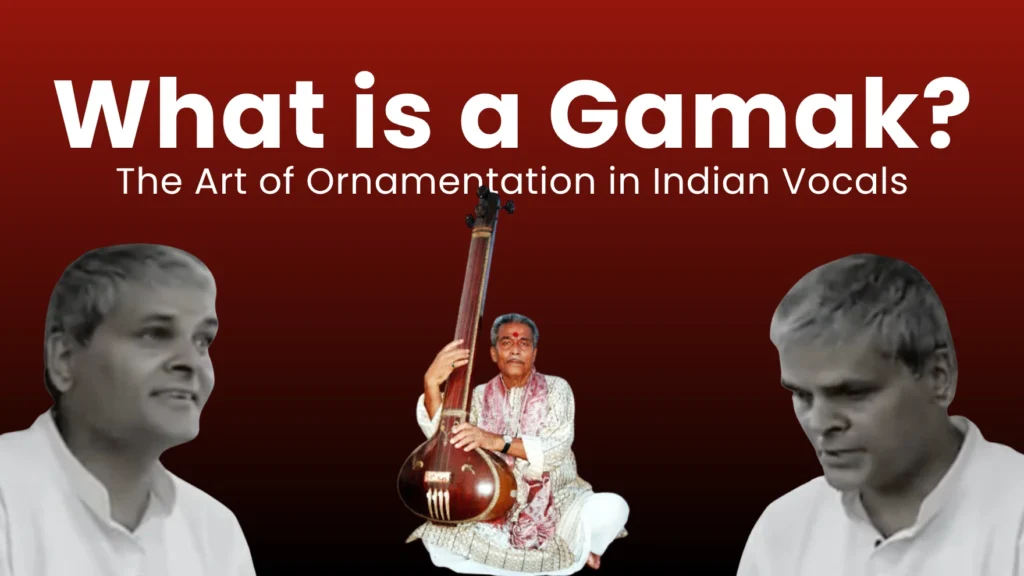
Gamak, derived from the Sanskrit word for “movement” or “gait,” refers to the intricate, nuanced ornamentation applied to notes (swaras) in Indian classical music. Far more than mere decoration, gamakas are the “lifeblood” of the raga, defining its identity and emotional depth. Unlike Western ornamentation, which is often optional, gamakas in Indian vocals—particularly in Carnatic music—are integral to the raga’s definition, transforming a simple, linear scale into a vibrant musical portrait.
Gamaka has been defined by Sarngadeva and others as the ornamentation of a note by shaking it. But evidence from their works can be cited to show that the idea of gamaka is more extensive than the connotation of this definition; it has been used to convey the idea of beautifying a note not only by the shake but by any other means which seem to be efficient or adequate. For instance by the adjustment and control of the volume of a single note it can be made to assume different shades of colour, and these effects can be, and have been legitimately classed under the category of gamakas.
This complexity in the nature of gamakas, as used in vocal and instrumental music, has been noticed and exhaustively treated in Sanskrit treatises on music. They offer an abundance of material on this subject as well as on others.
The Origin of Gamak
Gamak, derived from the Sanskrit word ‘gam,’ which means ‘to go,’ is a fundamental embellishment technique in Carnatic music. It’s a style of ornamentation where a note is oscillated rapidly between two adjacent notes in a scale or a phrase. This technique adds a fluidity, expressiveness, and depth to the melodic lines in Carnatic music. Gamak is believed to have originated in ancient India, evolving over centuries as a means of expressing the myriad emotions and sentiments inherent in this musical tradition.
Gamak in Ravana’s Prayer to Lord Shiva
Ravana was a master scholar of the Vedas, an expert on the Rudra-Veena, and a legendary devotee of Lord Shiva. In Hindu tradition, gamak plays a pivotal role in the origin story of his most famous prayer, the Shiva Tandava Stotram:
- The Catalyst: Prideful Ravana attempted to lift Mount Kailash. Lord Shiva effortlessly pinned Ravana’s hand beneath the mountain with his toe.
- The Birth of the Stotram: Trapped in agonizing pain, Ravana used his musical mastery to pacify Shiva. He composed and sang the Shiva Tandava Stotram on the spot.
- Musical Execution: The stotram features a highly rhythmic, heavy, and booming phonetic structure (e.g., “Jata tave gala jjala…”). To project the raw power (Raudra rasa) and deep agony of the moment, Ravana sang using intense guttural gamaks (Humphita) and heavy vocal oscillations (Kampita).
- The Instrumental Companion: According to folklore, Ravana built the first Rudra-Veena using his own arm as the beam and his nerves as strings to accompany his voice. The deep fretwork of the Rudra-Veena was specifically designed to execute massive, sweeping glides (Meend) and deep deflections (Gamak), mirroring the thundering cosmic dance of Shiva.
The Use of Gamak in Chanting the Vedas
Vedic chanting is strictly governed by the Vedanga Shiksha (the science of phonetics and pronunciation). It features a rigid three-note pitch system: Udatta (high pitch), Anudatta (low pitch), and Svarita (independent swara/falling pitch). Within this system, gamak is used as a functional tool rather than a mere artistic decoration.
1. Navigating Tonal Transits
When transitions occur between a low pitch (Anudatta) and a high pitch (Udatta), Vedic priests use precise glides (Ullasita) to shift between notes without breaking the continuity of the sacred sound wave (Sama).
2. The Svarita Shake
The Svarita note naturally demands a downward or falling tonal contour. In specific regional branches of Veda recitation (such as the Jaiminiya Samaveda), this curve is executed as a controlled, wavy vibration. This is an ancient functional ancestor of the Kampita (oscillated) gamak.
3. Preserving Oral Text Integrity
Advanced patterns of recitation like Jata Patha and Ghana Patha involve repeating scriptural words in forward, reverse, and cross-combinations to prevent any corruption of the text.
- During reverse-word transitions (e.g., moving backward from Word 2 to Word 1), the required pitch shifts drastically.
- The chanter relies on sudden stressed variations (Sphurita) and touch notes (Aahata) to accurately hit the required pitches at high chanting speeds.
4. Acoustic Resonance
Specific sounds in the Vedas, such as the Anusvara (nasal “M” sound) or the Visarga (breathy “H” sound), are prolonged during long-form sacrifices. Chanters utilize Mudrita (humming with a closed mouth) and Humphita (chest-driven emphasis) to create deep acoustic vibrations that resonate throughout the chanting space.
Types of gamakas
Here are the 15 types of Gamaka (Panchadasa Gamakas) commonly used in Indian Classical music:
- Tiripa: A swift, vibrating oscillation on a note, similar to a shake.
- Sphurita: An emphatic oscillation where the note is touched by a quick glance at the note below it.
- Kampita: A distinct shake or trembling of a note (similar to vibrato), often used as the defining ornamentation in many ragas.
- Leena: A smooth, gentle, and continuous glide merging one note into another.
- Andolita: A slow, swinging oscillation or “swing” between two adjacent notes.
- Vali: A rolling or curved oscillation that covers a wide range of notes, often sounding like a wave.
- Tribhinna: A complex vocal technique producing a blended tone, often difficult to replicate on instruments.
- Kurula: Producing a note by bringing pressure from the lower note.
- Ahata: A striking or touching of the succeeding note and returning to the original note immediately.
- Ullasita: A upward glissando or ascending sweep from one note to a higher one.
- Plavita: A long, prolonged oscillation, often with an internal swaying movement.
- Humphita: A vocal-specific technique often produced with a closed, humming, or subtle “hmmm” sound.
- Mudrita: A closed-mouth technique where the sound is produced as a gentle, closed-vocal hum.
- Namita: A downward bend, curve, or slope from a higher note to a lower one.
- Misrita: A combination or mixture of two or more of the other types of gamakas in one phrase.

gamak in dhrupad

Gamak in Dhrupad is a fundamental, heavy, and vigorous oscillation of notes, deeply rooted in traditional, meditative, and precise musical expression. Unlike the lighter, faster gamaks in Khyal, Dhrupad gamak uses vocal syllables (like ‘Ri Ta Na Nom Tom’) rather than pure vowels (aakaar), and often employs a powerful, throat-driven shake, especially in the Khandaharbani style
Key Characteristics of Gamak in Dhrupad
- Definition & Technique: It is a heavy, rhythmic “shake” or oscillation that can span a wide interval. It involves a deliberate, powerful shaking of the note in the throat rather than a delicate flourish.
- Difference from Khyal: While khyal uses faster, often more fluid oscillations on aakaar, Dhrupad uses a more grounded, sometimes syllable-based approach, emphasizing force and precision.
Use in Styles (Bani)
- Khandaharbani: Known for very heavy and vigorous gamaks. Darbhanga Gharana is famously known for khandahar bani whose style depicts the naad swar in the form of different types of gamak. The aalap section as well as the bandish section of the dhrupad is decorated using the gamaks.Artist like Vidhur mallik , Ram chatur mallik is highly known for this style of music.
- Dagarbani: Focuses on slower, more melodic meend (glides) and subtle, controlled gamaks.
- Nauharbani: Uses fast, jerky passages with a variety of gamaks.
In Hindustani classical music, gamak is the umbrella term for note ornamentation through oscillation. However, the execution, aesthetic purpose, and vocal mechanics of gamak differ fundamentally between the ancient Dhrupad tradition and the modern Khayal genre
Key Differences
- Production Source: Dhrupad gamak relies on epiglottal and diaphragmatic pressure, utilizing deep resonance from the navel (nabhi). Khayal gamak is generated primarily from the upper chest and throat, allowing for agile, rapid movements.
- Vocal Syllables: Dhrupad artists use staccato consonants (like Ta, Na, Ri ,Nom, Tom) to anchor the heavy oscillation. Khayal singers perform gamak using vowels, typically open-throat aakaar (the “ah” sound).
- Aesthetic Intent: Dhrupad seeks statuesque weight, majesty, and architectural precision. Khayal prioritizes fluidity, intricate speed, and emotional flexibility. [1, 2, 3, 4]
Comparison Table
| Feature | Dhrupad Gamak | Khayal Gamak |
|---|---|---|
| Primary Vocal Source | Lower abdomen, navel, and diaphragm. | Throat, pharynx, and upper chest. |
| Vocal Medium | Non-semantic consonants (Nom-Tom). | Pure vowel sounds (Aakaar) or lyrics. |
| Speed & Tempo | Generally slower, highly controlled. | Can achieve lightning-fast speeds. |
| Oscillation Width | Wide, distinct microtonal shifts. | Narrower, compact, and compressed. |
| Character & Texture | Heavy, robust, and percussive. | Smooth, liquid, and highly agile. |
| Structural Placement | Structured sections of Alap, Jor, Jhala. | Woven freely into Taans and Bol-Taans. |
| Microtonal Clarity | Individual microtones (shrutis) remain distinct. | Microtones blur into a rapid wave. |
FAQS
What is the core purpose of gamak?
It injects emotion, prevents flat notes, and defines a raga’s identity.
Can any raga use heavy gamaks?
No, heavy gamaks belong to serious ragas like Bhairav, while lighter ragas use softer variations.
Is gamak used on instruments?
Yes, musicians pull strings sideways (Sitar) or slide across fretless fingerboards (Sarod).
How does it differ from Western vibrato?
Vibrato is a narrow, rapid tone modulation; gamak is a wide, microtonal deliberate swing.
What is the best way to practice it?
Sing Akar (the “Ah” sound) very slowly, gradually accelerating only when stable.
Why does it cause vocal strain for beginners?
Beginners squeeze their throat muscles instead of pushing air from the diaphragm.
Are all 15 historical gamaks still used?
No, ancient systems have been streamlined into modern practical techniques like Andolan and Murki.
Is gamak essential in Carnatic music?
Yes, Carnatic notes (swaras) are almost never sung flat; gamak forms their foundation.
Can you write gamak in standard notation?
It is difficult because standard fixed symbols cannot easily capture fluid microtonal curves.
Can an artist use too much gamak?
Yes, overusing it causes musical instability and masks the true structure of the raga.