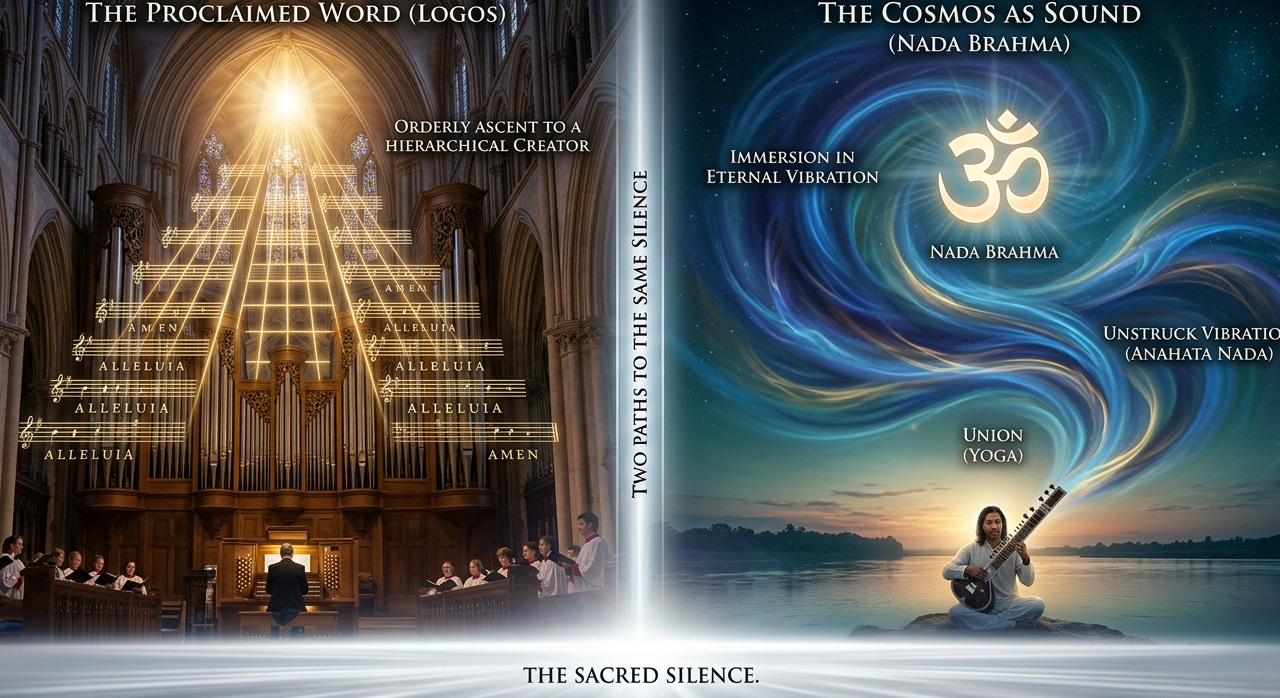
In many cultures, music isn’t just an accompaniment to prayer it is the prayer. However, the “sonic theology” (the study of how sound conveys the divine) differs drastically between the Indian classical tradition and the Western tradition of liturgical hymns. While one seeks to mirror the architectural order of heaven, the other seeks to tap into the primordial vibration of the universe.
1. The Source: Nada Brahma vs. Logos
This foundational divergence is where sonic theology truly begins, defining whether music is seen as the essence of reality or the messenger of truth.
Nada Brahma: The Cosmos as Sound
In the Indian classical and Vedic traditions, the universe is not merely described by sound; it is constituted by it. Nada Brahma means, literally, “the ultimate reality (Brahman) is sound (Nada).”
The ancient sages (Rishis) taught that the entire cosmos is in a state of vibration. This primordial, unmanifest sound is called Anahata Nada (unstruck sound), which exists even in silence and is the source from which everything is manifested. Music, as we perceive it (Ahata Nada, or struck sound), is the closest possible echo of that original, divine frequency.
When a musician sings or plays a Raga, they are not simply creating an aesthetic experience. They are engaged in a form of sonic yoga, attempting to align their personal consciousness with the universal vibration. The drone, established by instruments like the Tanpura, is the sensory bridge to this infinite, unchanging sound field. Every perfect note is an encounter with the divine, and the entire system with its intricatemicrotones (shrutis) and precise tunings is designed to fine-tune the human entity until it resonates in perfect sympathy with Nada Brahma.
Logos: The Proclaimed Word
Contrast this with the Western theological framework. While Greek philosophy also discussed the “Music of the Spheres,” the biblical tradition primarily emphasizes the spoken Word (Logos) of God as the primary agent of creation and revelation.
“In the beginning was the Word, and the Word was with God, and the Word was God” (John 1:1). In this theology, God speaks the world into existence. The core of Western worship, therefore, is rooted in scripture, sermon, and the proclamation of doctrine.
Music in this context serves a powerful but distinct purpose: it is the vehicle for the Logos. A hymn’s theology is located specifically within its lyrics. The music is a beautiful container, architecturally structured (through harmony and meter) to support, uplift, and make memorable the sacred text. A congregation singing a hymn is affirming a unified belief system, using structured sound to worship the rational God of Order, whose truths are articulated through His Word.
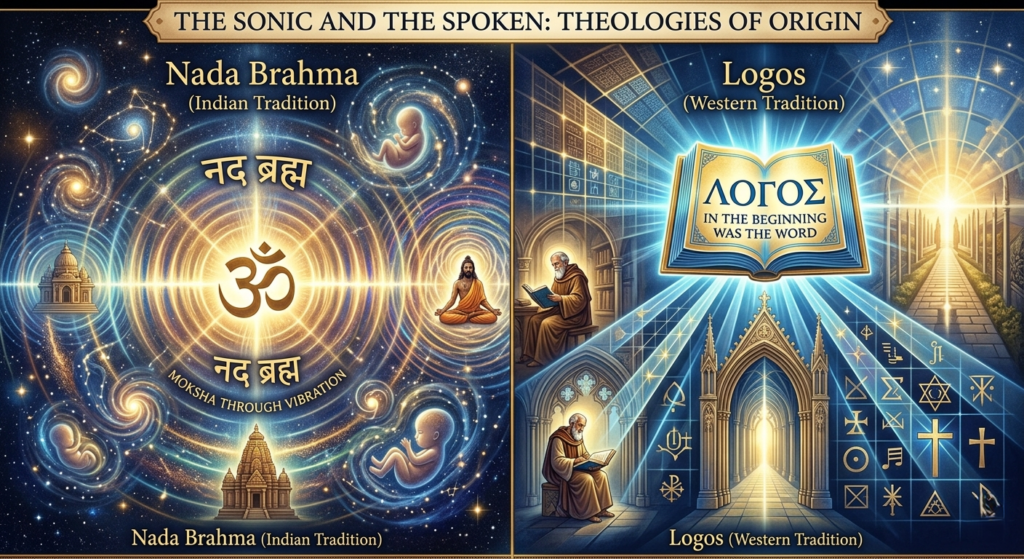
Analysis of the Conceptual Diagram
The accompanying image visualizes this fundamental theological split.
- Left Side (Indian Tradition): The focus is the luminous Sanskrit ‘Aum’ (Om) symbol, the supreme sound representation of Brahman. It radiates outwards as expansive, spiraling waves of sapphire and gold energy. These waves are not abstract; they structure the background, and within them, the cosmic elements—such as nebulae, an embryonic figure, and the architectural plan of a temple directly materialize. This shows that sound itself is the blueprint and source of creation. Text like “Nada Brahma” and “Moksha through Vibration” explicitly links sound to liberation.
- Right Side (Western Tradition): The focus shifts to a sacred text: a stylized, glowing Codex (the ‘Logos’) in gold and azure light, embossed with “IN THE BEGINNING WAS THE WORD” and the Greek “ΛΟΓΟΣ.” Instead of organic sound waves, this source emits beams of structured, patterned light that form orderly, grid-like geometric pathways and a strong Gothic archway (the visual anchor of a cathedral/order). Creation here is a result of established light and structured geometry derived from the authoritative Word. Text like “Logos (Western Tradition)” anchors the perspective.
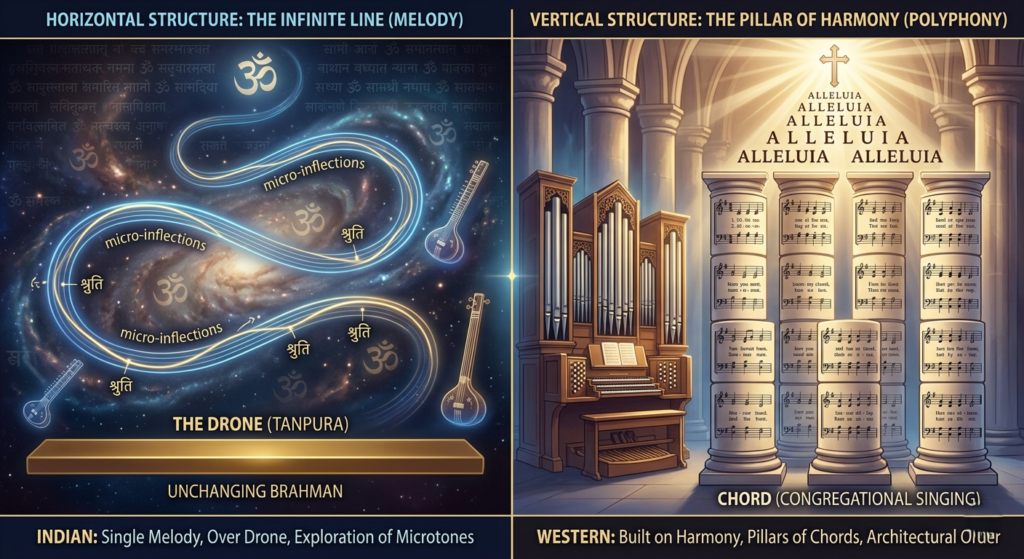
2. Horizontal vs. Vertical Structures
The most striking technical difference lies in how the music is “built.”
Indian Music: The Infinite Line (Melody)
Indian classical music is monophonic. It focuses on a single melodic line that explores the spaces between the notes.
- The Raga: A raga is not just a scale; it is a “color” or a mood. It uses shruti (microtones), which are the tiny pitches between the standard keys on a piano.
- The Drone: The constant hum of the Tanpura represents the eternal, unchanging Brahman (the Absolute). All music happens over this “infinite” sound.
Western Hymns: The Pillar of Harmony (Polyphony)
Western prayer music is traditionally homophonic or polyphonic.
- Harmony: Hymns are built on chords. When a congregation sings, they are creating “vertical” stacks of notes.
- The Organ: Unlike the drone, the church organ provides a massive, architectural foundation of harmony, reflecting a structured, hierarchical view of the divine.
3. Fixed Scripture vs. Spontaneous Devotion
How a worshiper interacts with the music also varies by “theology of time.”
| Feature | Western Hymns | Indian Raga/Bhajan |
| Composition | Pre-written, fixed lyrics and notation. | Framework-based, largely improvised. |
| Participation | Communal; everyone sings the same words. | Individualistic; the performer leads the soul’s journey. |
| Duration | Concise (3–5 minutes) to fit a liturgy. | Expansive; a single Raga can last over an hour. |
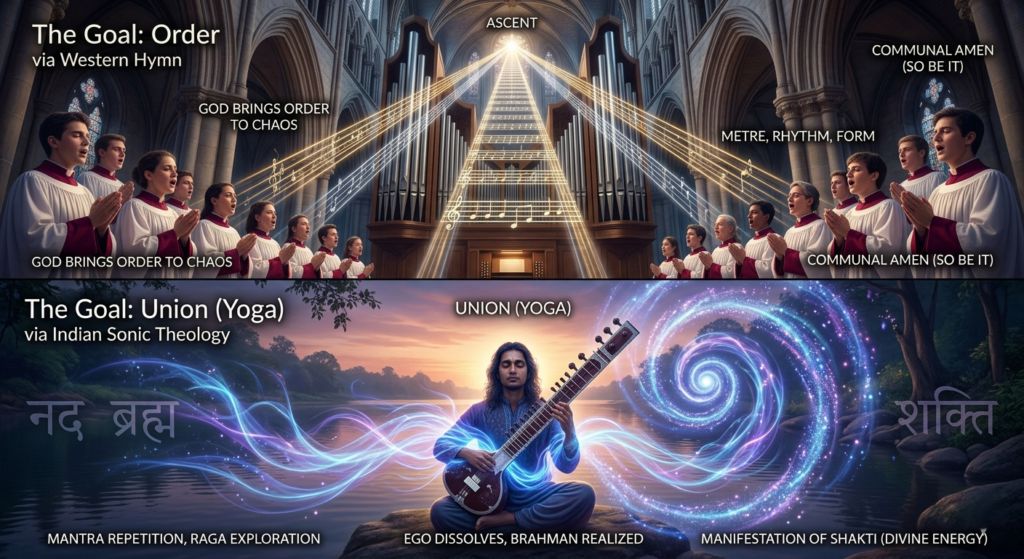
4. The Goal: Order vs. Union
In a Western hymn, there is a sense of “ascent.” The music is orderly, metered, and rhythmic, reflecting a God who brings order to chaos. It is a communal “Amen” (so be it).
In Indian Sonic Theology, the goal is “union” (Yoga). Through the repetition of a mantra or the winding exploration of a Raga, the ego of the performer and the listener is meant to dissolve. The music doesn’t just point to the divine; it is intended to be a manifestation of the divine energy (Shakti) itself.
Conclusion: Two Paths to the Same Silence
The sonic theologies of India and the West offer profoundly different, yet equally valid, pathways toward the divine. While the Western hymnody tradition leverages structural order, complex harmony, and the articulated word to create a collective ascent toward a hierarchical creator, the Indian classical tradition offers a fundamentally different, experiential journey.
It is in the Indian concept of Nada Brahma that we find the most distinct culmination of this comparison. When the final note of a complex Western hymn or organ symphony fades, it leaves behind a structured echo of a divine order proclaimed. But in Indian sonic theology, when the last note of a prolonged Raga dissolves, the practitioner and the listener are meant to find themselves immersed within the eternal, “unstruck” vibration of the cosmos.
Nada Brahma, “The Cosmos as Sound,” isn’t merely a philosophical concept; it is the ultimate destination. The journey through the microtones (shrutis) of the Raga and the repetitive call of the Bhakti mantra is designed to quiet the conscious mind and dissolve the personal ego (ahamkara). The music itself is a manifestation of divine energy (Shakti), serving as a vehicle that merges the individual consciousness back into the infinite, vibrating reality from which it emerged.
Both traditions ultimately seek a sacred silence. One moves through architectural sonic splendor toward the stillness of a cathedral; the other flows like a river of melody into the silent ocean of Anahata Nada (unmanifest sound). They are two distinct, magnificent rivers of sound flowing into the same, eternal silence.