introduction
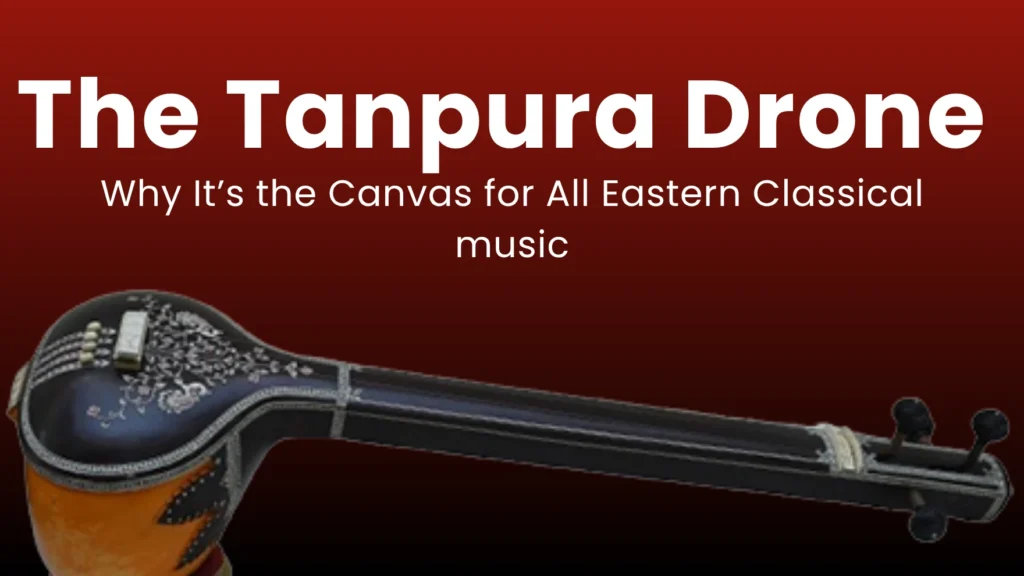
The Tanpura drone is a stringed instrument that serves as the essential sonic canvas for Indian classical music, providing a constant harmonic base (Sa) that allows artists to paint complex melodic ragas. By producing a rich, buzzing soundscape called jawari, it creates a fixed, stabilizing reference for pitch, enabling musicians to explore microtones, maintain precise tuning, and create deep emotional expression.
Tanpura is a drone instrument and it has come from the family of lute instruments. It is a string instrument which is known as Tanpura in North India and as Tambura, Thamboora, Thambura or tamboora in Southern part of India.
Tanpura is usually carved out of jackwood. It does not contain frets. A long neck contains a round shaped resonator at the end which vibrates and increases the sound. Tuning of the instrument can be performed with the help of tuning pegs present at the top end of the neck. About 4 strings are present between the tuning pegs and the resonator which pass over an ivory bridge. Along with these, silk threads called ‘jeeva’ are also used which helps in generating buzz sound and in enhancing the tonal quality. This feature makes tanpuraa unique instrument.
Based upon size, tanpura can be male or female. A male tanpura is larger than a female version. Also there are three other styles of tambura known as Miraj style, Tanjore style and Tamburi (an instrumental version).
A Miraj style is generally used by Hindustani (North-Indian) musicians. It is about 3-5 feet in length and a non-tapered neck. Its resonator can be usually made of gourd but sometimes from wood too.
The Tanjore style is preferred in the Carnatic (South-Indian) Sangeet. It consists of a tapered neck, flat front plate and a wooden resonator. It has same length as that of Miraj style.
Tamburi is the instrumental version of tanpura. It is about 2-3 feet in length and contains a curved wooden resonator. It might consist of 4, 5 or even 6 strings. Due to its different size, it is played differently than other tanpuras. Although it does not have too good sound but it is favoured due to its portability. It is much easier to tune and maintain the same.
While playing tambura, it is placed on the right lap. Strings are controlled with right hand and resonator with the left one. First string is initially plucked with middle finger and the remaining ones with index finger.
Tanpura is mainly used in concerts, but it is never played by the main artist. Tambura artist sits behind the main artist and starts playing the same before the concert starts and plays till the end.
History of tanpura
The harmonic drone component of Indian classical music dates back to ancient times. Over 2,000 years ago, the foundational text on the arts, Natya Shastra, identified the root ensemble of music as rhythm, melody and harmonics. These three concepts are represented musically as talas, ragas and drone. The drone noise is meant to form a series of notes within the raga, providing a base tone as a backdrop for everything else.
Early evidence of harmonic drones came in other instrumental forms, including other stringed instruments and the wind instrument ottu. It is believed that the tanpura musical instrument as we know it today evolved from the sitar, which also includes drone strings, called sympathetic strings. By the 16th century, the tanpura had become a standard addition to classical ensembles, as evidenced by its presence in paintings and compositions from that era.
The electronic tanpura instrument was invented in the late 19th century by G Raj Narayan, an engineer and musician. Beginning first as electronic boxes with transistors that imitated the sound of the tanpura, the electronic versions evolved to loop recordings of the traditional tanpura. Though controversial among performing artists, electronic tanpura is undoubtedly a practical accompaniment for many musicians. Most recently in the 2000s, mobile apps have been developed to make the classic tanpura sound even more accessible.
Types of Tanpura
There are three types of tanpura musical instruments, each of which differs in size and tone. The exact measurements vary between instrument makers and the figures below are averaged estimates. These three categories are also represented by many electronic tanpuras and apps.
Instrumental tanpuras are the smallest version, with a length typically below 115 cm (roughly 3.5 ft). Typically accompanying sarod and sitar compositions, the instrumental tanpura is tuned around the key of C/Sa.
Female tanpuras are medium-sized, at around 130 cm in length (a little over 4 ft), and are typically used to accompany female singers. Tuned near the key of G/Pa, this version is pitched between the instrumental and male versions.
Male tanpuras are the largest, with a length of 150 cm (nearly 5 ft), and are typically used to accompany male singers. The sound produced by the male version is louder and sustains longer than the others. This tanpura is also tuned near the key of C/Sa, but is pitched lower than the instrumental version.
Structure of tanpura
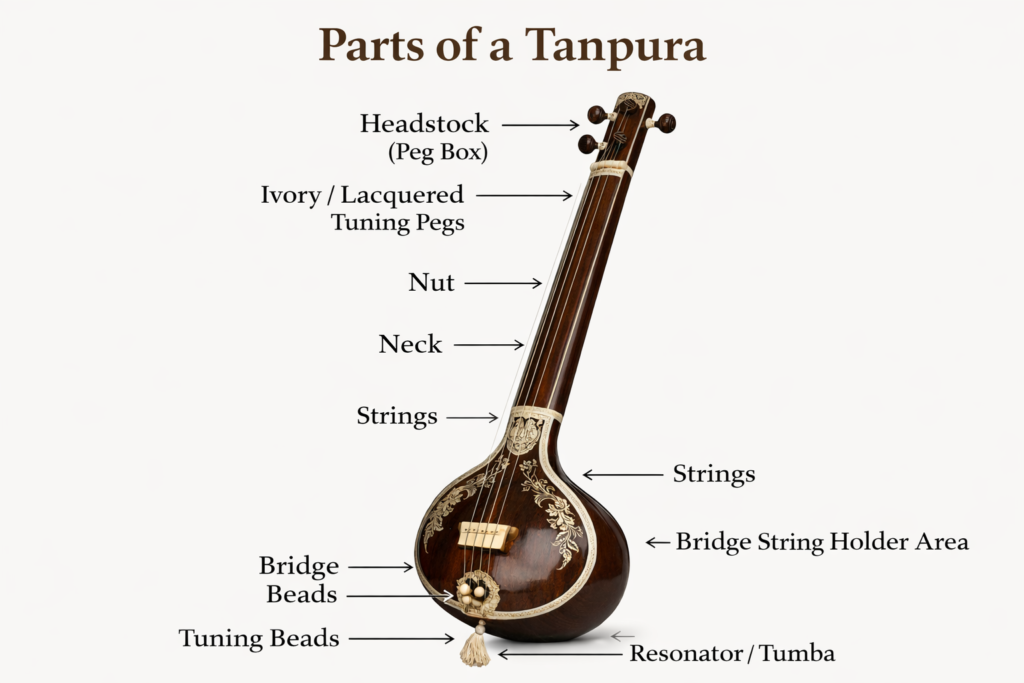
The pitch of a tanpura depends on the thickness of the strings used. The thicker the strings, the lower the pitch and vice versa. Each string is attached to a tuning peg that adjusts the tension of the strings. Looser strings produce a lower pitch while taut strings produce a higher pitch. The standard for tuning a tanpura depends on the number of strings, but typically follows a pattern established within the range of a particular raga. For example, a four-stringed tanpura may be tuned to a fifth, basic note, and two octaves of a note in the raga.
Many electronic tanpuras have multiple settings that need to be adjusted before playing that change the pitch, tone and volume. Some versions of the electronic tanpura have the ability to save certain selections for repeated use.
Tanpura Playing Techniques
How to Play the Tanpura?
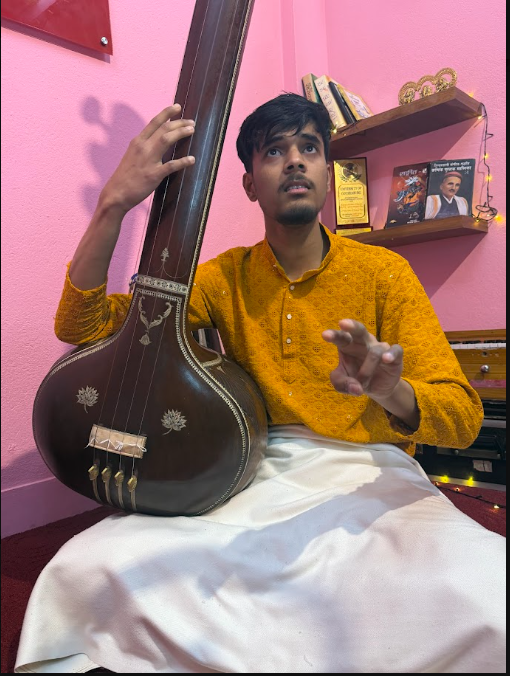
The Tanpura is held and played sitting upright and resting on either the floor or the lap of the player. This is the traditional technique, but it may also be played while lying horizontally on the lap or floor in front of the player. The strings are plucked in a continuous pattern with the pads of the fingertips. The plucking of the strings is meant to be soft and consistent, setting the strings to a gentle vibration. In addition to being an accompaniment to musical compositions and performances, the Tanpura is also practiced and listened to on its own. It is a popular choice for accompanying meditation and yoga in the background.
The drone is meant to be constant, but there is a slight variation in playing Tanpura. The strings are plucked in a regular, repeating rhythm. When the last note of the rhythm is played, the pattern repeats after a slightly longer pause. This brief period allows the last string to echo slightly longer. This is to give the impression of a living vibration. Not even the electronic Tanpuras are meant to play a mechanical sound, as the harmonic component of Indian classical style is meant to sound flowing.
Why the Tanpura is the Canvas for Indian Music
- Tonal Stability & Pitch Anchoring: The drone serves as a constant point of reference, allowing performers to maintain perfect pitch (sur) throughout complex melodic improvisations.
- Creating the “Javari” Spectrum: The instrument’s unique bridge—the javari—creates a buzzing, vibrant sound rich in harmonics, transforming simple melodies into complex harmonic landscapes.
- Shaping the Raga (Musical Atmosphere): It is tuned specifically to the raga being performed (usually the fundamental, octave, and the fifth or fourth), creating a unique mental and acoustic tapestry that brings the raga to life.
- Active Partner in Performance: Rather than mere background noise, legendary artists consider the tanpura an active partner that provides the depth and acoustic space needed to explore the nuances of raga.
- Internalization of Pitch: Continuous practice with the tanpura helps musicians develop a sharp sense of pitch, enhancing their ability to notice minute deviations.
- Cultural & Spiritual Significance: Often used in, or influencing, meditational and devotional music (such as Bhakti or Sufi practices), it helps calm the mind and focus on the auditory experience
The tanpura has a few different forms and styles dependent on the preference of the performer. The Miraj style is favoured by Hindustani performers and made of a dried gourd with a wooden neck. These are available in both larger male and smaller female forms to accommodate different pitches. The Tanjore style is used more commonly by South Indian musicians and is made entirely from wood. The smallest form is the tanpuri, only two or three feet long with a lighter, less dominating sound often used for accompanying solo strings or for ease of transport.
These days electronic tanpuras sometimes replace their manual counterparts due to ease and practicality. Even more recently, a crop of smartphone apps such as iTanpura have been created to allow tanpuras to literally be pocket-sized. But most musicians still feel that the digital version will never replace the dynamic quality of the real thing, and that the ease of switching on a button is encouraging a lower standard of tuning ability amongst young musicians.
According to the ancient teachings of Indian music, the tanpura expresses the resonant sound that is eternally present throughout creation, sometimes known as om, the sacred syllable. The sustained notes found in nature have long been an inspiration for musicians who would practise in the outdoors.
tanpura for the singers
In Indian classical music, every performance, every practice, and every lesson begins with the same sound – the soft, continuous drone of the Tanpura. Its strings do not create melody on their own, yet they carry the weight of every melody that follows. The Tanpura is the foundation upon which the entire edifice of Indian music stands.
Its role is subtle but indispensable. By sustaining the śruti – the perfect tonal reference – the Tanpura provides a living framework for the vocalist or instrumentalist to weave their raga. Without it, the notes lose direction; with it, the music acquires depth, stability, and purity.
For a student, sitting beside the Tanpura is often the first initiation into discipline. It teaches patience as they tune it, humility as they surrender to its constancy, and concentration as they align their swaras to its drone. For the performer, the Tanpura is a constant companion – never demanding attention, yet always offering support. For the listener, it is a soundscape that draws them into the experience of the raga, creating the atmosphere in which rasa can truly be felt.
The Tanpura is not merely an instrument; it is a philosophy. Its unbroken resonance reminds us that music is more than performance – it is sadhana, a meditative practice that balances body, mind, and spirit. In a world that often values the spectacular, the Tanpura remains a quiet reminder of the power of simplicity and continuity.
FAQS
1. What is the primary role of a Tanpura in Indian classical music?
The Tanpura provides a continuous, rich harmonic drone that acts as the foundational pitch reference. It does not play a melody but creates an acoustic canvas that grounds the performers and helps them maintain perfect tuning.
2. How does the Tanpura benefit a vocal performer?
It provides a steady reference for the root note (Sa), helping vocalists cultivate precise pitch accuracy (Sur). The rich overtones also mask minor vocal fluctuations, allowing the singer to blend their voice seamlessly into the soundscape.
3. Why is playing a physical Tanpura preferred over using an electronic box or app?
An acoustic Tanpura produces genuine physical vibrations and dynamic overtones that resonate directly with the performer’s body. This physical resonance creates a deeply meditative environment that digital loops cannot fully replicate.
4. Can instrumentalists benefit from practicing with a Tanpura?
Yes, instruments like the Sitar, Sarod, and Violin require precise microtonal adjustments during performance. Practicing with a Tanpura helps instrumentalists train their ears to align their notes exactly with the drone’s harmonics.
5. What are the standard tuning configurations for a four-string Tanpura?
The standard tuning depends on the Raag being performed, typically set to Pa-Sa-Sa-Sa (Fifth), Ma-Sa-Sa-Sa (Fourth), or Ni-Sa-Sa-Sa (Seventh). The middle two strings are always tuned to the middle octave root note, while the last is the lower octave root.
6. What is the function of the small cotton thread (Jwari) under the strings?
The Jwari thread adjusts the contact point between the string and the bridge to create a buzzing, overtone-rich sound. Moving this thread slightly completely alters the depth and color of the drone’s resonance.
7. Is it difficult to learn the plucking technique of the Tanpura?
The physical action of plucking with the middle and index fingers is simple, but maintaining an unhurried, perfectly even rhythm requires practice. A steady, uninterrupted flow of sound is essential to avoid distracting the main performer.
8. How does practicing with a Tanpura help in performing an Aalap?
An Aalap relies on free-flowing, unmetered improvisation where the singer explores the spaces between notes. The Tanpura provides the essential ambient backdrop that fills these silent gaps, giving the artist the confidence to sustain long notes.
9. Why do Tanpuras come in different sizes for male and female performers?
Male vocalists generally sing at a lower pitch (typically around C to D#), requiring a larger Tanpura with thicker strings. Female vocalists sing at a higher pitch (typically G to A#), which requires a smaller instrument with thinner strings.
10. Can a beginner learn to play the Tanpura and sing simultaneously?
Yes, though it requires coordination to separate the physical rhythm of the hand from the vocal melody. Our training programs specifically focus on this synchronization to help students build independent control over their breath and fingers.
Conclusion
Manasukh Dhvani is a profound concept in Indian classical music that translates to the “sound that pleases the mind and soul.” It represents the ultimate state of musical tranquility, where the external sound aligns perfectly with internal peace. The foundational instrument required to achieve this meditative state of Manasukh Dhvani is the Tanpura.
The Tanpura does not play a melody; instead, it creates a rich, continuous drone of harmonic resonances. This steady soundscape serves as the canvas for the artist, anchoring the pitch, calming the mind, and allowing the Raag and Aalap to breathe. Learning to tune and play this instrument is the first step toward true musical immersion.