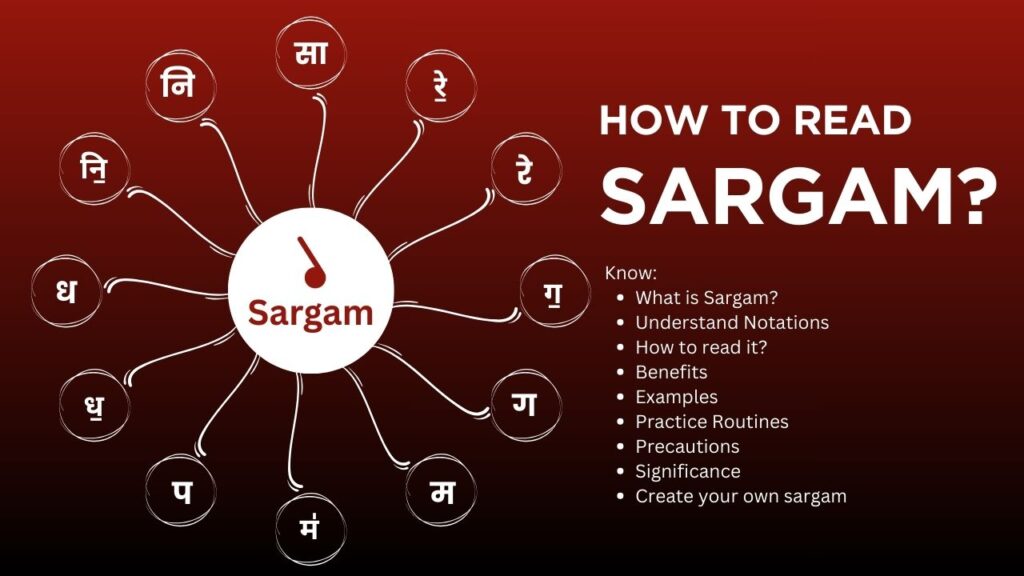
Sargam notation is the foundation of Eastern classical music – a beautiful system that has been used for over a thousand years to write and teach music. If you’ve ever wondered how to read those mysterious symbols in Indian classical music, you’re in the right place! Learning sargam is like learning the alphabet of classical music, and once you understand it, a whole world of beautiful melodies opens up to you.
Think of sargam as the DNA of Indian classical music. Just like DNA contains the code for life, sargam contains the code for every beautiful melody you’ve ever heard in classical music.
What is Sargam? The Musical Alphabet
Sargam gets its name from the first four musical notes: सा रे ग म (Sa Re Ga Ma). Just like the English alphabet has 26 letters to make all words, sargam has 12 musical notes that create all melodies in classical music.
The word “sargam” is created by combining:
- सा (Sa) – from Shadja
- रे (Re) – from Rishabh
- ग (Ga) – from Gandhar
- म (Ma) – from Madhyam
Why Learn Sargam?
Immediate Benefits:
- Read any classical music composition
- Communicate with other musicians easily
- Understand raag structures better
- Practice music systematically
- Preserve and share musical knowledge
Long-term Benefits:
- Master classical singing techniques
- Compose your own music
- Teach music to others
- Connect with centuries of musical wisdom
- Develop perfect pitch and musical memory
The Complete Sargam System: All 12 Notes
Here are all 12 musical notes (swaras) written correctly in Devanagari script:
सा रे॒ रे ग॒ ग म म॑ प ध॒ ध नि॒ नि सां
Let me break this down for you:
The 7 Basic Notes (Shuddha Swaras)
| Devanagari | English | Full Name | Meaning |
|---|---|---|---|
| सा | Sa | Shadja | The foundation note |
| रे | Re | Rishabh | The second note |
| ग | Ga | Gandhar | The third note |
| म | Ma | Madhyam | The middle note |
| प | Pa | Pancham | The fifth note |
| ध | Dha | Dhaivat | The sixth note |
| नि | Ni | Nishad | The seventh note |
Understanding the Special Markings
The secret to reading sargam correctly lies in understanding three types of notes:
1. Shuddha Swaras (Pure/Natural Notes)
These are written normally without any special marks:
- सा प (Sa, Pa) – These never change
- रे ग म ध नि (Re, Ga, Ma, Dha, Ni) – These are the natural versions
2. Komal Swaras (Flat Notes)
These have a small line below (्) the note:
- रे॒ (Re komal) – Flat Re
- ग॒ (Ga komal) – Flat Ga
- ध॒ (Dha komal) – Flat Dha
- नि॒ (Ni komal) – Flat Ni
3. Tivra Swara (Sharp Note)
This has a small line above right (॑):
- म॑ (Ma tivra) – Sharp Ma
Easy Memory Trick:
- Below line = Lower pitch = Komal
- Above line = Higher pitch = Tivra
- No line = Natural = Shuddha
The Complete 12-Note Scale
When we write all 12 notes in order, it looks like this:
सा रे॒ रे ग॒ ग म म॑ प ध॒ ध नि॒ नि सां
In simple English: Sa Re-flat Re Ga-flat Ga Ma Ma-sharp Pa Dha-flat Dha Ni-flat Ni Sa
Why Some Notes Have Variations
Fixed Notes (Never Change):
- सा (Sa) and प (Pa) are called “Achal Swaras” (immovable notes)
- They always stay the same and never have komal or tivra versions
Variable Notes (Can Change):
- रे ग म ध नि (Re, Ga, Ma, Dha, Ni) can be modified
- Re, Ga, Dha, Ni can be komal (flat)
- Ma can be tivra (sharp)
- This gives us the complete 12-note system
How to Read Sargam Notation: Step by Step
Step 1: Identify the Basic Note
Look at the main letter first. Is it सा, रे, ग, म, प, ध, or नि?
Step 2: Check for Special Marks
- Line below (्) = Komal (flat)
- Line above right (॑) = Tivra (sharp)
- No mark = Shuddha (natural)
Step 3: Understand Octave Marks
- Dot above (सा॰) = Higher octave
- Dot below (सा़) = Lower octave
- No dot = Middle octave
Step 4: Read the Rhythm
- Straight line under notes = Hold the note longer
- Curved line over notes = Smooth connection between notes
- Commas or dashes = Pauses in the melody
Practical Examples: Reading Real Sargam
Example 1: Simple Scale Practice
सा रे ग म प ध नि सां Sing: Sa Re Ga Ma Pa Dha Ni Sa This is the basic major scale in classical music.
Example 2: With Komal Notes
सा रे॒ ग म प ध॒ नि॒ सां Sing: Sa Re-komal Ga Ma Pa Dha-komal Ni-komal Sa This creates a different mood with flat notes.
Example 3: With Tivra Ma
सा रे ग म॑ प ध नि सां Sing: Sa Re Ga Ma-tivra Pa Dha Ni Sa The sharp Ma gives this scale a bright, uplifting feeling.
Example 4: Popular Raag Yaman
सा रे ग म॑ प ध नि सां This is how Raag Yaman looks in sargam notation – notice the tivra Ma.
Example 5: Famous Raag Bhairav
सा रे॒ ग म प ध॒ नि सां Raag Bhairav uses komal Re and komal Dha, creating a devotional mood.
Common Sargam Patterns You’ll See
Ascending Patterns (Aroha)
- सा रे ग म प ध नि सां – Natural major scale
- सा रे॒ ग म प ध॒ नि सां – With flat notes
- सा ग म प नि सां – Pentatonic (5-note) scale
Descending Patterns (Avaroha)
- सां नि ध प म ग रे सा – Coming down the scale
- सां नि॒ ध॒ प म ग रे॒ सा – Descending with flat notes
Jumping Patterns
- सा ग म प नि सां – Skipping notes
- सा म प सां – Wide jumps
- सा रे सा प ध प – Back and forth movement
How Different Raags Use These Notes
Popular Raags and Their Sargam
| Raag Name | Sargam Notes | Special Character |
|---|---|---|
| Yaman | सा रे ग म॑ प ध नि | Uses Tivra Ma – bright and peaceful |
| Bhairav | सा रे॒ ग म प ध॒ नि | Uses Komal Re, Dha – serious and devotional |
| Kafi | सा रे ग म प ध नि | All natural notes – sounds like folk songs |
| Todi | सा रे॒ ग॒ म॑ प ध॒ नि | Multiple flat notes – creates unique beauty |
| Malkauns | सा ग॒ म ध॒ नि | Only 5 notes – deeply meditative |
Singing Sargam: Practical Tips
Voice Preparation
- Start with breathing exercises – Take deep breaths and release slowly
- Warm up your voice – Hum gently before singing notes
- Find your comfortable pitch – Don’t strain to reach high or low notes
- Maintain good posture – Sit or stand straight for better sound
Beginning Practice Routine
Week 1-2: Basic Notes
- Practice: सा रे ग म प ध नि सां
- Sing slowly and clearly
- Focus on pure tone quality
- Don’t worry about perfect pitch yet
Week 3-4: Add Komal Notes
- Practice: सा रे॒ रे ग॒ ग म
- Compare komal and shuddha versions
- Feel the emotional difference
- Practice switching between them smoothly
Week 5-6: Include Tivra Ma
- Practice: म म॑ back and forth
- Notice how tivra Ma sounds brighter
- Practice scales with tivra Ma
- Try simple raag patterns
Daily Practice Schedule (30 minutes)
Warm-up (5 minutes):
- Breathing exercises
- Gentle humming
- Voice placement exercises
Scale Practice (10 minutes):
- Basic sargam: सा रे ग म प ध नि सां
- With variations: komal and tivra notes
- Both ascending and descending
Pattern Practice (10 minutes):
- Simple raag patterns
- Jumping between notes
- Smooth note connections (meend)
Cool-down (5 minutes):
- Slow, sustained notes
- Gentle humming
- Relaxation
Common Mistakes to Avoid
Reading Mistakes
Mistake 1: Ignoring the Special Marks
- Wrong: Reading रे॒ as regular रे
- Right: Always check for komal, tivra, and octave markings
Mistake 2: Confusing Octaves
- Wrong: Singing सा॰ (high Sa) when notation shows सा (middle Sa)
- Right: Pay attention to dot markings for octave
Mistake 3: Rushing Through Notes
- Wrong: Singing sargam too fast without clear pronunciation
- Right: Start slowly, pronounce each note clearly
Singing Mistakes
Mistake 4: Straining Your Voice
- Wrong: Forcing high or low notes uncomfortably
- Right: Stay within your comfortable range
Mistake 5: Ignoring Note Quality
- Wrong: Sliding between notes uncontrollably
- Right: Practice clean, clear note production
Mistake 6: Not Understanding Emotional Content
- Wrong: Singing komal notes with the same feeling as shuddha notes
- Right: Let different notes create different moods
Advanced Sargam Concepts
Melakartas and Note Combinations
As you progress, you’ll learn about melakartas – the parent scales that create different raags. Each melakarta uses a specific combination of shuddha, komal, and tivra notes.
Gamakas and Ornamentations
Advanced sargam includes gamakas (ornamental notes) and meend (gliding between notes). These are shown with special symbols and curves in notation.
Rhythmic Notations
Sargam also includes rhythm markings:
- Bold or underlined notes = Strong beats
- Curved lines = Connected smoothly
- Dashes = Hold the note longer
- Commas = Short pauses
Cultural and Spiritual Significance
The Sacred Tradition
Each note in sargam is believed to correspond to different chakras (energy centers) in the body:
- सा (Sa) – Root chakra, grounding and stability
- रे (Re) – Sacral chakra, creativity and emotion
- ग (Ga) – Solar plexus, power and confidence
- म (Ma) – Heart chakra, love and compassion
- प (Pa) – Throat chakra, communication and expression
- ध (Dha) – Third eye, intuition and wisdom
- नि (Ni) – Crown chakra, spiritual connection
Therapeutic Applications
Modern music therapy uses sargam principles:
- Komal notes help with relaxation and stress relief
- Tivra Ma energizes and uplifts mood
- Complete scales balance mental and emotional states
- Specific raag patterns target particular health benefits
Technology and Modern Tools
Digital Learning Resources
- Mobile apps with sargam practice exercises
- Online tanpura for pitch reference while practicing
- Recording apps to track your progress
- YouTube channels with sargam lessons and demonstrations
Notation Software
- Digital tools that let you write sargam notation
- Apps that convert sargam to Western notation and vice versa
- Software for creating practice exercises and compositions
Building Your Sargam Journey
Setting Realistic Goals
Month 1: Foundation
- Learn to read basic sargam notation
- Sing simple scales clearly
- Understand komal, shuddha, and tivra concepts
Month 2: Expansion
- Practice all 12 notes comfortably
- Read simple compositions
- Start learning basic raag patterns
Month 3: Application
- Sing complete raag scales
- Read and sing traditional compositions
- Begin understanding emotional content of different notes
Month 6: Proficiency
- Read complex sargam notation fluently
- Sing advanced raag patterns
- Start composing simple melodies using sargam
Year 1: Mastery
- Teach sargam basics to others
- Read and perform classical compositions
- Understand advanced ornamentations and rhythmic patterns
Finding Practice Partners
- Join online classical music communities
- Find local music circles and study groups
- Connect with other sargam learners for practice sessions
- Attend workshops and music festivals to meet fellow students
Conclusion: Your Musical Language Awaits
Learning to read and sing sargam notation is like learning a beautiful, ancient language that connects you to centuries of musical wisdom. The system of सा रे॒ रे ग॒ ग म म॑ प ध॒ ध नि॒ नि सां might look complex at first, but with patience and practice, it becomes as natural as reading your native language.
Remember that every great classical musician started exactly where you are now – looking at these symbols and wondering how they transform into beautiful music. The magic happens through regular practice, patient learning, and gradually building your understanding one note at a time.
The beauty of sargam lies in its perfect balance:
- Simple enough for beginners to start learning immediately
- Deep enough to provide a lifetime of exploration and discovery
- Precise enough to preserve exact musical knowledge across centuries
- Flexible enough to allow for personal expression and creativity
Your journey with sargam will:
- Connect you to the living tradition of classical music
- Develop your musical ear and voice systematically
- Provide tools for both learning existing music and creating new compositions
- Open doors to understanding the deeper spiritual and therapeutic aspects of music
The notation system you’ve learned today – with its careful distinctions between komal, shuddha, and tivra notes – represents the wisdom of countless musicians who refined this system over generations. When you sing सा रे॒ रे ग॒ ग म म॑ प ध॒ ध नि॒ नि सां, you’re participating in an unbroken chain of musical transmission that stretches back over a thousand years.
Start today with just the basic scale: सा रे ग म प ध नि सां
Practice it slowly, clearly, and with attention to the pure quality of each note. As these seven sounds become comfortable and familiar, gradually add the variations – the komal notes that add tenderness, the tivra Ma that brings brightness and energy.
Remember: Every expert was once a beginner. Every master musician once struggled to sing their first sargam scale. Your voice is unique, your musical journey is individual, but the path of sargam provides a time-tested route that has guided thousands of students before you.
The ancient tradition of sargam is waiting to become part of your personal story. These beautiful symbols – सा रे॒ रे ग॒ ग म म॑ प ध॒ ध नि॒ नि सां – are not just notation marks on a page. They are keys to unlock the treasure house of classical music, doorways to emotional expression you never knew you possessed, and bridges connecting your voice to the cosmic harmony that underlies all existence.
Your musical alphabet is complete. Now, what beautiful words will you learn to speak?
Begin with a single note. Sa. Let it resonate clearly and purely. From this one sound, an entire universe of musical possibilities awaits your exploration.